Features Podcasts Family Video Comics Music Tech Science Books Film & TV Games ✚

Jill

First-ever Web server

Cory Doctorow at 6:20 am Wed, Jul 9, 2008

— FEATURED —

Science

Making sense of the confusing Supreme Court DNA patent ruling

Book Review

The 'Geisters: spooky, scary novel

Science

Ants and Stars: Bruce Sterling and Jasmina Tesanovic visit the Sardinia Radio Telescope in Italy

Feature

The Snowden Principle

— FOLLOW US —

Boing Boing is on Twitter and Facebook. Subscribe to our RSS feed or daily email.


— POLICIES —

Except where indicated, Boing Boing is licensed under a Creative Commons License permitting non-commercial sharing with attribution


— FONTS —

Tweet
Kindle
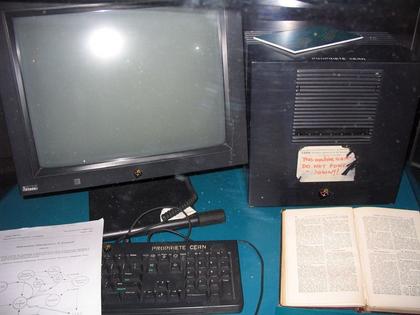
Wikipedia's image repository includes a photo of the NeXTCube that Tim Berners-Lee ran the first-ever Web server on, at the CERN lab in Geneva, Switzerland:

This NeXT workstation (a NeXTcube) was used by Tim Berners-Lee as the first Web server on the World Wide Web. Today, it is kept in Microcosm, the public museum at the Meyrin site of CERN, in the Canton of Geneva, Switzerland.

The document resting on the keyboard is a copy of "Information Management: A Proposal," which was Berners-Lee's original proposal for the World Wide Web.

The label on the cube itself has the following text: "This machine is a server. DO NOT POWER IT DOWN!!"
Link (Thanks, Fipi Lele!)

I write books. My latest is a YA science fiction novel called Homeland (it's the sequel to Little Brother). More books: Rapture of the Nerds (a novel, with Charlie Stross); With a Little Help (short stories); and The Great Big Beautiful Tomorrow (novella and nonfic). I speak all over the place and I tweet and tumble, too.

MORE:  Old school

More at Boing Boing

Ants and Stars: Bruce Sterling and Jasmina Tesanovic visit the Sardinia Radio Telescope in Italy

The Snowden Principle

  • laffmakr

    Only $40?!? Come one…your chance to hold the entire Internet in your hand has got to be worth more than that.

    However, $40 for a NeXT might be a bit high.

    I’m glad it’s in a museum.

  • OM

    …Ah, the NeXT. The machine that proved the theory that the reason the Mac remained colorless for so long was that Steve Jobs was color blind and wanted the rest of the world to suffer.

  • GregLondon

    The label on the cube itself has the following text: “This machine is a server. DO NOT POWER IT DOWN!!”

    Ah, the good ol’ days, when you could shut one server off, and take down the entire world wibe web!

  • padster123

    Come the singularity, that machine is going to be placed in a black hole and worshipped by the goo!

  • haaz

    Ahhh, NeXT. That was a cool effing box. What was it, a 40 MHz 68040? No! I checked Wikipedia (always reliable) and the first NeXT cube apparently had a 25 MHz 68030. Considering this was 1988, that was pretty good. (And again, a correction. According to Wikipedia, it came out in 1990.) The second generation had the ’040, and was actually cheaper than the first round, which is good, as they were not cheap.

    In my estimation, you cannot call NeXT a failure. Tim Berners-Lee used one to create the Web, the same thing most people consider to be the Internets. And the NeXT OS, NeXTSTEP, went on to become the basis of Mac OS X. And that actually is going pretty darn well.

  • tonx

    it should be kept perpetually running like an eternal flame, generating random numbers or something.

  • dculberson

    I actually had an ’040 Turbo NeXT Dimension cube and a turbo slab a little while back.. I sold the cube to a friend and gave him the slab as a bonus. They’re still incredible looking and feeling machines; the casing on the cube is magnesium, and the monitor base is magnesium. The build quality of the whole thing is incredible. I even had a couple matching laser printers; even the paper trays matched the design aesthetic. Hell, everything down to the freakin’ power cords matched!! (Logos, black, with little ribs, etc..) So cool. One of the highlights of computer history, for sure.

    And most certainly not a failure. Unless you mean failure as in not around any more. But they definitely contributed to the improvement of computers as a whole.

  • jredmond

    FWIW, that file is really hosted on the Wikimedia Commons, a centralized media repository for all Wikimedia Foundation projects. While the English Wikipedia allows fair use for images and other media, the Commons only allows material that’s either freely licensed or in the public domain. (Some Commons volunteers might get a little touchy about that “Wikipedia’s image repository” line, even though Wikipedias are currently where most Commons content is actually used.)

    Otherwise – love the photo.

  • tomic

    It’s so different than other NeXT Cubes! You can just SEE the porn radiating from it!

    srsly thgh, it’s funny how we persist in wanting to see the ‘first of’ even when the thing was an abstraction. Somehow we need to *see* it.