Features Podcasts Family Video Comics Music Tech Science Books Film & TV Games ✚

Jill

Prophecies of the Internet, 1971

David Pescovitz at 10:51 am Thu, Mar 31, 2011

— FEATURED —

Book Review

The Man Who Laughs: grotesque Victor Hugo potboiler was the basis for The Joker

Feature

Eurovision 2013: An American in London

Book Review

The Twelve-Fingered Boy - mesmerizing YA horror novel

— FOLLOW US —

Boing Boing is on Twitter and Facebook. Subscribe to our RSS feed or daily email.


— POLICIES —

Except where indicated, Boing Boing is licensed under a Creative Commons License permitting non-commercial sharing with attribution


— FONTS —

Tweet
Kindle
 Images Table1Baran-Tm
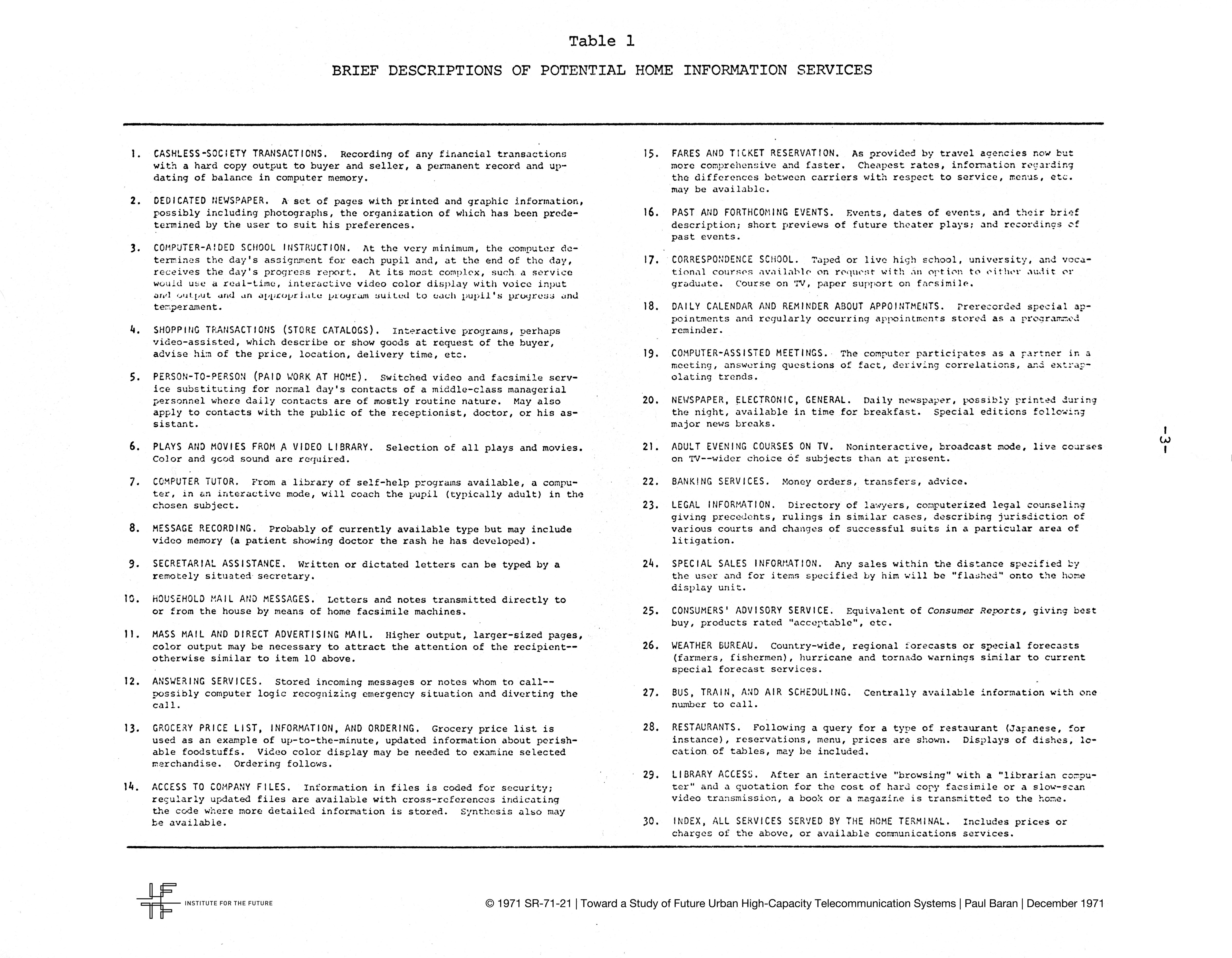
Earlier this week, I posted about the death of Paul Baran, co-inventor of packet switching -- the core technology of the Internet -- and a co-founder of Institute for the Future, the non-profit forecasting thinktank where I'm a research director. Yesterday, as we looked through our library of Baran's brilliant, and still-relevant, research papers, we came across a mind-blowing report from 1971, titled "Toward a Study of Future Urban High-Capacity Telecommunications Systems." At the time, Baran and his IFTF colleagues were considering how the military's ARPANET, the precursor to the Internet, might someday change our everyday lives if it became publicly accessible. This particular report contained a delightfully prophetic page of forecasts titled "Brief Descriptions of Potential Home Information Services." Click here to see a full scan of the page. Here are a few of my favorites (remember, this was 1971!):
 Tmp  Images Iftfbarantelecom * DEDICATED NEWSPAPER. A set of pages with printed and graphic information, possibly including photographs, the organization of which has been predetermined by a user to suit his preferences.

* PLAYS AND MOVIES FROM A VIDEO LIBRARY. Selection of all plays and movies. Color and good sound are required.

* RESTAURANTS. Following a query for a type of restaurant (Japanese, for instance), reservations, menu, prices are shown. Displays of dishes, location of tables, may be included.

* LIBRARY ACCESS. After an interactive "browsing" with a "librarian computer" and a quotation for the cost of hard copy facsimile or a slow-scan video transmission, a book or a magazine is transmitted to the home.

"IFTF Celebrates Paul Baran: Forecasting the Internet" (IFTF, thanks Jean Hagan!)

"Paul Baran obituary" (The Guardian)

David Pescovitz is Boing Boing's co-editor/managing partner. He's also a research director at Institute for the Future. On Instagram, he's @pesco.

MORE:  Technology

More at Boing Boing

Eurovision 2013: An American in London

The technology that links taxonomy and Star Trek

  • jody

    To the naughty-minded folk, porn is included in:

    6. PLAYS AND MOVIES FROM A VIDEO LIBRARY. Selection of all plays and movies. Color and good sound are required.

  • Mark Dow

    Wow, 30 of 30. That’s some futurology.

    • bklynchris

      What about the futurology that Japanese restaurants would be numerous enough to compare?

    • peterbruells

      Probably because he wasn’t a “futurologist” but an engeneer who worked on the stuff.

    • Allen Garvin

      “30 of 30″

      Well, except perhaps for #9, where the boss dictates letters to a remote secretary who types them up.

  • eyebum

    Awesome.
    Now, can we just call these descriptions “prior art” and void all the stupid f#@king patent troll nonsense that is rampant now?

    “LOOK. SOMEONE THOUGHT OF THIS AND WROTE IT DOWN IN 1971. YOUR IDEA IS NOT ORIGINAL.”

    • Anonymous

      Well it wouldn’t be a patent, it would be copyright, and you can’t copyright an idea.

      Unless you mean that current patent holders that based their technology on his ideas are at risk of losing their patents; in which case that’s still wrong, as a patent is granted via the discretion of the patent office. If they can’t find a reference then it’s not considered to be an accepted concept in the public domain.

      Either way there’s no cause for patent concern.

  • jetfx

    Pretty impressive that all of their predictions are bang on, but I would argue that their predictions are fairly conservative in nature. It’s fairly easy to accurately predict possible technical applications of an emerging technology, but the hard part is predicting what its going to do to everything else.

  • hdon

    I wonder if he knew this exact document would become available, in perpetuity, to people all over the world

    Rest in peace

  • nixiebunny

    They talk an awful lot about facsimile and not at all about ASCII text. What’s up with that?

  • emo hex

    I’d love to know the break down
    of boingboing readers born . . .

    Pre 1971 Post 1971

  • DrPretto

    Very interesting, he was a visionary, bright man.
    What about this short film: 1999 A.D. (1967)
    http://www.youtube.com/watch?v=uO58SGiYwwo
    http://www.youtube.com/watch?v=C7hXmab4T1A

  • muteboy

    This is seriously make me well up. Beautiful.

  • Anonymous

    They missed porn.

  • DrPretto

    More info on that movie:
    Wink Martindale confirms that “Year 1999 A.D.” was really made in 1966 by Ford Philco and isn’t a hoax:
    http://www.avgeeks.com/wp2/wink-martindale-talks-about-year-1999-ad/

  • ducu

    Working on the DEDICATED NEWSPAPER prophecy → http://earlyedd.com

  • SamSam

    I read “Adult Evening Courses on TV” as “Adult Evening TV,” and thought, euphemisms aside, this guy knew what he was talking about…

    Then I realized my mistake and saw that he omitted to forecast one of the biggest uses of the internet, and so was disappointed.

    • Mark Dow

      Yes but full credit for not sketching all the kitsch like wrist phones and recipes for the wife. Beats the hell out of Toffler’s “Future Shock” (1970).

      http://en.wikipedia.org/wiki/Future_Shock

  • DrPretto

    Also visionaries that imagined elements of waht we call internet today were Paul Otlet (1934), Jorge Luis Borges (1941) and Vannevar Bush (1945).
    http://www.nytimes.com/2008/06/17/health/17iht-17mund.13760031.html
    http://www.themodernword.com/borges/borges_papers_rollason2.html
    http://en.wikipedia.org/wiki/As_We_May_Think

  • a nonny mouse

    Yeah, what Mark Said, 30 for 30. Just wow. But he did miss a few items.

    -Dissemination of LOLcats. But really, who saw that coming in 1971? This document pre-dates American’s Funniest Home videos by what, 15 years?…so maybe that extrapolation was harder to make.

    -Massive porn distribution. Maybe he saw this coming but decided to leave it out for the sake of propriety.

    -Internet Snark. But perhaps that is somehow implicit in all of this, just assumed that massive communications improvements will eventually lead to massive amounts of communicated snark.

    • ManOutOfTime

      +1

  • lasttide

    Could this be considered prior art or sufficient evidence of obviousness to bust a few thousand software patents?

  • a nonny mouse

    Okay, actually, number 6 totally covers porn. Silly me. Nonetheless…

    31. AMUSEMENT. Sharing pictures of cats that have been anthropomorphized by the addition of humorous caption. Captions should use poor spelling.

    • Mark Dow

      His wording would have been “fascimiles of felines”.

      • a nonny mouse

        You’re so right! I wish I’d put that in there.

  • rks1157

    Where’s the porn?

  • ManOutOfTime

    Too lazy to go back and read Future Shock — and really don’t expect Toffler has held up well, but that could be an unfair bias I’ve developed once I learned Newt Gingrich was an adherent. I can only imagine, though, that docs like this one — if not this very doc — were the sources on which he relied. I do recall the custom newspaper was in Future Shock, as it has been in every update of the vision of the connected/interactive lifestyle over the last 40+ years.

  • Anonymous

    Dudes, Paul Baran was indeed a genius, but it was never “the military’s arpanet” – true, Baran’s design was intended to provide second-strike resilience but it was rejected by the Pentagon, and Bob Taylor diverted the initial seed funding for arpanet from a missile defence project but that’s afaik the only military influence on the creation of the Internet until Milnet split off a decade later. Arpanet was conceived, designed and created with purely civilian rationale and purpose.

  • SamSam

    Interesting oversite: no consideration of user-generated content. The user in this is always just a passive consumer of information.

    That shows one of the biggest changes between now and then. Back then, the idea that almost any and every kid with a camera (and no need for skill) would be making videos and posting them for the world to see, and that people would actually be watching these videos.

    I think it would have been hard to foretell the incredible lowering of the bar for creating and distributing.

  • Anonymous

    @25: Medical transcription. In my short career, I’ve seen hospitals switch from cassette tapes to wholly digital dictation. Unfortunately, I’ve also heard of hospitals outsourcing the work to India, with an inevitable effect on quality. I get job security by working in a crazy moon-language.

    • Gag Halfrunt

      Indian staff doing transcrption work for American doctors no doubt earn much less than the Americans they replaced, but are probably better qualified than them.