Features Podcasts Family Video Comics Music Tech Science Books Film & TV Games ✚

Jill

Model files for a working 3D-printable clock

Cory Doctorow at 10:24 am Sat, Apr 23, 2011

— FEATURED —

Science

Making sense of the confusing Supreme Court DNA patent ruling

Book Review

The 'Geisters: spooky, scary novel

Science

Ants and Stars: Bruce Sterling and Jasmina Tesanovic visit the Sardinia Radio Telescope in Italy

Feature

The Snowden Principle

— FOLLOW US —

Boing Boing is on Twitter and Facebook. Subscribe to our RSS feed or daily email.


— POLICIES —

Except where indicated, Boing Boing is licensed under a Creative Commons License permitting non-commercial sharing with attribution


— FONTS —

Tweet
Kindle

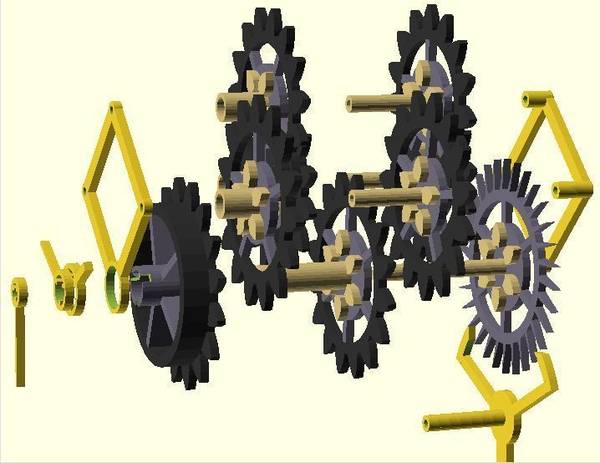
After a season of intensive, public experimentation and iteration, Thinigverse user Syvwlch has completed and uploaded a design for a working, 3D-printable clock that can be output from a cupcake Makerbot printer (these being DIY, open source 3D printers that can output things about the size of a cupcake or smaller).
Syvwlch's work on a printable clock has been one of the most exciting ongoing projects on Thingiverse. He's just upload what might be a final version of his work. This version includes the escapement, pendulum, gears for the seconds, minutes, and hours, and a set of nested concentric gears to provide the corresponding second, minute, and hour movement. And, let's not forget he's made this entire clock parametric in OpenSCAD - in case you need to print up a grandfather clock or a teeny-tiny watch.
Syvwlch's Printable Clock - ready for printing!

I write books. My latest is a YA science fiction novel called Homeland (it's the sequel to Little Brother). More books: Rapture of the Nerds (a novel, with Charlie Stross); With a Little Help (short stories); and The Great Big Beautiful Tomorrow (novella and nonfic). I speak all over the place and I tweet and tumble, too.

MORE:  watch

More at Boing Boing

Ants and Stars: Bruce Sterling and Jasmina Tesanovic visit the Sardinia Radio Telescope in Italy

The Snowden Principle

  • jphilby

    Clock??? Nah. Twit me when they’re printing Antikythera replicas.

  • wakeupsilver

    My coworker Peter Schmitt from MIT Media Lab has created 3d printable clocks (and other things) that blow me away

    http://www.instablogs.com/outer_permalink.php?p=3d-printed-clock-by-peter-schmitt

    • Syvwlch

      Oh, how I would dearly love to have access to that kind of printer!

      Those are beautiful designs, and truly inspiring. :-)

  • robcat2075

    I don’t know how accurate the mechanism is as designed but scaling it certainly would affect the accuracy severely since a pendulum’s period is dependent on its length, no?

  • usonia

    I’ve been trying to do this in my spare time at work (goodwoodnyc.com, laser fun all day!), but I’m not…somethingsomething math enough/too lazy to figure out the gears properly.

  • EH

    Is dynamic.boingboing.net hosted on an Arduino?

  • Syvwlch

    Thank you Cory :-)

    The first physical instances of the printable clock model are being printed today, and pictures are going up on it’s page at Thingiverse: http://www.thingiverse.com/thing:7976

    It’s looking pretty good so far, I seem to have gotten the tolerances and design trade-offs about right. I expect to have to tweak the escapement a few more times, but we’re getting close!

  • Project2501

    Rad!

  • Syvwlch

    Here are some pictures of the first print:

    http://www.thingiverse.com/derivative:8707

    They are a good representation of what these printers can do, both in size and in resolution.

    We’re not going for accuracy, at least not yet, but you are quite right that the pendulum’s period varies with its length, and it can’t be shrunk without speeding it up… a lot.

    For small oscillations, length is proportional to the square of the period, and in SI units, a pendulum with an effective length of 25cm should have a period of 1 second.

  • secretagentmoof

    For people who aren’t clock nerds:

    The key thing about clocks isn’t the vast majority of the gears; it’s the escapement, pendulum, and escape wheel (or equivalent). In this 3d model, those three things are the rightmost wheel and the yellow thing at the bottom right. All that the rest of the gears do is divide the rotation of the escape wheel to drive the display (i.e. the hands.)

    The interesting/hard bit will be coming up with the gears for the power source (e.g. weights) and tweaking the escapement so that it’ll consistently drive the pendulum without causing stuttering or inaccuracy in the process.

    • Alvis

      THIS.

      I know 3D-printing is super-neat right now, but I wasn’t aware it was yet capable of making something with the precision and smooth angles needed for an escapement. Everything 3D-printed I’ve seen is very aliased close-up.

  • Syvwlch

    Absolutely!

    The power source is a weighted string wound on the drum sticking out of the left-most gear (the one with the hour hand).

    The escapement is definitely the finicky bit, and the design will allow for tweaking it without having to redesign, or reprint, the rest of the clock. I’ve done some animation/simulation but we’re just going to have to test it in the physical world. :-)

    The only real challenges with the gear train and the hands had to do with the constraints of these 3D printers. This design is right at the edge of what they can do in size, resolution and accuracy.

    In particular, instead of a common two step 60:1 reduction (like 6 and 10, or 7.5 and 8), I had to use four steps with the lowest gear ratios I could, just to keep the gears printable!

    I settled on 3.2, 3, 2.5 and 2.5 in the end.