Features Podcasts Family Video Comics Music Tech Science Books Film & TV Games ✚

Jill

Scalzi's Fuzzy Nation: a masterful, likable reboot of one of the great sf classics

Cory Doctorow at 7:29 am Mon, May 16, 2011

— FEATURED —

Science

Last chance to enter the Armchair Taxonomist challenge!

Book Review

Black Code: how spies, cops and crims are making cyberspace unfit for human habitation

Book Review

We Can Fix it! - a graphic novel time travel memoir

Science

The technology that links taxonomy and Star Trek

— FOLLOW US —

Boing Boing is on Twitter and Facebook. Subscribe to our RSS feed or daily email.


— POLICIES —

Except where indicated, Boing Boing is licensed under a Creative Commons License permitting non-commercial sharing with attribution


— FONTS —

Tweet
Kindle
Last year, John Scalzi announced that he'd been commissioned by the estate of H Beam Piper to write an updated version of the classic sf novel Little Fuzzy. I'm very fond of this novel (here's my review of last year's award-winning audiobook adaptation), not least because it was the first sf novel I bought with my own money, from the used section of Bakka Books in Toronto (I was nine, and Tanya Huff was working behind the counter; she listened seriously to my enraptured discussion of the Asimovs and Heinleins I'd read from my Dad's shelves and went and got me the Piper. I never looked back).

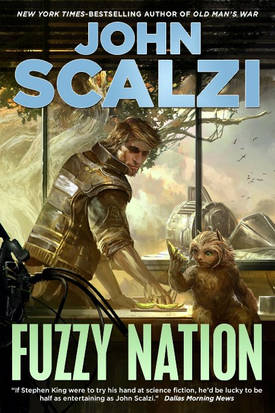
Scalzi's novel, Fuzzy Nation, came out last week and I read it over the weekend. I went to it cold, not sure if it was a sequel or what. There were two Fuzzy novels for some time (Piper having committed suicide before writing a third). Then there was a third volume written by another writer, and then, years later, they recovered a lost Piper manuscript for his own third book, making the whole sequence a little confused.

It turns out that Scalzi and the Piper estate have swept the slate clean with Fuzzy Nation -- this isn't a sequel, prequel, or retelling. It's a new novel that reboots the Little Fuzzy story, writing it from a thoroughly modern place that takes account of our present-day consensus on the future. For all that Scalzi completely rewrites Piper's story (only a few characters survive, and several of them undergo personality, gender, and professional reassignments), he is remarkably true to Piper's original appeal -- like Little Fuzzy, Fuzzy Nation is a story about good people trapped in a big organization, and how some of them choose to go along to get along and some of them buck the system, and what it all means for a race of "primitive" sentient beings who've just made potentially disastrous first contact with the human race.

In Fuzzy Nation, Jack Holloway is an independent contractor working as a mining surveyor on a distant world, trying to recover valuable geological oddities called sunstones. After inadvertently blowing up a cliffside (and triggering harsh environmental penalties for the company that has the exclusive license to mine the planet), he is fired. A few minutes later, he shows the company rep the massive lode of sunstones he's just uncovered, and he is quickly recontracted, with a handsome bonus, much to the company man's humiliation. Jack -- a disbarred lawyer and misanthrope who lives with his dog in the middle of the jungle -- is feeling pretty good about this when he gets back to his isolated cabin and discovers a kind of large, bipedal cat in his cabin. His dog goes crazy, and he puts it outside, and discovers that his visitor is smarter than any cat he's ever met -- smart enough to befriend the dog when he's allowed back in.

Here begins the two entwined struggles in Jack's life: first, the struggle to hold onto his claim (which turns out the be one of the biggest in the history of interplanetary exploration) in the face of the rapacious, authoritarian company that runs the planet; second, the struggle over the destiny of the Fuzzys, who, if sentient, will trigger an evacuation of the planet and a cancellation of Jack's claim a staggering fortune.

Told in Scalzi's trademark snappy, sarcastic style, Fuzzy Nation is an absolute delight, full of great set-pieces in which the clever and bright outmaneuver the crass industry barons, thuggish private security muscle, and an entire ediface of interplanetary law that is pretty ambivalent about the role of sentient aliens in the universe. Jack (and his frenemies, like his ex-girlfriend who happens to be the company's on-planet xenobiologist; and her new boyfriend, who is the company's chief counsel on-planet) run one caper after another, generally one step ahead of the bad guys, except when they aren't, and even though you know they're going to get out of it -- this is a book with "happy ending" written all over it from page one -- you're never sure how.

Scalzi's version of Jack Halloway is an interplanentary, futuristic Travis McGee: a likable, quick-thinking, brawling lunk whose cynicism can't quite triumph over his internal goodness. Add to that the insanely cute Fuzzys (Scalzi's deep affection for critters is on full display here) and a real affection for Piper's original material, and you've got a book that can't miss. This is a perfect swinging-in-the-hammock, summer-weekend novel -- and the perfect novel to give to a clever young person of your acquaintance to spark a lifelong love affair with science fiction and all it has to say about how we treat one another, how we treat the rest of the universe, and what we do when the circumstances offer us the chance to sell out our integrity for fortune.

Scalzi is on tour with Fuzzy Nation right now, with upcoming stops in Portland (tonight!), Seattle, Salt Lake City, Scottsdale and Washington, DC.

Update: John Scalzi clarifies: "One small point of fact: I wasn't commissioned by the Piper Estate to write the novel; I actually wrote it for myself, as (more or less) fan fiction and for fun. And in fact I wasn't even originally planning to sell it. But when I showed it to my agent he asked if he could talk to the Piper estate about it (it's now administered by Penguin) and he asked them to read it and if they liked it to give us their blessing and endorsement. Which they did. "

Fuzzy Nation

I write books. My latest is a YA science fiction novel called Homeland (it's the sequel to Little Brother). More books: Rapture of the Nerds (a novel, with Charlie Stross); With a Little Help (short stories); and The Great Big Beautiful Tomorrow (novella and nonfic). I speak all over the place and I tweet and tumble, too.

MORE:  Reviews

More at Boing Boing

The technology that links taxonomy and Star Trek

Hackers prepare for first "national holiday" in their honor

  • Rich Keller

    I read Little Fuzzy and Fuzzy Sapiens when I was about 16 and remember really enjoying them. My only problem with them was entirely my fault. I kept envisioning the Fuzzies as tinier versions of Chaka from Land of the Lost for some reason and kept trying to bend my mind to see them more as described in the books.

  • LILemming

    On the one hand, I usually dismayed by the zombification of late authors’ series.

    OTOH, it is Scalzi.

    OTGH, in a similar thread some years ago I said the same sort of optimistic thing about Brin and Benford and their forthcoming Foundation books. . .

    • Anonymous

      I too had great hopes for the “Killer B’s” expansion of the Foundation series … suffice to say that Scalzi’s revisit / re-imagination of HBP’s original is much**3 more enjoyable.

      Disclaimer: I finished reading Fuzzy Nation yesterday (just before John’s signing at Borderlands in SF) — for the second time. Am perhaps a bit biased on the subject.

              - CJH / esper

  • Shmuel

    “he is remarkably true to Piper’s original appeal — like Little Fuzzy, Fuzzy Nation is a story about good people trapped in a big organization”

    I would respectfully, but strenuously, disagree with this. What Scalzi does is turn Piper’s theme inside out. The new book’s theme is, more or less, “Everybody’s a bastard. Even good people can be trusted to betray their principles if manipulated well enough, and sometimes that’s just what the nominal ‘good guys’ need.”

    It’s a fun read while it lasts, but when you hit the end and realize that there are no more reversals waiting in the wings, it becomes more problematic. At least for me.

  • Otter

    Most novels are written with no assurance that they will be sold, but it’s kind of amazing that Scalzi wrote one under the assumption that it could not be sold. If I had that urge, I’d lie down until it went away. Which is what separates me from successful writers, I suppose.

  • ckd

    There were two “third” Fuzzy books by other authors in addition to the later-discovered Piper; the sequel Fuzzy Bones by William Tuning, and the “Little Fuzzy from the Fuzzies’ viewpoint” Golden Dreams: A Fuzzy Odyssey by Ardath Mayhar.

    (The Wikipedia entry for Little Fuzzy says that there’s yet another sequel coming out this spring, in addition to the Scalzi reboot.)

  • couchguy

    WARNING: THIS MAY BE A LITTLE SPOILERY!

    I read Fuzzy Nation as fast as I could download the Kindle edition, having been waiting anxiously (in both senses of the word) to see it. There was no doubt in my mind it would be masterfully written, and it is.

    Less than a fourth of the way into the book, however, I became a little worried. it was beginning to read like someone skillful had deliberately rewritten Little Fuzzy to be a more palatable sale for a movie. The protagonist had changed from a crotchety-but-lovable old coot to a young bad-boy type who was improbably multi-talented as a sunstone prospector and a lawyer. This, of course, made it possible for him to be involved in the inevitable love triangle with the lady scientist and the slick-Willie company lawyer. Little Fuzzy himself became Papa Fuzzy with his own brood including mischievous boy and cute baby, who still don’t quite grab me the way the original Fuzzy family does. Instead of Victor Grego (one of the best “villains” in SF, IMHO) we get the currently-trendy villainy of a truly dimwitted and unredeemably rotten scion of a massive corporate family — somebody straight out of a current movie about Wall Street. I was scared to go on.

    Go on I did, and glad I did, too. Scalzi pulls it out, and in unexpected ways. The ending begs for a sequel, of course — but that’s no surprise. It still comes off a little more Hollywood than it could have, but it is a fine read and worthy of the memory of the man who originated the tale. It can never replace Little Fuzzy in my heart, but it earned its place on my virtual bookshelf.

  • WizarDru

    “On the one hand, I usually dismayed by the zombification of late authors’ series.”

    Speaking as someone who’d never read Piper before…Scalzi’s announcement got me to buy and read Piper’s original book. And I’ll likely buy and read the follow-ons. Piper’s name is not a well-known one these days. Fuzzy Nation has brought him some much-deserved attention. If for no other reason, this project is good on that merit alone.

  • Kabur Naj

    The audiobook version (released by Audible Frontiers) is read by Wil Wheaton :D. For good measure, they’ve appended a full audiobook of “Little Fuzzy” (previously released also from Audible Frontiers and read by Peter Ganim).

    http://www.audible.com/pd/ref=sr_1_1?asin=B004YXLK7G

  • Rob Myers

    I wish I could remember the first SF book I bought with my own money. Probably one of the Dragonfall 5 ones, although that wouldn’t even count as YA now. The first adult SF I bought was probably “The Lives And Times Of Jerry Cornelius”.

  • Nicky G

    So basically it’s Avatar, but they’re not tall and blue?

  • pfh

    “committed”

    Surely there is a better word than one that implies criminality?

  • Anonymous

    As John tells the story, rather than being commissioned by the Piper estate (a publishing group, as he left no heirs) John wrote the story for fun and relaxation with no intention of publishing it. He agent, though after reading it told him it was quite salable, and so after getting the blessing of the Piper estate, here it is.

    And great fun it is, too. Scalzi has his snark on, and this Jack Holloway is not much like the original, but that’s okay. It is enjoyable to see the difference between 60s sensibility, and ours.

    –Jerry

  • wylkyn

    I bought it, but it was with more than a little trepidation. “Little Fuzzy” is one of my all-time favorites, and I’ve probably reread that book more times than any other. I’ll try to be open minded about it, though.

  • huntsu

    I agree completely. I don’t know what blog I saw this on, but Little Fuzzy was one of my favorite books as a kid when I was more into sci-fi than I am now. I prefer mysteries these days, but immediately went to get this one.

    I also couldn’t quite figure out where this book was in the series, and was pleasantly surprised that it was a retelling of the Little Fuzzy book. It also reads like a lot of soft thrillers and mysteries, and Travis McGee is a great comparison though Halloway is not a tough or morally compromised.

    I went to Amazon and ordered three other books by Scalzi, who I had not read before this. That’s a pretty good recommendation from me.

  • simonbarsinister

    So I am wondering which to introduce my 11 year old to first: Little Fuzzy or Fuzzy Nation…

    • schnauzer

      Both versions are wonderful, but I’d start a young reader off with fuzzy nation. It moves faster. The only caveat is there is a bit of pg13 language in Scalzi’s Fuzzy Nation…

  • CLP

    I read it too, and enjoyed it greatly. There’s even bacon involved!