Features Podcasts Family Video Comics Music Tech Science Books Film & TV Games ✚

Jill

DMZ 10: when siege turns to surge

Cory Doctorow at 5:27 am Tue, May 24, 2011

— FEATURED —

Science

Making sense of the confusing Supreme Court DNA patent ruling

Book Review

The 'Geisters: spooky, scary novel

Science

Ants and Stars: Bruce Sterling and Jasmina Tesanovic visit the Sardinia Radio Telescope in Italy

Feature

The Snowden Principle

— FOLLOW US —

Boing Boing is on Twitter and Facebook. Subscribe to our RSS feed or daily email.


— POLICIES —

Except where indicated, Boing Boing is licensed under a Creative Commons License permitting non-commercial sharing with attribution


— FONTS —

Tweet
Kindle
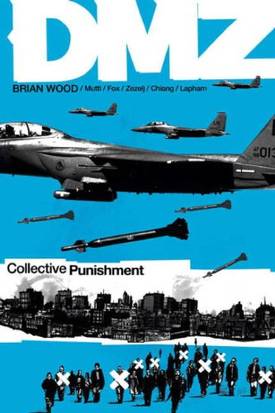
Collective Punishment, the tenth volume of Brian Wood's fantastic (anti-)war comic DMZ, follows the format set out in the first half of book nine: a series of short vignettes that jump from character to character, setting to setting, each illustrated by different artists,It's a chance for the illustrators who've been captured by Wood's apocalyptic, besieged New York City to play around in his world.

Collective Punishment is the story of a "surge" aimed at breaking the back of the resistance in Manhattan, the titular DMZ in a dirty civil war that has split America. Told from the points of view of traitors, refugees, artists, prisoners, power brokers, radicalized civilians and soldiers, the powerful and the powerless, these stories are particularly poignant today, as bombs fall in Libya and security forces shoot at protesters in Syria and Bahrain.

Wood's version of a war story is all grit, no romance. As always, he's telling the story of people who are the involuntary spectators and participants in someone else's clash of civilizations. It's a perspective that's simultaneously unforgiving and deeply emphatic, and it's why Wood's DMZ is some of the best material written about war in any medium.

DMZ Vol. 10: Collective Punishment

I write books. My latest is a YA science fiction novel called Homeland (it's the sequel to Little Brother). More books: Rapture of the Nerds (a novel, with Charlie Stross); With a Little Help (short stories); and The Great Big Beautiful Tomorrow (novella and nonfic). I speak all over the place and I tweet and tumble, too.

MORE:  Reviews

More at Boing Boing

Ants and Stars: Bruce Sterling and Jasmina Tesanovic visit the Sardinia Radio Telescope in Italy

The Snowden Principle

  • flink

    There is a basic flaw in writing about war. If you portray it well enough, and truly capture it’s despair and futility, then you’ll suceeed in depressing the reader. You probably won’t get that person to re-read your story.

    People may admire the writing and recommend it to others, but man, I certainly don’t re-read a depressing story.

    And example of an author who has done this is Rick Shelley. His “Second Commonwealth” trilogy nails warfare. I’m a compulsive reader. I couldn’t help but read all three once I started. But I’ll never read them again.

    On the other hand, I’ve read his “Dirigent Mercenary Corps” series several times. Shelley’s writing is pretty good.

    War is a depressing enterprise. It seldom accomplishes what it sets out to do. It often ruins that which it attempts to preserve and defend. It always hurts. When you can engender those emotions in a person, it works like aversion therapy. It’s rough for repeat business. Had I read Shelley’s Second Commonwealth series first, it would have been the last of his writing that I would have read.

    • The Hug

      Disagreed, especially with regards to this outstanding series, which I am now a little behind on. DMZ is a war story, sure, but the backdrop of war recedes for much of it into the role of plot device. It’s always present, but it serves mainly to set the stage for a real story about a place and the people in it.

      The main players in DMZ have less to do with the war proper and really just want to get on with their lives. There is of course a large amount of extremely graphic, rather disturbing content in DMZ, but it functions as a foil for the little bits of hope and humanity that come from the protagonists. I remember finding this series quite often strangely uplifting, less mournful about what war destroys, and more focused on the little bits of humanity.

  • petsounds

    There is a basic flaw in writing about war. If you portray it well enough, and truly capture it’s despair and futility, then you’ll suceeed in depressing the reader.

    I can’t agree with that statement. While war is gruesome and tragic, the people stuck in it are often also humorous, romantic, wise, and stupid. I read tweets from Libyan freedom fighters, and while there are moments of despair and great sadness, there is also hope, a great concern for their fellow men and women, and a undeniable sense of humor. While some of this is coping mechanism, in general, war stretches humans to extremes. Extreme cruelty, extreme barbarism, but also extreme kindness and fellowship.

  • fionnmatthew

    sold

    :)

  • Shart Tsung

    Demilitarized Zone, I was just thinking about this series yesterday.

    Good comic recommendations, no love for super-hero books though?

  • sevenhenchmen

    I think DMZ may be more about human resilience in the face of overwhelming sorrow, terror and confusion.

  • lisechen

    If Wood wrote better dialogue, I might read this series. As it is, I just can’t bring myself to care. Maybe that makes me a horrible person.