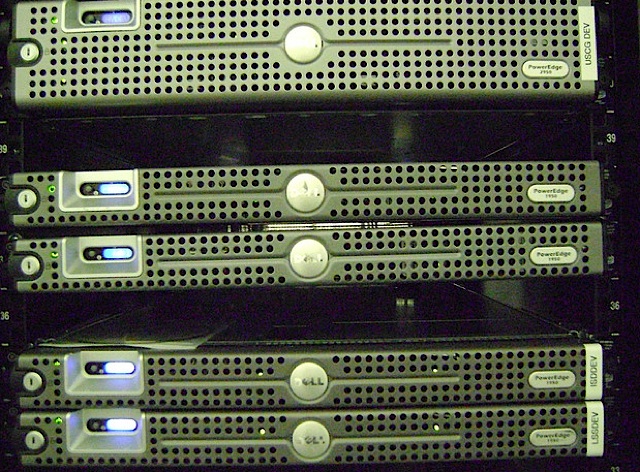
Server farms generate so much heat that they have to run air conditioning year round. That requires energy, which costs money and tends to mean burning more fossil fuels. Meanwhile, in winter, a lot of houses are cold. The people who live there have to turn on the heat, which costs money and tends to mean burning more fossil fuels.
So here's an idea: Why not distribute the hardware from a server farm, putting heat-producing equipment in houses that actually need the heat?
If a home has a broadband Internet connection, it can serve as a micro data center. One, two or three cabinets filled with servers could be installed where the furnace sits and connected with the existing circulation fan and ductwork. Each cabinet could have slots for, say, 40 motherboards — each one counting as a server. In the coldest climate, about 110 motherboards could keep a home as toasty as a conventional furnace does.
The rest of the year, the servers would still run, but the heat generated would be vented to the outside, as harmless as a clothes dryer's. The researchers suggest that only if the local temperature reached 95 degrees or above would the machines need to be shut down to avoid overheating. (Of course, adding a new outside vent on the side of the house could give some homeowners pause.)
According to the researchers' calculations, a conventional data center must invest about $400 a year to run each server, or about $16,000 for a cabinet filled with 40 of them. (This includes the costs of building a bricks-and-mortar center and of cooling the machines.)
Having homes host the machines could reduce the need for a company to build new data centers. And the company's cost to operate the same cabinet in a home would be less than $3,600 a year — and leave a smaller carbon footprint, too. The company's data center could thus cover the homeowner's electricity costs for the servers and still come out way ahead financially.
It could certainly produce some logistical problems with security, but it's an intriguing idea, and a great example of how we can get the energy services we want for much less energy use. The researchers who proposed it, from Microsoft and the University of Virginia, call it a "data furnace." It'll be interesting to see where the idea goes from here.
• Read the white paper where the idea of data furnaces was introduced. White papers are not peer-reviewed, by the way.
• Read the New York Times article quoted above.
Via Geekwire and Stephen Curry
Image:Image: Dawdle's new servers – front, a Creative Commons Attribution (2.0) image from dawdledotcom's photostream


