Features Podcasts Family Video Comics Music Tech Science Books Film & TV Games ✚

Jill

Digi-Comp 1 emulator toy for learning the foundations of computers

Cory Doctorow at 9:10 pm Mon, Dec 26, 2011

— FEATURED —

THE LATEST

Guatemala: Nation's highest court throws out Ríos Montt genocide trial verdict and prison sentence

Feature

Eurovision 2013: An American in London

Book Review

The Twelve-Fingered Boy - mesmerizing YA horror novel

Book Review

Black Code: how spies, cops and crims are making cyberspace unfit for human habitation

— FOLLOW US —

Boing Boing is on Twitter and Facebook. Subscribe to our RSS feed or daily email.


— POLICIES —

Except where indicated, Boing Boing is licensed under a Creative Commons License permitting non-commercial sharing with attribution


— FONTS —

Tweet
Kindle


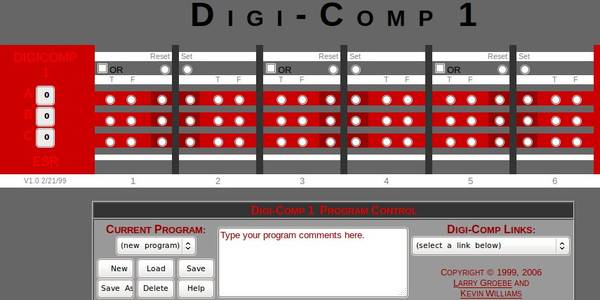
Avi sez, "The Digi-Comp 1 toy kit was a cool hands-on way to learn the basics of computing. The Digi-Comp 1 emulator is an interim substitute for those who can't get their hands on one."

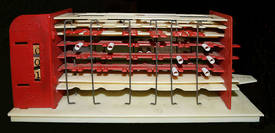
In essence the Digi-Comp I contains three mechanical flip-flops and provides an ability to connect them together in a programmable way using thin vertical wires that are either pushed, or blocked from moving, by a number of cylindrical pegs. The whole arrangement is 'clocked' by moving a lever back and forth. Different configurations of these cylinders cause the Digi-Comp to compute different boolean logic operations. With a three binary digit (3-bit) readout of the state of the flip-flops, it can be programmed to demonstrate binary logic, to perform various operations such as addition and subtraction and to play some simple logic games such as Nim.
See also the magnificent CARDIAC, the cardboard teaching computer produced by Bell Labs.

D I G I - C O M P 1 (Thanks, Avi!)

I write books. My latest is a YA science fiction novel called Homeland (it's the sequel to Little Brother). More books: Rapture of the Nerds (a novel, with Charlie Stross); With a Little Help (short stories); and The Great Big Beautiful Tomorrow (novella and nonfic). I speak all over the place and I tweet and tumble, too.

MORE:  computer science • education • submitterator • web theory

More at Boing Boing

Eurovision 2013: An American in London

The technology that links taxonomy and Star Trek

  • cratermoon

    My dad had one of those! I dunno if it’s still in his closet anywhere, but I remember fooling with it and not understanding it when I was little.

    • cellocgw

      kids….  *I* had one of those as a kid.  Now on interviews I can claim I started machine-language programming in 1969 :-).

  • gullevek

    My dad gave me the V1 when I was a kid. That was such an awesome toy.

    • bwcbwc

      I received one too, but we were never able to get all the pieces to fit…they eventually became cat toys.

  • haineux

    I had one. The emulator is pretty much as good as the actual item. 

    It is made of plastic plates, very thin stiff wires, and plastic tubing. Sliding the clock plate causes the wires to swoop in and push the counter plates around, depending on where the plastic tube “bits” are placed.Very, very limited: Three bits of I/O, six logic gates (or two can be ORd together), no storage per se. If it were any cheaper, they’d have sold it in the back of comic books.

    That being said, I am very grateful to my parents for getting me one, along with the Braun/Raytheon Lectron kits. They paved the way for me to go get an old N-in-1 electronics kit at a yard sale, and a pile of 7400 DIPs, a pile of LEDs, and a breadboard.

    Seriously, the current N-in-1 kits they sell at Radio Shack are a lot more educational/entertaining/fun.

  • http://profiles.google.com/eliotfur Илья Найдов

    Redstone in Minecraft is much better in that regard… Incredible stuff can be done with just three in-game items: redstone torch, redstone dust and blocks…

  • http://vtblom.posterous.com vtblom

    I had a Digicomp as a lad back in the ancient past…many hours sitting around writing code scripts to perform calculations then assemble the pegs, set the gates, then count the computer cycles. Record the result reset for the next calculations….rinse repeat til done. Not to long after I moved on to a Telecomp terminal tied into MIT to actually play Nim against the computer! Also began learning programming languages. We had to do the code on paper tape then feed it in to be processed. Ah the good old days…:)

  • noen

    Someone could make a game version of Digi-Comp. Unity would work. Then publish as an app for iPad and android.

  • http://lobrien.myopenid.com/ Larry O’Brien

    OK, apropos to the season, some Christmas in the late 70s I got a “computer simulator” that had about 12 slides that could go Up-Middle-Down onto which you’d clamp metal conductors that would complete circuits through the wires that you’d put on either side of the slides, all of which ultimately led to the turning on and off of small incandescent lights up at the top, which would glow through pieces of paper showing numbers in “computer font.” Anyone know what _that_ thing was called?

  • solid_ekans

    So help a dummy out plz. So this is basically what my computer is doing right now right? Only trillions of times faster and a trillion times more?
    I’ve played with it for a few minute and I’m baffled at what is going on.

  • http://jaylevitt.myopenid.com/ jaylevitt

    Forget the app… within ten years I bet we can print our own Digi-Comp.