Features Podcasts Family Video Comics Music Tech Science Books Film & TV Games ✚

Jill

Funny titles mask serious science

Maggie Koerth-Baker at 7:54 am Mon, Jan 23, 2012

— FEATURED —

Feature

Eurovision 2013: An American in London

Book Review

The Twelve-Fingered Boy - mesmerizing YA horror novel

Book Review

Black Code: how spies, cops and crims are making cyberspace unfit for human habitation

— FOLLOW US —

Boing Boing is on Twitter and Facebook. Subscribe to our RSS feed or daily email.


— POLICIES —

Except where indicated, Boing Boing is licensed under a Creative Commons License permitting non-commercial sharing with attribution


— FONTS —

Tweet
Kindle

Sabina Hossenfelder, an assistant professor of high-energy and nuclear physics at Sweden's Nordic Institute for Theoretical Physics, is collecting a list of scientific research papers with hilarious names. I've long known that humanities researchers have a good deal of freedom in titling their work—ever since running across the seminal work "Like a Thesis: A post-modern reading of Madonna videos" in college. But I'd not guessed there would be as many ridiculously-titled scientific papers as Hossenfelder has managed to come up with.

There's some real beauties in here, including "Local Pancake Defeats Axis of Evil", "Deconstructing Noncommutativity with a Giant Fuzzy Moose", and a pair of papers from 2002 and 2006, respectively, entitled "Nutty Bubbles" and "Nuttier Bubbles".

Many of the papers on Hossenfelder's list come from arXiv, so they have not necessarily been through a formal peer review process, but they are all about very real science. That's an important thing to stress. In all the examples I listed, for instance, silly titles are adding a touch of levity to some otherwise highly technical physics work that I am not able to explain to you without first doing a whole lot of additional research. In fact, that's part of what makes this list so awesome. Here's the abstract for "Local Pancake Defeats Axis of Evil":

Among the biggest surprises revealed by COBE and confirmed by WMAP measurements of the temperature anisotropy of the CMB are the anomalous features in the 2-point angular correlation function on very large angular scales. In particular, the $\ell = 2$ quadrupole and $\ell = 3$ octopole terms are surprisingly planar and aligned with one another, which is highly unlikely for a statistically isotropic Gaussian random field, and the axis of the combined low-$\ell$ signal is perpendicular to ecliptic plane and the plane defined by the dipole direction. Although this $< 0.1 %$ 3-axis alignment might be explained as a statistical fluke, it is certainly an uncomfortable one, which has prompted numerous exotic explanations as well as the now well known ``Axis of Evil'' (AOE) nickname. Here, we present a novel explanation for the AOE as the result of weak lensing of the CMB dipole by local large scale structures in the local universe, and demonstrate that the effect is qualitatively correct and of a magnitude sufficient to fully explain the anomaly.

I'll give you a hint. It's about astrophysics.

Check out Hossenfelder's full list.

Via jebyrnes

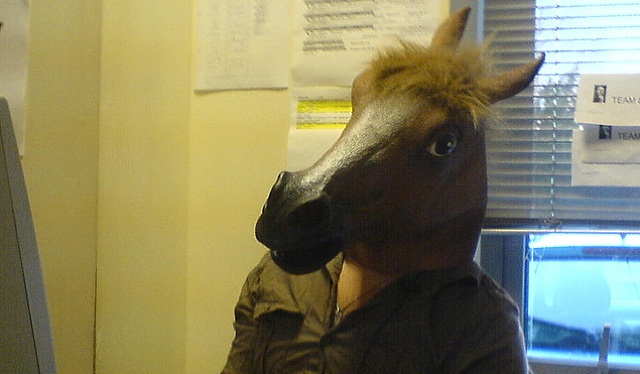
Image: KISS's Noble Steed - Fancy Dress At Work #3, a Creative Commons Attribution (2.0) image from rileyroxx's photostream

Maggie Koerth-Baker is the science editor at BoingBoing.net. She writes a monthly column for The New York Times Magazine and is the author of Before the Lights Go Out, a book about electricity, infrastructure, and the future of energy. You can find Maggie on Twitter and Facebook.

Maggie goes places and talks to people. Find out where she'll be speaking next.

MORE:  arxiv • physics • Science • science LOL • scientists

More at Boing Boing

Eurovision 2013: An American in London

The technology that links taxonomy and Star Trek

  • joeposts

    It’s not a published science paper, but I was always proud of my aptly titled, first-year philosophy essay Filasafy: Even me can do it. Prof liked it.

  • Christopher Ing

    I while ago I compiled a list of inappropriate science papers that were published in actual journals, only funny for a non-expert :P

    http://www.jacksofscience.com/lol/unintentionally-inappropriate-science-papers/

  • lknope

    I eagerly await the “Nuttiest Bubbles” paper.

  • Lissamphibia

    Best presentation title at the Behavior 2011 conference: “Do house crickets strategically ejaculate in the face of sperm competition?”

    (It was by Worthington, et al. from Iowa State.)

  • http://www.youtube.com/user/Freethinkersanon Christopher

    I don’t know if it qualifies as a funny title, and it’s not science, but the title “‘How Do You Know She’s a Witch?’: Witches, Cunning Folk, and Competition in Denmark” by Timothy R. Tangherlini in the Summer/Autumn 2000 issue of the journal Western Folklore cracked me up.

    Even better was the article’s conclusion:

    Already in the seventeenth century the answer to the question “How do you know she’s a witch?” is not “She turned me into a newt” or some other example of physically verifiable maleficium, but rather, “Because I say so.”

  • Bevatron Repairman

    I’m a big fan of “Higgs in Space!”  http://arxiv.org/abs/0912.0004  – co-written by a friend of mine — which suggests a method for detecting Higgs particles with deep space telescopes.

  • http://fieldguidetohummingbirds.wordpress.com/ Sheri L. Williamson

    I’m relieved that “Decapitating Tadpoles” is a physics paper.