Features Podcasts Family Video Comics Music Tech Science Books Film & TV Games ✚

Jill

"My Favorite Museum Exhibit": Arab Courier Attacked by Lions

Maggie Koerth-Baker at 3:52 pm Thu, Jan 26, 2012

— FEATURED —

Book Review

The Man Who Laughs: grotesque Victor Hugo potboiler was the basis for The Joker

Feature

Eurovision 2013: An American in London

Book Review

The Twelve-Fingered Boy - mesmerizing YA horror novel

— FOLLOW US —

Boing Boing is on Twitter and Facebook. Subscribe to our RSS feed or daily email.


— POLICIES —

Except where indicated, Boing Boing is licensed under a Creative Commons License permitting non-commercial sharing with attribution


— FONTS —

Tweet
Kindle

Earlier this week, I challenged readers to send me photos of their favorite museum exhibits and specimens, preferably from museums that might go overlooked in the tourism pantheon. Over the next few days, I'll be posting some of these submissions, under the heading, "My Favorite Museum Exhibit". Want to see them all? Check the "Previously" links at the bottom of this post.
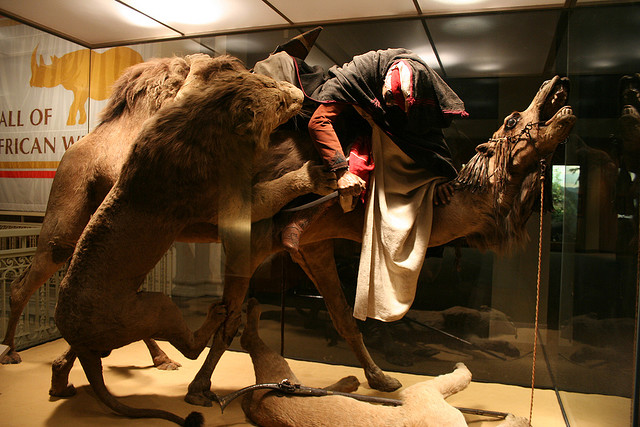
Who says a diorama has to be boring? Sam Donovan's favorite museum exhibit is "Arab Courier Attacked by Lions", on display at the Carnegie Museum of Natural History in Pittsburgh. Built by Jules Verreaux for the Paris Exposition in 1867, it was purchased first by the American Museum of Natural History—which quickly thought better of it*—and was then sold to Andrew Carnegie in 1898 for $50. Today, it can be purchased in snow-globe form** for $40. Inflation is a bitch.

The lions preserved here are Barbary lions, a subspecies that went extinct in the wild in the early 20th century.

The "Arab courier", thankfully, is a mannequin. However, that might not have always been the case. Jules Verreaux had previously stuffed and mounted the corpses of non-Europeans before he made this diorama. Meanwhile, the man who was preparator-in-chief at the Carnegie Museum at the time they purchased "Arab Courier" once wrote that the courier "might have been real prior to 1899 when it was refurbished." So, yeah. Historical racism. How about that?

There are often problems associated with how natural history museums traditionally collected and displayed artifacts. The history here actually ends up being a great example of how culture and social norms and influence how we think about science. The facts may not change, but our interpretation of them does. For instance, the Dyche Museum at the University of Kansas, my childhood natural history museum, owns the taxidermied body of a U.S. cavalry horse that was the only member of the 7th Cavalry to survive the Battle of the Little Big Horn. For decades, this horse was billed as "the only survivor of the Battle of the Little Big Horn." Which, for obvious reasons, is both wildly inaccurate and pretty racist.

*The AMNH, while acknowledging the skill it took to produce a diorama like this, wasn't quite sure it lived up to their standards as a display of scientific educational value.

**Yes, there is something a little weird about snow falling on this scene.

  • Museum photos: Mummified Ice-Age bison

Image: Flickr user happy via, via CC license.

Maggie Koerth-Baker is the science editor at BoingBoing.net. She writes a monthly column for The New York Times Magazine and is the author of Before the Lights Go Out, a book about electricity, infrastructure, and the future of energy. You can find Maggie on Twitter and Facebook.

Maggie goes places and talks to people. Find out where she'll be speaking next.

MORE:  audience participation • Culture • happy mutants • my favorite museum exhibit • natural history • racism • Science

More at Boing Boing

Eurovision 2013: An American in London

The technology that links taxonomy and Star Trek

  • rhodian

    Barbary lions extinct?  I saw one in Belfast zoo last year!  Ah, extinct in the WILD…

  • jkg

    very cool! reminds of this photo I took of a rather odd exhibit at a museum in Tucson, AZ
    http://www.flickr.com/photos/octalkhan/6587218177/lightbox/

  • jhoosier

    I’d like one of those snowglobes, but the camel’s mouth weirds me out.  Why does the inside of a mouth have to be painted brilliant red?  The snow doesn’t bother me.  They  should’ve made it sand-colored, then it could be a sandstorm.

    • nankerphelge

      The museum’s website says:”Instead of traditional snowflakes, the globe, when shaken, produces a sand storm that surrounds the courier and animals.”

      Still odd though.

  • Frenchfarmer

    So they were uncivilised yet they had Camel Express way back then?

  • http://twitter.com/LjSwiech Lj Swiech

    My grandmother lived a block away from the Carnegie Museum. Every Sunday that we would visit my brothers and me would bolt ASAP over there. It was free back then. That diorama was a favorite. At that time it was on the third floor which was dimly lit, like an attics, which only added to the neat factor of the poor Arab guy on his way to being lion chow. Museums are too polish and sanitized now a days. I still believe it was a real guy stuffed back then.

  • JamesMcDaniel

    Indeed, we denizens of the 21st Century are much more enlightened than the “historical racists” of 1899. People of today would never exhibit preserved and mounted corpses of non-Europeans for the purpose of education, much less profit – right?

    http://www.bodiestheexhibition.com/
    http://en.wikipedia.org/wiki/Bodies:_The_Exhibition#Uncertainty_about_provenance_of_the_bodies

    • retepslluerb

      Dont know about the 21st century in your part, but in our part we mount and display the remains of non-non-Europeans, yes.

  • http://www.geekforce.com Hugh Johnson

    That exhibit was always a highlight of school field trips, only surpassed by the fossil of the giant trilobite, which in 5th grade,  Duane puked all over. My kids both enjoy the Carnegie, and the “Guy getting eaten by lions” is one of the faves.

  • http://ok-cleek.com/blogs cleek

    why would that be racist?

    if you’re going to make a diorama of someone being attacked by lions, that someone should probably be from a place where lions actually live(d).

    • millie fink

      Not sure if that’s snark or not, but in case it’s not–

      Because stuffing non-white corpses while refusing to do so to white ones is racist. What museum that displayed actual, dead and stuffed (non-white) people as various sorts of  ”savages” also displayed, say, actual dead and stuffed white people as Pilgrims?

    • snowmentality

      “Historical racism” was not referring to the mannequin’s skin color. It was referring to the possibility that the rider might have been an actual taxidermied human being at one point, and that bodies of non-European people were actually taxidermied and displayed in other museums, as though they were animals. I’m gonna go ahead and say yeah, that’s racist.

      • http://ok-cleek.com/blogs cleek

        the bodies of white people were also taxidermied, dismembered, dissected in theaters, and cut up for display! didya see the post that immediately follows this one?

        • millie fink

          But people who work in museums almost never also work in theaters. The issue here is more a matter of institutional racism within the realms of “History” and “museums.”

  • Christopher Ing

    I can’t give much context, but there’s a somewhat similar diorama at “Museum National d Histoire Naturelle” in Paris, that I snapped a pic of attached.

  • gadgetgirl

    I’ve seen racist uses of human bodies for museum exhibits, but I’m not sure this counts. Besides, I’ve also seen at least three examples of European corpses on display in museums: two soap people in the US (wasn’t one featured in Boing Boing a while ago?) and the skeleton of a 19th century man who was hanged for a crime he very likely didn’t commit — but the local medical researchers thought he had nice bone structure and especially even teeth. The skeleton was in a museum in Oxford UK.

  • snowmentality

    Oh Jesus. I honestly did not know that human beings were stuffed and mounted as exhibits as described in that link about Verreaux. I guess I shouldn’t be surprised, but I’m still shocked.

    Several years ago I visited the Harvard Museum of Natural History, which has a truly creepy amount of taxidermied animals of all kinds. One of the exhibits was a diorama of two taxidermied gorillas, male and female, which had been mounted standing fully upright. I was really disturbed by the idea of stuffed gorillas, and remember telling my boyfriend “That’s just way too close to killing and stuffing people.”

    Now I find out that happened.

    P.S. I went to see Bodies before I knew the source of the bodies. I thought they were voluntarily donated to science. I had it confused with Body Worlds, which really does use only bodies donated with proper informed consent. Then I found out Bodies used the bodies of Chinese prisoners, and didn’t even try to verify consent. I felt horrible for having given them my money, and angry because I felt like Bodies was dishonestly trading on Body Worlds’ ethical reputation.

    • Ipo

      I feel very strongly that gorillas are people. 
      Some have spoken with us, using a vocabulary of over 600 words/signs,  in one of OUR languages. 
      And tought it their children.

      It’s all a terrible mix-up.  It’s corporations that are not people, damnit!

  • StephenJJohnson

    Actually, Comanche – the horse at the KU Natural History Museum – was restored in 2005 http://naturalhistory.ku.edu/galleries/comanche-restoration-project and moved to a new enclosure on the fourth floor with new – and more culturally sensitive signage.

    There’s a public event at the musum on February 2nd http://naturalhistory.ku.edu/calendar/2012/02/02/comanche150 to mark his almost 150 years.

  • Jeff Kaplan

    NO WAY! I was just at the Carnegie a month or two ago and was exclaiming that this was always my favorite thing.  I remember as a boy, looking up at into the beady eyes of the camel and the man and being mesmerized. 

  • Wreckrob8

    I think collections should be mixed up as much as possible – authenticity should be treated the same way as the Mediaeval world treated holy relics – the more the better. (I am aware that this was partly to relieve people of their cash.)

  • bryan rasmussen

    **Yes, there is something a little weird about snow falling on this scene.Screw the sandstorm idea. I want snow and it should play little drummer boy or jingle bells or some such when shaken. Then I could tell my kid it was one of the three wisemen getting mauled to death after seeing baby jesus.

  • coryf

    For decades, this horse was billed as “the only survivor of the Battle of the Little Big Horn.” Which, for obvious reasons, is both wildly inaccurate and pretty racist.

    No, it’s just short hand for “the only survivor of the US Calvary side of the Battle of the Little Big Horn”, everybody knows that the Indians survived. It’s just assumed that any “survivors” must be from one side.

    • StephenJJohnson

      So *no* native Americans were killed?

    • EvilSpirit

      No, it’s sh0rt hand for “the only survivor of the Battle of Little Big Horn that we give a fuck about.” To imagine otherwise is pretty clueless.

      • StephenJJohnson

        My point, precisely.

  • Mia C

    I go to the Carnegie Museum at least once a year. I’ve been there dozens of times. How have I missed this? I feel very unobservant right now. Maybe I’m too captivated by the dinosaurs?

  • http://profile.yahoo.com/C4OIQWBRR4BL2EI4YSHSDQ6NHM John

    I might be mistaken but wouldn’t this diorama have been the Exhibition version of the Delacroix painting from 1850 – it would have been well known by that time
    http://www.wikipaintings.org/en/Tag/lions#supersized-search-187710  

  • http://www.zhrodague.net/ Drew from Zhrodague

    Former/future Pittsburgher. This diorama is also one of the neat things at the Carnegie Museum. The aviary also has some vintage dioramas, and there are some impressive dinosaur bones. Some cities do not have these kinds of museums, and I feel lucky to have been all over this one.

  • JG

    Over the years of viewing
    “Arab Courier Attacked by Lions”, my sympathies have evolved. First, as a kid, I feared for the courier, wondering if I could have gotten off a shot with that rusty musket. Later, I was concerned about the camel, its wounds so realistic you knew it would never survive. Finally, I came to appreciate, then morn the plight of the Barbary Lion, abused by everyone from Roman Gladiators to decrepit zoos and circuses. Fortunately, I’ll never need to worry about this fantastic exhibit of a deadly desert encounter, the Carnegie Museum has preserved it forever, in a ‘sand globe’

  • Ito Kagehisa

    Broca and Cope both wanted to be displayed in a museum after death;  however both of them turned out to be insufficient to the requirements of the position.

    This Arab has been elevated to the position of exemplar of humanity, and any racism you see came from the prejudice lodged firmly in your own eye.