Features Podcasts Family Video Comics Music Tech Science Books Film & TV Games ✚

Jill

A futurist prediction that came true

Maggie Koerth-Baker at 3:37 pm Wed, Feb 8, 2012

— FEATURED —

THE LATEST

Guatemala: Archive of documents from Rios Montt genocide trial, overturned 10 days after guilty verdict

THE LATEST

Guatemala: Nation's highest court throws out Ríos Montt genocide trial verdict and prison sentence

Feature

Eurovision 2013: An American in London

Book Review

The Twelve-Fingered Boy - mesmerizing YA horror novel

Book Review

Black Code: how spies, cops and crims are making cyberspace unfit for human habitation

— FOLLOW US —

Boing Boing is on Twitter and Facebook. Subscribe to our RSS feed or daily email.


— POLICIES —

Except where indicated, Boing Boing is licensed under a Creative Commons License permitting non-commercial sharing with attribution


— FONTS —

Tweet
Kindle

Sure, it's fun to post old pages of mid-century science magazines and make fun of the predictions that never came true—flying cars! Weather control!

But it's equally, if not more, enjoyable to read predictions for things that actually happened. These are the things that remind us that the world we live in today is pretty goddamn amazing. Teacher Michael Poser sent me one such prediction that he and his students found in The Science Year Book of 1947, a sort-of proto-aggregator that compiled reprints of stories in science magazines. This quote came from a Scientific American article entitled "Microwaves on the way":

In peacetime microwaves are slated for an even more spectacular career… Private phone calls by the hundreds of thousands sent simultaneously over the same wave band without wires, poles, or cables. Towns where each citizen has his own radio frequency, over which he can get voice, music, and television, and call any phone in the country by dialing. Complete abolition of static interference from electrical devices and from other stations. A hundred times as much “space on the air” as is now available in the commercial radio band. A high-definition and color-television network to cover the country. And, perhaps most important of all, a nationwide radar network to regulate all air traffic and furnish instantaneous visual weather reports to airfields throughout the land. By such a system, every aircraft over the United States or approaching it could be spotted, identified and shown simultaneously on screens all the way from Pensacola to Seattle.

What an awesome find! I don't know about you, but I pretty much take for granted all the things that short wavelength radio waves (i.e. microwaves) do for me every day. It's amazing to see something that has become so blase talked about like the wonder of technology it actually is.

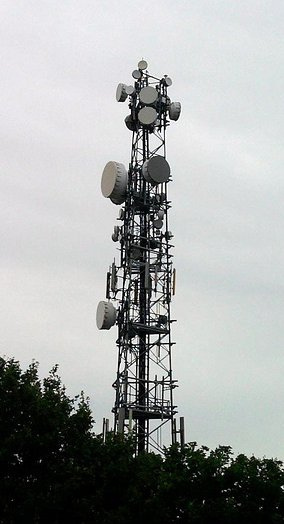
Image: mercury m3 sunbury microwave mast, a Creative Commons Attribution Share-Alike (2.0) image from osde-info's photostream

Maggie Koerth-Baker is the science editor at BoingBoing.net. She writes a monthly column for The New York Times Magazine and is the author of Before the Lights Go Out, a book about electricity, infrastructure, and the future of energy. You can find Maggie on Twitter and Facebook.

Maggie goes places and talks to people. Find out where she'll be speaking next.

MORE:  awesome • communications • futurism • History • retrofuturism • Science • Technology

More at Boing Boing

Eurovision 2013: An American in London

The technology that links taxonomy and Star Trek

  • http://drjeffblog.blogspot.com/ Dr. Jeff

    I am happily still blown away by just about everything in life. My kids make fun of me for constantly being amazed that one can just pick up a little cell phone and talk to anyone, or for remarking how cool it is that we can send big winged tin cans full of people  across the country with ease.

    Microwaves are definitely on the list of amazing stuff.

  • Geoduck

    My favorite example of this is Murray Leinster’s 1946 story “A Logic Named Joe”, which essentially predicts the Internet, complete with YouTube and porn potential.

  • GordonM

    That’s actually quite a remarkable prediction, even if it glosses over the details (couple of things in there that don’t have anything to do with microwave). But if you translate “their own frequency” as  their own website / email / etc.. it has all come true. Amazing.

    • Bookburn

      I understood “their own frequency” as their own phone number.

  • Cocomaan

    My dad is an electrical engineering professor, and will love this. Thanks for posting.

  • Graysmith

    Funny, I was thinking about this just the other day, of how amazing it really is to have this little machine that you put something into and shortly thereafter as if by invisible magic you have a hot meal or beverage. I can only imagine it must’ve seemed like pure witchcraft when the first home-use microwave ovens were released in 1967, especially considering how crude technology in general was back then.

    • Their feldspars

      1964. World’s Fair. Greyhound pavilion. The future!

    • paulj

      Back in the early 1970′s my mother’s aunt from the old country saw one and refused to have anything to do with it. Since it couldn’t heat food by any means that she was familiar with, it was obviously the work of the devil.

  • Mark Dow

    Another fantastic set of related predictions from that era (1945) is Vannevar Bush’s “As We May Think” essay.
    http://en.wikipedia.org/wiki/As_We_May_Think
    In some ways the essay drove the predictions: for example Douglas Engelbart, a radio engineer and then internet pioneer, was influenced by the ideas.

  • Palomino

    1953, Ray Bradbury’s Fahrenheit 451.

  • MythicalMe

    While I am impressed with some of the predictions, most of them, by 1947 were easily possible. Microwave energy was already being harnessed and radar was developed in WWII. Frankly, I think the predictions made by Jules Verne were much more impressive.

    Ray Bradbury, and to a certain extent, Isaac Asimov were also good at future predictions.

  • GyroMagician

    Nice find.

    Some days, I’m still blown away by automatic doors. I mean, a door that knows I’m standing there, and realizes I want to come in, and opens all by itself. Amazing. On those days, mobile phones and the internet just explode my head.

    In reply to MythicalMe: Yes, the pieces were mostly available, but it takes some imagination (and luck) to put them together into something that will actually happen. There is a big gap between building a microwave source/receiver, and everybody in the country carrying a mobile phone in their pocket, linked by some kind of packet network to share data between them.

  • sisyphus321

    Technically …

    Optical fiber pretty much killed microwave voice backhaul in the 1980s. Some of the spectrum that was used for private microwave voice and voice-bandwidth transmission around 2 GHz was re-allocated for cellular use (ok, ‘PCS’, but basically the same thing) in the early 1990s. There are a lot of efforts to reallocate microwave frequencies for short-range cellular or wifi-like uses.

    The SciAm article is really about the amount of bandwidth that becomes available when the signal bandwidth is a fraction of a very high underlying carrier frequency. Of course, the ‘carrier frequency’ of an optical signal is much higher than a microwave radio signal, so the bandwidth expansion with fiber is much higher than radio.

  • bolamig

    It sure feels like he anticipated the internet, even if he couldn’t quite put it into words.

  • seyo

    All that, AND, unquestionably the best and fastest way to cook a sweet potato!

  • teapot

    Complete abolition of static interference from electrical devices and from other stations

    Someone forgot to tell this to my wireless FM headphones.