Features Podcasts Family Video Comics Music Tech Science Books Film & TV Games ✚

Jill

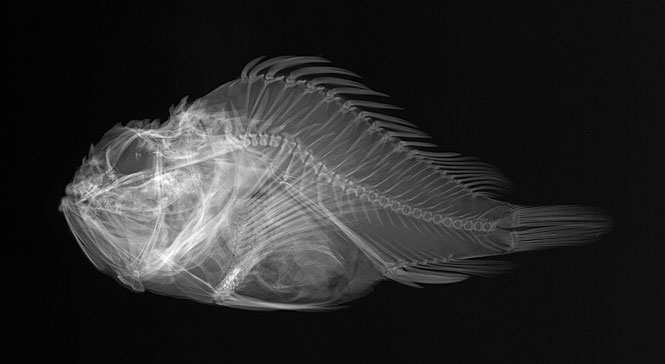
X-Ray of a scorpion fish

Maggie Koerth-Baker at 7:45 am Wed, Mar 14, 2012

— FEATURED —

Science

Making sense of the confusing Supreme Court DNA patent ruling

Science

Ants and Stars: Bruce Sterling and Jasmina Tesanovic visit the Sardinia Radio Telescope in Italy

Feature

The Snowden Principle

Book Review

Carl Hiaasen's Bad Monkey

— FOLLOW US —

Boing Boing is on Twitter and Facebook. Subscribe to our RSS feed or daily email.


— POLICIES —

Except where indicated, Boing Boing is licensed under a Creative Commons License permitting non-commercial sharing with attribution


— FONTS —

Tweet
Kindle

The Smithsonian National Museum of Natural History has a new exhibit up dedicated to x-ray portraiture of fish. All the shots were taken by Sandra Raredon, a museum specialist in the Division of Fishes (which is kind of a wonderful title, yes?)

I dig this because, on verbal description, this sounds rather dull. X-rays of fishes. Great. But when you actually see the images you remember two very important facts: First, fishes have tons of little, teeny bones packed into a relatively small body; Second, fishes come in a wide variety of frequently crazy shapes. That all adds up to fish x-rays being way more interesting than you might initially guess.

Take the scorpionfish. In real life, this family tends to look a bit like a bunch of Muppet trolls—runaway cast members from "Labyrinth" or something. In x-ray, you can see past the wild colors and stubbly, camouflage skin to spot the spines these fish use for delivering a numbing, toxic poison.

Check out all the fish x-rays at the Encyclopedia of Life.

Maggie Koerth-Baker is the science editor at BoingBoing.net. She writes a monthly column for The New York Times Magazine and is the author of Before the Lights Go Out, a book about electricity, infrastructure, and the future of energy. You can find Maggie on Twitter and Facebook.

Maggie goes places and talks to people. Find out where she'll be speaking next.

MORE:  fish • Science • x-rays • zoology

More at Boing Boing

Ants and Stars: Bruce Sterling and Jasmina Tesanovic visit the Sardinia Radio Telescope in Italy

The Snowden Principle

  • http://www.facebook.com/dan.l.warren Dan Warren

    The California Academy of Sciences has a great book and exhibit on fish x-rays as well:

    http://www.calacademy.org/exhibits/x-ray_ichthyology/

    If you want to see something even cooler, though, you should look for an exhibition of “cleared and stained” fish.  This is a process in which the flesh of the fish is made transparent via the application of special chemicals while their bones and connective tissue are dyed.  Just do a Google image search for “cleared and stained fish” and you’ll be blown away.

    • http://www.facebook.com/profile.php?id=701878416 Nicholas Robinson

      Very interesting . . . but when they’re X-rayed, even the tiniest fibrils of bone are perfectly preserved in exact position, whereas I’d imagine by removing the underlying structures, ie. muscle, fat, cartilage etc. some of the smaller structures would become deformed by gravity.

      Now I’d like to see a human being cleared and stained!

  • http://www.facebook.com/profile.php?id=701878416 Nicholas Robinson

    I’m fascinated by the fact that if you somehow persuade yourself that you’re not necessarily looking at a fish, you can see the underlying structure of mammals, reptiles, even (you have to stretch it) insects. Things are yes, elongated, skewed, bent, feathered, but still, there’s that “all non-vegetative life on Earth” paradigm going on in this lowly fish . . . I’d like to see one of those neat morphing videos turning this fish skeleton into, say, a cheetah skeleton. I’ll bet it could be done without too much removal/addition.

  • Bookburn

    My science classroom needs prints of these.  Heck… my bedroom needs prints of these.

  • bobcorrigan

    I’ll look in to what we can do to make those prints available.  It’s a good idea.

    • http://www.facebook.com/marko.raos Marko Raos

      nvm

  • bobcorrigan

    I like the Solenostomus cyanopterus x-rays, you can see the skeletons of what their last meals were.    Here’s a higher-res photo: http://www.flickr.com/photos/nmnh/6721868695/lightbox/