Features Podcasts Family Video Comics Music Tech Science Books Film & TV Games ✚

Jill

Describe a flame, win a VIP pass to the World Science Festival

Maggie Koerth-Baker at 7:47 am Wed, Mar 21, 2012

— FEATURED —

Science

Last chance to enter the Armchair Taxonomist challenge!

Book Review

Black Code: how spies, cops and crims are making cyberspace unfit for human habitation

Book Review

We Can Fix it! - a graphic novel time travel memoir

Science

The technology that links taxonomy and Star Trek

— FOLLOW US —

Boing Boing is on Twitter and Facebook. Subscribe to our RSS feed or daily email.


— POLICIES —

Except where indicated, Boing Boing is licensed under a Creative Commons License permitting non-commercial sharing with attribution


— FONTS —

Tweet
Kindle

What is a flame?

If you can explain that, on a level that an 11-year-old can understand, then you could win a VIP pass to the World Science Festival, May 30 to June 3 in New York City.

This is one of those questions that is harder to answer than it first appears. Alan Alda, the man behind this contest, asked his teacher that question when he was 11. Her answer, "It’s oxidation," meant nothing to him. So this contest isn't just about accuracy, it's about communication.

I often hear people complain about journalists and science popularizers "dumbing down" the science. And I suppose that's something reasonable to complain about, if what you mean is that those people are getting the science grossly wrong.

But that's not usually what "dumbing down" means. In fact, most of the time, when somebody is complaining about a dumbing down of anything, I've found that what they mean is that the topic has been made accessible and entertaining to a broad audience. Dumbing down means taking the information beyond the experts and enthusiasts, and convincing people that this is a topic they should be interested in. That's not a bad thing. It just means that there are different ways to reach different people with the same information.

To me, that's what this contest is about. Explain a flame—without using jargon—and make the science behind it capture a kid's imagination. That's not easy. It will take some dumbing down. But I think some of you can do this. And I'm excited to see the results.

Entries can be turned in as text, video, audio, or graphics. But they're due by April 2, so get to work!

Enter Alan Alda's Flame Challenge

Via Lauren Wolf

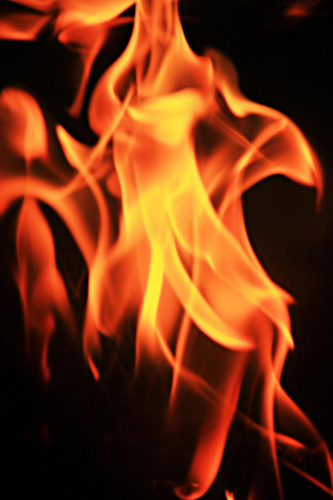
Image: Flames, a Creative Commons Attribution Share-Alike (2.0) image from juniorvelo's photostream

Maggie Koerth-Baker is the science editor at BoingBoing.net. She writes a monthly column for The New York Times Magazine and is the author of Before the Lights Go Out, a book about electricity, infrastructure, and the future of energy. You can find Maggie on Twitter and Facebook.

Maggie goes places and talks to people. Find out where she'll be speaking next.

MORE:  communication • contest • Science

More at Boing Boing

The technology that links taxonomy and Star Trek

Hackers prepare for first "national holiday" in their honor

  • Guest

    A flame is the suns energy stored and then released all at once. 

  • mynonymouse

    The (very awesome!) Story Collider recently had a a great podcast about just this kind of science communication question; where lies the proper pedagogical line?

  • technogeekagain

    Not that interested in entering the contest, but I’ll give all of you a big head start: Note that the question is not “what is fire”.

  • Cowicide

    This is wonderful.  Jargon is the last refuge of a lazy scoundrel who won’t creatively communicate and lacks empathy.

  • xzzy

    Heck, they might as well ask for an explanation that an average public educated adult could understand. It was never described to me what a flame actually is in my classes, it wasn’t until I was reading about it on my own that I understood what it was.

    Though I suppose aiming it at kids could be to avoid embarrassing said adults. :D

  • http://pulse.yahoo.com/_X3I3A73KKDGPDT2DH2RI7KPTRM Anthony

    Feynman already answered this 

    http://www.youtube.com/watch?v=ITpDrdtGAmo

    • OoerictoO

      love that guy.  thank you for posting this.

    • http://disqus.com/Kimmoth/ Kimmo

      Great stuff naturally, but I’m disappointed he didn’t cover the light. Although the details aren’t news, it’s still enlightening to hear such a champion tell the story.

      I’d already been blown away by realising trees come of out of the air, although that only happened a couple of years ago after I studied biology… great fun to notice something like that for yourself; it has surprisingly little play for such a mind-bending factoid : )

  • http://profiles.yahoo.com/u/OKEONAMLFIOS5WI7MPQY6SXBCQ IRMO

    “It’s the area above a fire where the air is hot enough to glow.”

    Anyone have an 11 year old to test this answer on? I can only deliver results on a 12 year lead time, minimum. 

  • Dv Revolutionary

    I know this because I’ve wondered the same thing and watched closely. Why does a flame burst into existence over one part of a wood or charcoal fire and not another? Why does it smolder some places and burst into flames others. In a candle why does the top of the flame trail off into smoke? What is the gradation at the top between flame and smoke/soot?

    In a wood fire this is my best description of flame.

    A flame is very hot carbon monoxide, other gases, and fine carbon particles lifting off of something burning, meeting with oxygen and then themselves burning as they rise in the air. If the gasses and soot aren’t hot enough you just get thick smoke rising out of the primary burn. When the gases and soot get hot enough they burst into flames. Flame is smoke itself on fire.

    • http://disqus.com/Kimmoth/ Kimmo

       This seems concise enough and nicely comprehensive, but I don’t know quite enough physics to back its accuracy.

      Sounds pretty good though

    • Beanolini

      Would you care to extend that to cover magnesium burning (bright flame, but produces no gases or soot)? Or even magnesium burning in nitrogen (same, but no oxygen involved).

      I personally find it particularly fascinating that considering the colour of flames leads to electron energy levels, quantisation of light,  and right through to quantum theory.

  • alcimeda

    It’s something I carry around in my pocket when I have the hots for someone.

  • cellocgw

    There’s a great collection of lectures given to schoolkids over winter break at some British school in the late 1800s.  The lecturer was Kelvin or Thompson or one of those  greats; he explains candle flame and then goes on to use a candle to demo thermal expansion, gas flow, and a pile of other stuff.  Naturally, I’ve forgotten the name and the link :-( 

    • prof_jellis

      It was Faraday, in 1848.  A text version of the lectures, The Chemical History of A Candle, is available at http://www.amazon.com/The-Chemical-History-Candle-ebook/dp/B002RKTH8W/

      • Sparg

        Thanks for the heads-up, prof!  I also found that Projekt Gutenberg has it without having to jump through Amazon’s Kindle hoops.

        http://www.gutenberg.org/ebooks/14474

  • AirPillo

    My only problem with science reporting where I consider it “dumbed down” is how the Popular Science genre is so often tempted to report on a nuanced and interesting science, but only just gloss over the actual science, and devote the rest of the article to anecdotes about its’ conception or grossly exaggerated predictions of its’ future uses.

    In this case it’s “dumbed down” in the sense that it assumes “you’re too dumb for the science, so here’s a fun story to read instead”

    • penguinchris

       Agreed. Was going to make a similar comment. Dumbing down in the sense that Maggie is referring to (and does herself, in her excellent science writing) is fantastic and necessary – and I, as a scientist myself, prefer to read things written that way if it’s just a casual article.

      If I want to know the details I will look them up – but the key is that I shouldn’t have to look up the details after reading an article just to actually understand what it is they’re referring to which is what happens when things are dumbed down the wrong way.

  • wafna

    “Phlogiston” would have sent my 11 year-old self straight to the library.

  • http://twitter.com/digitalArtform Joseph Francis

    It’s like a dense droplet of ink falling through clear water, only it’s upside down, fast, and invisible except for the densest parts of the rising fluid, which glow.

    • http://pulse.yahoo.com/_OAUXAA362EXWLYVMPJOKLFB5JQ Incipient Madness

       Thank you Aristotle. Seriously, that was pretty much his answer.

  • Diogenes

    It’s an upside-down waterfall of gases, sort of like air, that are so hot they’re glowing. 

  • bcsizemo

    This scene from Event Horizon sums it up for me:
    https://www.youtube.com/watch?v=GmgP0eZYlSU&feature=related

  • http://twitter.com/AgentBurnhard Bernard Petershie

    Its boiling air

    • http://disqus.com/Kimmoth/ Kimmo

       Can you melt a liquid?

  • elix

    This sounds like a job for r/explainlikeimfive!

    • william beaty

      Brief  r/explainlikeimfive Alda flame discussion.  I added mine, add your own.

  • David Wattenbarger

    a visible flame is light created by energy released by a chemical reaction.  When something burns (paper, wood, etc), it releases energy.  Much of that energy shows itself as heat or light.  The shape of the flame, its heat, and its color are influenced by the chemical reactions (depending on the burned material) and environmental factors.

    Or, as Calvin’s dad said, the wind is trees sneezing.

  • awjt

    It’s when someone says something on the Internet that really pisses you off and you write something back that totally destroys their ego and makes you seem like God in comparison.  The problem is they try to do the same thing back, and you get into this back-and-forth called a flame war, and at some point somebody mentions Hitler and the whole thing gets stupid and boring and you move on to another topic.

  • neurolux

    It’s the smallest unit of fire.

  • Bob N Johnson

    A flame is the burning gases released from a material that has been heated enough to release those gases. A fire requires three things fuel, a heat source, and oxygen.

    When wood or any other substance that will burn gets very hot it releases gases that when mixed with oxygen burn. These burning gases are called a flame.

    Fire is a chemical reaction that releases the energy stored in any material that will burn. A material that will burn is called a combustible material.

    This is how I explained fire to my young son. The gases are really more of a vapor, but that’s another story.

  • Antinous / Moderator

    Electrons excited until they produce light.  At least according to my 9th grade science teacher.

  • detroit32002

    A flame is like a fire that is really hot and could be dangerous, if you see a fire call for help.

    • http://disqus.com/Kimmoth/ Kimmo

       I think it’s meant to be an 11-year old’s question, not a 3-year old’s.

      • detroit32002

        I don’t have an 11 year old kid, I wouldn’t know how they would answer. I’m explaining the basics to a kid that’s not even a teenager. Most 11 year olds won’t understand photons and particles and elements at the age of 11.

  • Bob N Johnson

    Light is the photons released from the electrons in materials heated to high temperatures or excited in some other manner. Light can be emitted from any material with an high enough temperature or is excited in some way and does not require combustion.

  • Jemmy

    Faraday did a pretty good job of this back in 1860 with his Royal Institution Christmas Lecture series entitled The Chemical History of a Candle. The lectures were intended for the children of London, and did an excellent job of breaking down the science of combustion, such as it was in the mid-19th century.

  • http://newnumber6.livejournal.com Peter

    A flame is matter’s zombie bite.   See, there’s a chunk of ordinary matter, just going about it’s business.  Then… bam… this insane, raving piece of matter comes in its face and bites it!  At first, it just gets hot, and thinks it might be okay… but the infection’s beginning to grow inside.  Soon the piece of matter that was ‘bitten’ starts losing its cool and starts spreading, biting all the matter that’s nearby, and so on, until all the matter is part of the horde of fire. 

    Luckily, this is not a supernatural zombie apocalypse, this is a 28 Days Later zombie apocalypse… sooner or later, the zombie matter will die out.  Of course, you can always shoot it in the head with some water to end the threat earlier. 

  • http://www.facebook.com/people/Robert-Sanders/100000011989161 Robert Sanders

    Fire happens when a fuel like wood, gas, or anything else that burns, snaps together with the oxygen in the air you’re breathing right now. Think of the oxygen like Lego blocks that snap together with the paper or gas Legos. They call it oxidation; the same thing happens when oxygen mixes together with iron and makes rust or even when you digest food, but with fire it happens really fast. It happens so fast that it makes a lot of heat and light. That’s why fire is hot and it’s bright. Fire needs 3 things.
    1. oxygen- like in the air you breathe. 
    2.fuel- wood, gas, etc. fire uses these things like food, and the more “food” it has, the bigger it gets.
    3.heat- Without heat, the oxygen and fuel can’t snap together, Likewise, you need warmth to work. 
    In  many ways fire is almost alive. I Hope this cleared things up for you.