Features Podcasts Family Video Comics Music Tech Science Books Film & TV Games ✚

Jill

Historic photos of female scientists at work

Maggie Koerth-Baker at 1:01 pm Fri, Mar 23, 2012

— FEATURED —

THE LATEST

Gweek 098: Win Hugh Howey's Paperwhite Kindle!

Book Review

Lexicon: smart, sharp technothriller from Max "Jennifer Government" Barry

Book Review

The 'Geisters: spooky, scary novel

Science

Ants and Stars: Bruce Sterling and Jasmina Tesanovic visit the Sardinia Radio Telescope in Italy

— FOLLOW US —

Boing Boing is on Twitter and Facebook. Subscribe to our RSS feed or daily email.


— POLICIES —

Except where indicated, Boing Boing is licensed under a Creative Commons License permitting non-commercial sharing with attribution


— FONTS —

Tweet
Kindle

I'm sure there are a lot of people reading this who will have a hard time understanding why I love this collection of historic photos of female scientists. "Why female scientists?" I can already hear them asking. "Aren't you doing a disservice to female scientists by singling them out as something special?"

But here's the thing. These photos are special, and what they show is something that the vast majority of us have not had much exposure to: Images of women (who are not Marie Curie), working in the sciences prior to the 1970s or 1980s. And that matters.

When I was in school, I was presented with a history of science that excluded these women entirely. Other than a precious few exceptions that seemed to prove the rule, what I learned was that women had not been scientists. Even if you follow that up with a helpful reminder that women can be scientists today if they want, that edited version of history is (from my personal experience as a little girl) discouraging to little girls.

Meanwhile, it turns out that there were plenty of women working in the sciences, all along. Presenting a version of history that pretends they didn't exist devalues them, and contributes to the idea that, when we talk about the history of women in science, we're really just being PC, rather than talking about things that actually happened.

That's why I think these photos are important. They bring attention to women we should have been aware of, and they help to create a fuller, more diverse perspective on the history of science. Both those things are pretty awesome, as far as I am concerned.

The photos come from the Science Service (now the Society for Science and the Public), which basically served a role of science popularizer and news service in the first half of the 20th century. (The collection includes photos of women who wrote for the Science Service, images I consider pretty powerful since they are basically presenting me with people who did the job I now do.).

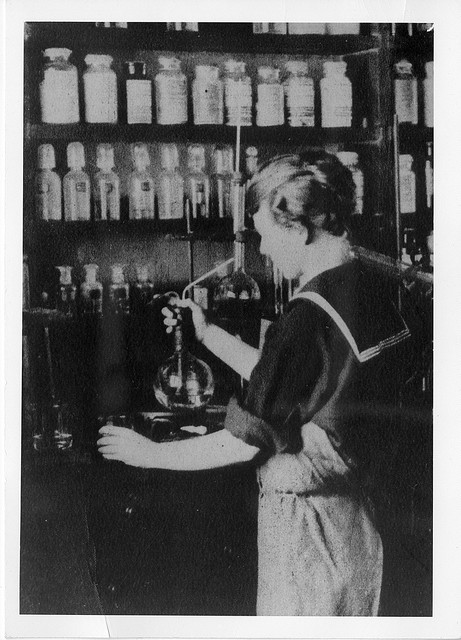
The photo above is a picture of chemist Margaret Foster, who was born in 1895.

Margaret D. Foster (1895-1970) working in the lab in 1919. Foster was the first woman chemist to work for the United States Geological Survey, starting in 1918, just three days after receiving her A.B. from Illinois College. Foster's studies primarily focused on the analysis of natural waters. Her work on the Manhattan Project resulted in two new quantitative methods of analysis, one for uranium and one for thorium.

View the photo collection on Flickr

Read more about the photo collection, and find out how you can help the Smithsonian Institution identify some of the women in the photos, and add more information to their biographies.

Via Jacquelyn Gill

Maggie Koerth-Baker is the science editor at BoingBoing.net. She writes a monthly column for The New York Times Magazine and is the author of Before the Lights Go Out, a book about electricity, infrastructure, and the future of energy. You can find Maggie on Twitter and Facebook.

Maggie goes places and talks to people. Find out where she'll be speaking next.

MORE:  History • Science • women

More at Boing Boing

Ants and Stars: Bruce Sterling and Jasmina Tesanovic visit the Sardinia Radio Telescope in Italy

The Snowden Principle

  • Brainspore

    Ms. Foster was an important trailblazer for both female scientists everywhere and cartoon ducks alike.

  • wysinwyg

    I can already hear them asking. “Aren’t you doing a disservice to female scientists by singling them out as something special?”

    Singling out women scientists won’t be doing them a disservice until the prompt “name 10 famous scientists off the top of your head” routinely elicits answers including 4 or 5 or (dare I dream?) 6 female scientists instead of, you know, one. Thanks for posting this, Maggie.

    http://xkcd.com/896/

  • arikol

    I also think of the first computer programmer (the ENIAC programmers, and of course Ada Lovelace) as examples I want to have visible to my children.
    That kind of suggests that the “girls don’t know math” and “girls don’t know technology” lines are somewhat stupid..

  • Cowicide

    Is this the late unicorn chaser for the 80MPH post?

  • CRonMorgan

    See also, Henrietta Swan Leavitt (1868-1921). As women were not allowed to operate the telescopes in early 20th century, she performed the manual task of computing star luminosity from photographic plates. She went on to discover the luminosity-period relationship of cepheid variable stars. This was ground breaking (sorry, bad pun). @aricol, I used to teach the Ada programming language; always pointed out the genesis of the name to the students.

    • Brainspore

      As women were not allowed to operate the telescopes in early 20th century…

      That would be funny if it weren’t so sad… some of the greatest deductive minds of their age acting like a bunch of kindergarteners.

      “Can I look?”

      “NO! You’ll get cooties on it!”

    • Catherine Roberts Shteynberg

      You might enjoy the Smithsonian Institution Archives’ blog post on Leavitt and other women “computers” that worked in astronomy labs in the 19th century: http://siarchives.si.edu/blog/pickering-women

      Thanks for calling out Leavitt, who was one amazing woman.

      Best,
      Catherine Shteynberg
      Smithsonian Institution Archives

      • CRonMorgan

        Thank you for this reference.

  • suburbanhick

    My 7-year-old daughter’s science hero is Lise Meitner. She was SO pissed to learn that Otto Hahn got all the credit just ‘cuz he was a guy. Grrr!!!!

    • anondrea

      That’s how I felt when I learned about Rosalind Franklin’s contribution to the discovery of DNA. 

  • Jeb Adams

    Hard to believe no shots of Darleane Hoffman in there. She was in government sponsored posts from about 1953 or so at Oak Ridge and then LANL. 

    http://en.wikipedia.org/wiki/Darleane_C._Hoffman 

    • MadRat

      What about Darleane Hoffman… don’t you mean what about Leona Woods??  You know, the woman who helped invent the nuclear reactor and saved the Manhattan Project?  

      http://en.wikipedia.org/wiki/Leona_Woods

      Say has anyone ever told you your avatar picture looks like Jared the atonal amigo?

  • http://twitter.com/hoydenhere Hoyden Here

    A lovely image from the collection of Library and Archives Canada:
    http://collectionscanada.gc.ca/pam_archives/index.php?fuseaction=genitem.displayItem&lang=eng&rec_nbr=3198784&rec_nbr_list=3612809,3612808,3198784,3629824 

  • DeanCutlet

    Hawt!

  • petsounds

    Smart is sexy. I wonder if there’s a similar collection of women in early computer engineering?

    • Lupelu

       What does sexy have to do with anything in this post?

      • Mark Dow

        Smarts.

        • Lupelu

           Well thanks for clearing that up.

    • benher

      Girl scientist in Sailor-fuku saves world – a popular motif with sexy results!

  • jimmersd

    Ms Curie was a ground breaker in the physical sciences. The shame is that there are items of her personal property that still can’t be handled without special protections. Makes me wonder about the antique stuff that can be found at the flea market.

  • Tynam

    XKCD is right, Noether for the win.

    My personal favourite overlooked female scientist right now, however, is WWII crypto nerd Joan Clarke Murray, a name that by rights ought to be nearly as famous as her co-worker (and one-time fiance) Alan Turing. A key member of the Bletchley Park team and critical to Naval Enigma decryption in particular, despite the prejudice against female mathematicians.

    (She was also, later, a big figure for historians interested in Scottish coinage, but that’s not the mathematical achievement I think she should be known for.)

  • Catherine Roberts Shteynberg

    Many thanks to you, 
    Jacquelyn Gill, for your wonderful profile of our “Women in Science” set on the Smithsonian Flickr Commons stream. Our archivists at the Smithsonian Institution Archives, are always thrilled to add photos to this set yearly. It has been incredible to see the detailed research the public has been able to add to some of these women’s profiles, and to see the identifications of unidentified women within the set come in thanks to the generosity of so many.

    We have many sets of images on the Flickr Commons, but this one in particular has generated so much interest and has a special place in my own heart. For those of you who are interested, the Archives is doing profiles about some of these women on our blog. Feel free to hop on over: http://siarchives.si.edu/blog/tag/women%E2%80%99s-history-month and if you have any hunches about those scientists who are still unidentified, please do chime in on Flickr!

    Best,Catherine Shteynberg
    Smithsonian Institution Archives

  • Brainspore

    Somebody missed a golden opportunity for a bad radiation pun. The title should have been “Marie Curie: A Half-Life.”