Features Podcasts Family Video Comics Music Tech Science Books Film & TV Games ✚

Jill

The chilling history behind a museum's disembodied uterus

Maggie Koerth-Baker at 6:35 pm Mon, Mar 26, 2012

— FEATURED —

Book Review

Lexicon: smart, sharp technothriller from Max "Jennifer Government" Barry

Book Review

The 'Geisters: spooky, scary novel

Science

Ants and Stars: Bruce Sterling and Jasmina Tesanovic visit the Sardinia Radio Telescope in Italy

— FOLLOW US —

Boing Boing is on Twitter and Facebook. Subscribe to our RSS feed or daily email.


— POLICIES —

Except where indicated, Boing Boing is licensed under a Creative Commons License permitting non-commercial sharing with attribution


— FONTS —

Tweet
Kindle

To be fair, there are really only a few ways that London's Hunterian Museum would end up with the uterus of a young woman floating in a jar. Given that the museum is home to surgical specimens, many of which were collected in the days before surgery involved anesthesia, it's easy to guess that the story behind the uterus is not a pretty one.

But at The Chiurgeon's Apprentice blog, we learn that the story is even more grisly than you might have suspected. In fact, it belonged to a woman who committed suicide by drinking arsenic in 1792. She was, at the time, a month or so pregnant. Medical historian Lindsey Fitzharris writes about the autopsy:

In his [autopsy] report, Ogle remarked that her stomach contained ‘a greenish fluid, with a curdy substance…an effect produced by the arsenic’. He also noted that there was ‘an uncommon quantity of blood in the vessels of the ovaria and Fallopian tubes’ and that it was ‘evident, from this circumstance, that conception had taken place’.Nevertheless, when told that the date of her last period had only been ‘a little more than a month before her death’, Ogle began to question whether Mary had been pregnant when she died.

Curious to know the truth, Ogle removed the ‘organs of generation’ and gave them over to the famous anatomist, John Hunter, whose interest in pregnant cadavers was well known. Hunter injected the arteries and smaller vessels of the uterus with a wax-like substance so that ‘the whole surface became extremely red’. The uterus was then split open and the ‘inner surface of the cavity…was examined with a magnifying glass’...

Read the rest of the story at The Chirurgeon's Apprentice

Via Deborah Blum

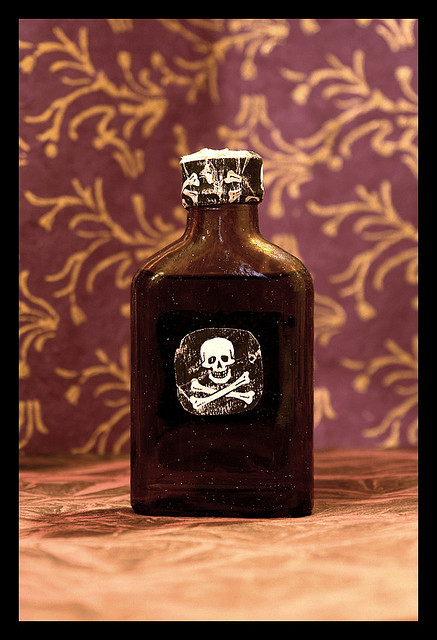
Image: Poison, a Creative Commons Attribution (2.0) image from -cavin-'s photostream

Maggie Koerth-Baker is the science editor at BoingBoing.net. She writes a monthly column for The New York Times Magazine and is the author of Before the Lights Go Out, a book about electricity, infrastructure, and the future of energy. You can find Maggie on Twitter and Facebook.

Maggie goes places and talks to people. Find out where she'll be speaking next.

MORE:  History • horrors • medicine • poison • Science

More at Boing Boing

Ants and Stars: Bruce Sterling and Jasmina Tesanovic visit the Sardinia Radio Telescope in Italy

The Snowden Principle

  • Michael Belcher

    I went on a field trip, in college, to the Hunterian museum last year. The park across the street is so nice, the building is very pretty, and the specimens… are all floating in glass jars. 
    The craziest thing though? The kid’s section. Not specimens of kids, but a special section set aside for small children filled with animal (mostly sea life) specimens, and different activities for them to do, like sketching specimens they found interesting. 
    That sounds great and all, but to get to the kid’s section one has to walk past the body parts, skeletons, abnormalities, and finally past the historical surgical instruments to get there. 

  • teapot

    There is a pic of said uterus in the linked article and it looks nothing like I’d imagine.
    http://thechirurgeonsapprentice.files.wordpress.com/2012/03/uterus2.jpg

    • Ultan

       Yeah, that does not look at all like a uterus – maybe just the inner lining. Uteri are extremely solid and dense, the consistency of a rubber ball.

      Far more noisome are ordinary placentae, which smell something like rotting liver, and are surprisingly big and ugly. Unlike most specimens, placentae are generally kept fresh for examination, with no formalin or alcohol. Pathologists often have to poke through placentas of miscarriages for fetal bits, though often none are found, even well into the 2nd trimester.

  • chgoliz

    How do they know she was specifically committing suicide as opposed to taking something she was told would cause her to abort?

    • http://thechirurgeonsapprentice.com Lindsey Fitzharris

      It’s true – it may have been an attempt to abort the baby, although arsenic was not typically used for this purpose in the 18th century. The story told is based on the facts listed in the surgeon’s casebook published in 1840. Thanks for reading! 

  • rattypilgrim

    Same old same old. Woman gets pregnant, takes the rap, footman walks off scott free.
    I would also hesitate to call a 1 month old fetus an unborn child unless you mean to meld minds with Pat Robertson, Michele Bachman, Rick Santorum, et al.
    chgoliz might be on to something. Abortions are as old as history and maybe that’s exactly what this poor woman was trying to accomplish. Imagine how much suffering would have been spared women (and their children raised in poverty) if they had birth control 200 years ago. Oh, the way things are going in 21st century USA we will be discussing the same scenario. Same old same old.

  • http://disqus.com/Kimmoth/ Kimmo

    Uh, the post had me waiting for my sensibilities to offended, yet there was nothing of the sort implied.

    • http://nelc.livejournal.com/ NelC

      I don’t know, the description of Mary’s hours of agony was pretty gruesome. Then there’s the whole ‘suicide or prostitution’ angle.

    • http://thechirurgeonsapprentice.com Lindsey Fitzharris

      This may be a bit more disturbing – books made from human flesh!  http://thechirurgeonsapprentice.com/2012/01/31/books-of-human-flesh-the-history-behind-anthropodermic-bibliopegy/

      • http://disqus.com/Kimmoth/ Kimmo

         There we go, thread’s delivered now.

        That’s the kind of wantonly abhorrent deal the headline and vibe had me expecting.

        • http://thechirurgeonsapprentice.com Lindsey Fitzharris

          This, too, is very gruesome (although remember – what has been read cannot be unread!)  http://thechirurgeonsapprentice.com/2011/10/04/cutting-for-the-stone-the-case-of-stephen-pollard/

          I’m the creator behind the website and am surprised this latest article has generated so much interest (but also very pleased!) It certainly is not one of the most horrifying articles I’ve written though. My aim was to bring a human face to the disembodied specimens at the Hunterian Collection. 

          Thanks for checking out The Chirurgeon’s Apprentice! 

  • http://www.facebook.com/profile.php?id=8834925 Chauncey Scott

    Is the history chilling, because you can feel it in your uterus? 

  • Ito Kagehisa

    Tae help the folk in medical school, word is passed around

    A body nae mair than ten days auld will bring in fourteen pound.

    It’s a terrible thing, but truth tae say,  in this age o’ greed

    A man’s worth little when he’s alive, but plenty when he’s deid.

    An’ it’s doon the close an’ up the stair

    Watch yer back for Burke and Hare

    Burke’s the butcher, Hare’s the thief

    And Knox the man that buys the beef.

    • rattypilgrim

       Creepy, scary. Where does this ditty come from?

      • chgoliz

        It’s an old English folk song (as opposed to an Old English folk song, which most people wouldn’t be able to read).