Features Podcasts Family Video Comics Music Tech Science Books Film & TV Games ✚

Jill

If you put all the water on Earth in one place

Maggie Koerth-Baker at 12:16 pm Thu, May 10, 2012

— FEATURED —

THE LATEST

Guatemala: Archive of documents from Rios Montt genocide trial, overturned 10 days after guilty verdict

Feature

Eurovision 2013: An American in London

Book Review

The Twelve-Fingered Boy - mesmerizing YA horror novel

Book Review

Black Code: how spies, cops and crims are making cyberspace unfit for human habitation

— FOLLOW US —

Boing Boing is on Twitter and Facebook. Subscribe to our RSS feed or daily email.


— POLICIES —

Except where indicated, Boing Boing is licensed under a Creative Commons License permitting non-commercial sharing with attribution


— FONTS —

Tweet
Kindle

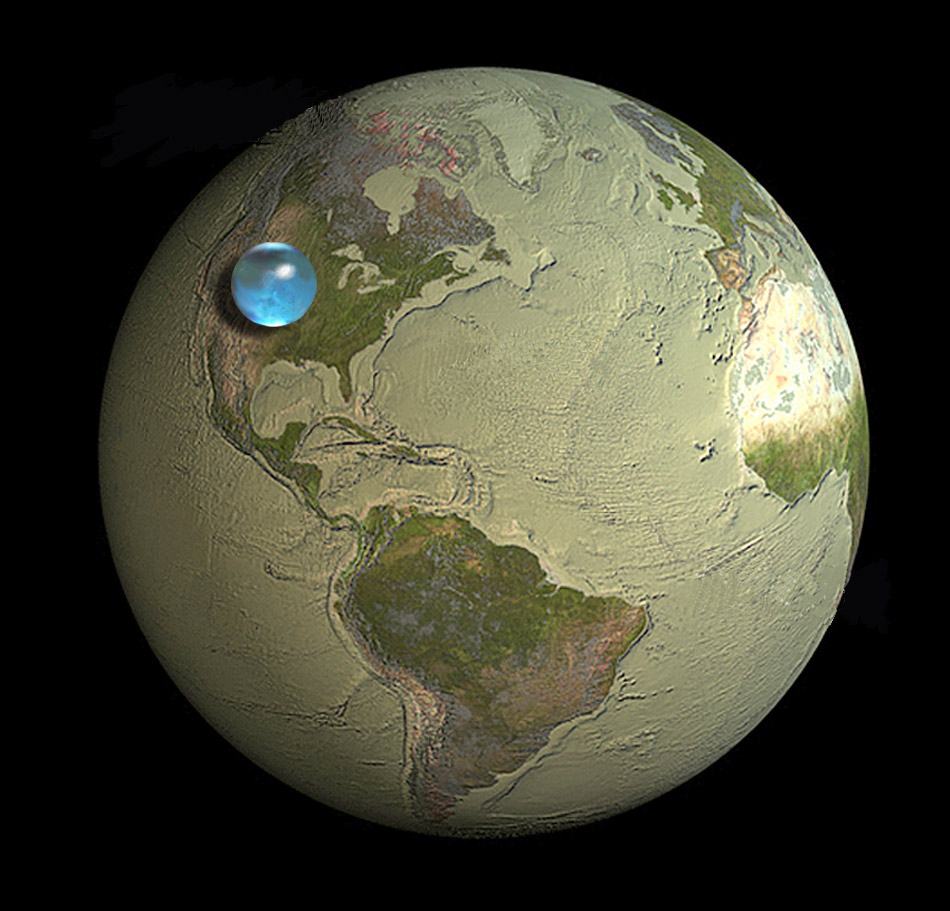
Put all the water on this planet into a single sphere and it would have a diameter of about 860 miles, says the United States Geological Survey. For reference, that's roughly the distance between Salt Lake City, Utah, and Topeka, Kansas.

About 70 percent of the Earth's surface is water-covered, and the oceans hold about 96.5 percent of all Earth's water. But water also exists in the air as water vapor, in rivers and lakes, in icecaps and glaciers, in the ground as soil moisture and earthgwaquifer.html, and even in you and your dog. Still, all that water would fit into that "tiny" ball. The ball is actually much larger than it looks like on your computer monitor or printed page because we're talking about volume, a 3-dimensional shape, but trying to show it on a flat, 2-dimensional screen or piece of paper. That tiny water bubble has a diameter of about 860 miles, meaning the height (towards your vision) would be 860 miles high, too! That is a lot of water.

I really like this illustration because it shows off an important concept: Whether a number represents "a lot" of something or "a little" is pretty damn relative. As the USGS says, that is, in fact, a lot of water. But it also makes for a surprisingly little ball.

Read more about this graphic and the water cycle on the USGS website.

Maggie Koerth-Baker is the science editor at BoingBoing.net. She writes a monthly column for The New York Times Magazine and is the author of Before the Lights Go Out, a book about electricity, infrastructure, and the future of energy. You can find Maggie on Twitter and Facebook.

Maggie goes places and talks to people. Find out where she'll be speaking next.

MORE:  earth science • Environment • information • Science • water

More at Boing Boing

Eurovision 2013: An American in London

The technology that links taxonomy and Star Trek

  • http://twitter.com/fossilfuels Funk Daddy

    Dont do that those people will drowned!

    • dmatos

       All the people between Salt Lake City and Topeka, Kansas?  Meh.

      (j/k)

      • http://www.facebook.com/profile.php?id=100001121924727 Donovan Correll

        Thats about 5 people lol

        • http://daruiburns.tumblr.com/ Dlo Burns

          not a big fan of Denver, huh?

    • dmatos

       All the people between Salt Lake City and Topeka, Kansas?  Meh.

      (j/k)

  • http://www.facebook.com/KBENBENEK Kurt Benbenek

    The big question is how much money did it cost the US taxpayers to have the United States Geological Survey discover the difference between a LOT of water and a LITTLE bit of water? Was this survey even necessary? What kind of tax money did it take to do this survey…a LOT of money or a LITTLE bit of money?

    • http://maggiekb.com/ Maggie Koerth-Baker

      Eye roll

      Do you seriously think the USGS did an entire new survey just to find out how big a ball you could fit all the water on Earth into? If you scroll down to the bottom, you will see that this is an educational page based on data that was collected in the 1980s. Finding out how much water there is present in Earth’s entire water cycle, and where it is stored, is an important thing to know. Finding new ways to present old information to help educate new generations of Americans is a useful thing to do and, for my money, an efficient use of resources.

    • acupunk

      I think the government does waste a lot of money as well but the USGS budget? I am more concerned with the trillions wasted bailing out Goldman Sachs and Bank of America and all the other too big to fail crap. Wanna save money? Cancel the Joint Strike Fighter which is slated to cost 1.51 Trillion dollars over the life of the program. The USGS is money well spent. 

    • lorq

      “Quick!  Someone mentioned government!  Immediately associate it with waste!  Buzz-words and faux-populist catch-phrases (“us normal tax-paying citizens…”) at the ready!  Let’s move out!”

    • koko szanel

      Go back to watching Dancing with the stars/”learning channel”

    • SamSam

      Yup. True that. It was just a “job creating” boondoggle with the USGS wasting tax-payer money. To be fair, they did create millions of jobs during that one hour where they had everyone rushing with buckets to collect all the world’s water and pouring it into that sphere for this stupid publicity photo-op, but since it was all over so quickly the jobs effect wasn’t lasting.

      Probably something Obama did to get better numbers for May…

      Putting all the world’s water in a giant sphere would have been something we’d let a private company do if we didn’t live in this Socialist government.

    • http://twitter.com/hinged_elephant Dave Messer

       Wow. How thick can you get?

  • bo1n6bo1n6

    I can’t quite swallow this stat… nope it won’t go down. Can someone explain this to me? It just looks wrong. If that little ball popped the whole earth would not get coated with vast amounts of water, just sayin’…

    • relawson

      I concur, i’ve seen it on a few sites this week and I still don’t really believe it. Surely someone put a decimal place in the wrong spot or something.

      • Ryan_T_H

        Nope, we just have a bad mental image of the size of the earth. Partly it is due to persistent inaccurate diagrams. You will almost never see any sort of planet/features diagram to scale because no interesting surface features would be visible. The entire surface of the world is a rounding error.

        To give an example, Challenger Deep, the deepest part of the ocean is roughly 10km. The radius of the earth is 6300km. So the biggest hole in the world represents 0.15% of the way to the center of the planet.

        I suspect that this picture is particularly jarring because the big wide ocean spread before us is the most massive thing most people will ever experience personally. It is probably the biggest thing most people will ever fit into their mental worldview. So to see it reduced like this is stunning.

        • http://disqus.com/Kimmoth/ Kimmo

          I know the thing about the flatness of the planet, but it still blows my mind.

    • Ihavenofuckingname

       If you consider that the average depth of the ocean is about 12,000 ft, then consider that 12,000 ft is just over 2 miles, it starts to make more sense.

      The average depth of the ocean is literally a 0.25% sliver cut from that ball, which is 860 miles wide!

      Though I agree, it’s hard to wrap my head around too.  I think it’s difficult to get a true sense of scale.  If the earth were reduced to globe size, the ocean would be shallower than the sheen of water on your windshield after it rains.

      • Glen Able

        Interesting.  I reckon an A3 sized sheet of kitchen tinfoil has roughly the right dimensions for a model – i.e. if you could fold that sheet round to make a sphere, the thickness would be pretty much the right scale for the average depth of water on Earth.

        Then if you scrunched it up, you could get that nice little ball.

      • http://twitter.com/incarnedine_v Dan Hibiki

         yeah but it all adds up to more then 1,338,000,000 kilometers cubed.

    • planettom

       well, keep in mind the sphere extends 860 miles above the surface of the Earth.  That’s 4 times the height the space station is orbiting at.

    • bzishi

      The Earth has a radius of about 6371 km, has 71% of the surface covered by oceans with an average depth of 3.79 km (0.06% of the radius). By contrast, if you took a basketball (radius of about 122 mm by my calculation), and coated it with water the same way as the Earth, the average depth would be 73 microns (about the thickness of a single hair).

      If you took that same basketball, dipped it in water and then shook it off as hard as you could, you would almost certainly have more water in proportion than the Earth does. The Inner Solar System is not particularly nice to water. Most water is blown out of the Inner Solar System past the ice line where the gas giants form. Any water that remains must be protected against the solar wind. On Earth we have our planetary magnetic field. That collapsed on Mars which is why it has almost no atmosphere and no surface water.

      • C.J. Hayes

        Blast, you took my analogy before I could visualize it!

    • http://tortoise-brand-pot-scrubbing-cleaner.myopenid.com/ Mister

      In reality, the water-to-rock ratio is even smaller than this illustration makes it look. Part of the problem is that you’re looking at a 3-dimensional representation of data on a 2-dimensional screen. This distorts the data far more than you might realize, and makes small quantities look much, much larger relative to larger quantities. In essence, you’re looking at the cube root of the volume of water on Earth versus the cube root of rock on Earth.

      In other words, if you plot the volume of water on the Earth and the volume of the Earth on a bar chart, so that you get a linear representation that is easier to realize accurately in a 2-dimensional medium, the volume of water will look even smaller. By choosing to plot the data as spheres, the USGS unintentionally made it look like the water-to-rock ratio is actually larger than it really is.

      The only data that should be plotted in three dimensions is data that actually has three dimensions. And no, I don’t mean that it should have units of volume, I mean that it should have three separate quantities plotted on three separate axes. USGS sacrificed accuracy to make a dramatic illustration. That is not necessarily wrong, but from a scientific standpoint this illustration is pretty useless.

    • http://tortoise-brand-pot-scrubbing-cleaner.myopenid.com/ Mister

      In reality, the water-to-rock ratio is even smaller than this illustration makes it look. Part of the problem is that you’re looking at a 3-dimensional representation of data on a 2-dimensional screen. This distorts the data far more than you might realize, and makes small quantities look much, much larger relative to larger quantities. In essence, you’re looking at the cube root of the volume of water on Earth versus the cube root of rock on Earth.

      In other words, if you plot the volume of water on the Earth and the volume of the Earth on a bar chart, so that you get a linear representation that is easier to realize accurately in a 2-dimensional medium, the volume of water will look even smaller. By choosing to plot the data as spheres, the USGS unintentionally made it look like the water-to-rock ratio is actually larger than it really is.

      The only data that should be plotted in three dimensions is data that actually has three dimensions. And no, I don’t mean that it should have units of volume, I mean that it should have three separate quantities plotted on three separate axes. USGS sacrificed accuracy to make a dramatic illustration. That is not necessarily wrong, but from a scientific standpoint this illustration is pretty useless.

    • http://tortoise-brand-pot-scrubbing-cleaner.myopenid.com/ Mister

      In reality, the water-to-rock ratio is even smaller than this illustration makes it look. Part of the problem is that you’re looking at a 3-dimensional representation of data on a 2-dimensional screen. This distorts the data far more than you might realize, and makes small quantities look much, much larger relative to larger quantities. In essence, you’re looking at the cube root of the volume of water on Earth versus the cube root of rock on Earth.

      In other words, if you plot the volume of water on the Earth and the volume of the Earth on a bar chart, so that you get a linear representation that is easier to realize accurately in a 2-dimensional medium, the volume of water will look even smaller. By choosing to plot the data as spheres, the USGS unintentionally made it look like the water-to-rock ratio is actually larger than it really is.

      The only data that should be plotted in three dimensions is data that actually has three dimensions. And no, I don’t mean that it should have units of volume, I mean that it should have three separate quantities plotted on three separate axes. USGS sacrificed accuracy to make a dramatic illustration. That is not necessarily wrong, but from a scientific standpoint this illustration is pretty useless.

      • chenille

        Think of this, then, as a great illustration of how much more a thin layer on the outside contributes to the volume of a planet than a layer at the core.

        For instance, it’s intuitive to think Neptune is mostly rock and ice because they fill up most of its cross-section. After seeing this, it might be easier to imagine how the outer gas could still be more prominent.

      • ocker3

         I wonder if it would work better if the sphere of water was put Next to the earth instead of partly in front of it?

    • C.J. Hayes

      I’m not a scientist, and I’ve been trying to wrap my mind around this too.  So…

      I’m envisioning a basketball.  It’s porous, and I know that the depth of most of the water on Earth is comparably minor, maybe akin to the depth of a pore on a basketball.  That amount of water looks like it might fit in a shot glass or two (using the Earth scaled down to the size of a basketball). I can believe being able to cover the outside of a basketball, or maybe 70% of it, with that amount of water.  It might only be just enough to leave it wet without visible pools of water, but the majority of water on Earth is essentially that.

    • http://twitter.com/kpkpkp Kevin Pierce

      As compared to the sphere of rock, the oceans are really not that deep.   

      Here’s an Earth-scale riddle:   
      Assume Earth is a dry uniform sphere and you have run a string around the entire equator – difficult to do, as you are ‘squaring the circle’.   That string has a certain ‘known’ length.   

      How much *longer* would the string need to be to uniformly elevate it 1″ from the surface, all the way around?

      • http://twitter.com/outdoorhabit Doug Lipinski

        2*pi, i.e. ~6.28, inches. duh.

        L1=2*pi*r, L2=2*pi*(r+1″), L2-L1=2*pi*r-2*pi*(r+1″)=pi*2″

        • http://twitter.com/kpkpkp Kevin Pierce

          Mmmm…. pi….

  • http://twitter.com/kpkpkp Kevin Pierce

    The dose makes the poison.

    • Antinous / Moderator

      In the vessel with the pestle?

      • retepslluerb

        No, the flagon with the dragon.

      • http://twitter.com/kpkpkp Kevin Pierce

        My sarcastic gist: Without or with a different sized drop of water accumulating on the 3rd rock, the solar system (universe?) would be safe from Earth’s toxic side effects (us).

  • http://twitter.com/AntiBoredomTeam Dan Century

    That’s amazing! There really isn’t that much of it, is there. :(

    • Donald Petersen

      Well, from an ecological conservation standpoint, yes.  One could also say that the volume of the Earth is much, much larger than our brains tend to imagine.  If the Earth were made of styrofoam, and you tunneled down a mile, then started tunneling laterally and carving out buildings, streets, trees, hills, and valleys, you could end up with subterranean continents with an area of more than 99% of the planet’s actual surface area.  And then you could tunnel down another mile and do it again. And again.  And again.  Each of those under-Earths would be only slightly smaller than the one above it.

      The volume that we actually inhabit of the planet is quite tiny indeed compared to the uninhabited volume.

  • drongo

    It looks like it’s about the size of one of those Saturnian moons which is just a big ball of ice. I never realised just how little of the water in the solar system is on Earth.

  • nowimnothing

    I would like to see a similar one with the volume of the atmosphere. I know that one gets hazy in the boundaries but it would be a good illustration of how little air and water we really have and how easy it is for us to affect it.

    • KaiBeezy

      also
      .
      oil
      people
      ants
      diamonds

    • Mark Dow

      All atmosphere at surface pressure would fit in a sphere roughly twice the diameter of the water sphere (8 x the volume). The scale height of the atmosphere is roughly 10 km, where the average depth of ocean is roughy an eighth of this.

  • http://profiles.google.com/stephen.schenck Stephen Schenck

    Shouldn’t the Mueller device be filled with red fluid?

  • http://profiles.google.com/stephen.schenck Stephen Schenck

    Shouldn’t the Mueller device be filled with red fluid?

  • http://www.facebook.com/profile.php?id=1444195588 Aaron David Cole

    No such thing as a water shortage on the Earth. Venus on the other hand, there’s a water shortage on that planet.

    • http://www.tumbleweed.net/ tyger11

       There’s a FRESH water shortage on Earth. Big difference.

    • Antinous / Moderator

      Not according to CS Lewis.

  • Jim Moskowitz

    Little?? That is an amazingly huge ball, compared to say, the total amount of all animal life on Earth (including humans), which would fit into a ball five miles in diameter – almost invisible next to the size of that water sphere!

    • Donald Petersen

      That would be a very entertaining katamari to see.  From a safe distance.

    • http://profile.yahoo.com/OMHO6ER5QJE3SIZ35VAXIRCLYM Stephan

      According to my calculation all humans would fit into a sphere no bigger than 1200m in diameter. That is if you squeeze them really tight of course.

  • Glen Able

    Actually, that picture isn’t from the USGS.  It was from a presentation at the White House showcasing the Bush administration’s vision for the future.

  • Nihir Vedd

    but the volume of the water on earth is massive… I still don’t believe the 860miles..
    http://hypertextbook.com/facts/2001/SyedQadri.shtml 

    • bzishi

       1.37 billion cubic km of oceans per your link. Using V=4/3 * pi * r^3, you get a radius of 689 km which converts to a diameter of 856 miles. The real value will be slightly larger due to glaciers lakes and rivers, so this value is very plausible.

      • wysinwyg

        Got confused by the quick switch from radius to diameter, but bzishi is right.  Do the math before you decide what makes sense and what doesn’t.

        • http://www.lightning-rose.com/ LightningRose

           What are you, some kind of bleeding heart liberal?

  • Ihavenofuckingname

    That’s not all the water on earth.  It’s a space station.

    • Donald Petersen

      Designed by Ackbar himself, no doubt.

      • gullevek

        It’s a trap!

  • Teller

    Okay, but how big would ball of land be?

    • http://www.tumbleweed.net/ tyger11

       Well, once you take away the water, 100% of what’s left. Just squish it down until it’s a perfect sphere.

  • http://twitter.com/LennStar_de LennStar

    And after watching that, think about that 99% aren’t usable as drinking water.
    Now think about what we do with drinking water.

    I don’t talk about uses like drinking ;) More the things like “put tons of very poisenous something in it”.
    First one is no big problem, it goes up and comes down as rain and *could* be distributed that it is enough for everyone.
    But in the second case the poison remains.

    • jackbird

       Not that water pollution isn’t a huge problem, but generally when the water evaporates to take another turn around the water cycle, the poisonous stuff mixed into it in the liquid phase is left behind.

  • Linosolas

    Reminds me about of this story about the 2 sailors…they were looking at the water and one says “that’s a lot of water out there”… and the other guy says “yeah, that’s just the top of it.”

  • http://home.earthlink.net/~ironybread Taylor Jessen

    Out of curiosity, is that sea-bed a false color representation, or is the bottom of the ocean really that clammy shade of beige?

    • penguinchris

      It’s probably fairly accurate. The ocean floor is covered with a layer of silt/clay, calcium carbonate, etc., all of which are drab brown or grey in color. When things erode and get washed out to sea, the beach is where sand-sized particles get stuck, and everything finer-grained gets washed out further. If you look at sand with a magnifying glass the individual grains (which are a variety of different minerals) are actually quite colorful, but as a whole it’s beige, and it’s the same story for finer-grained stuff.

      If I was to guess what the color would be before looking at this image, I would have come up with something a little darker and more grey, but while I am a geologist I’m not that familiar with oceanography type stuff :)

      Note how much detail went into coloring on the continents – all water, snow, and ice are removed from this representation and what you’re seeing are the colors of the rock where it would be exposed and of the vegetation. They didn’t just slap the ball of water on a pre-existing model of the earth, they put some thought into it :)

  • http://www.facebook.com/people/Jeff-Ritzmann/1532420118 Jeff Ritzmann

    Maggie- do we actually know the depths of certain parts of the ocean? I didn’t think we actually knew some of the accurate depths – in which case could we tell the volume that occupies those areas?

    • penguinchris

      The depth of the ocean is, for the most part, quite well known. Multiple ship-based surveys have mapped it out, starting in WWII (and there’s an interesting science history story there). You can use remote-sensing satellites now, too.

      Of course it isn’t perfect, but it’s more than good enough for these types of rough calculations :)

      • http://www.facebook.com/people/Jeff-Ritzmann/1532420118 Jeff Ritzmann

        Learn something new every day. Thanks for that Chris.

  • kennapea

    it begs the question: why would you do that? that really doesn’t sound like a fun idea. also, where would the octopuses sleep? 

    • Donald Petersen

      Down in the deep, where octopodes we keep.

  • http://avarana.blogspot.com MarlboroTestMonkey7

    It’s the Wet Star

  • Kevin

    I did the math.

    Area of the surface of the Earth is (7962 miles diameter):  A= 4 * pi * r^2
    4* pi*(7962/2)^2 = 197.4 million square miles of surface.

    Volume of the ball of water: V=4/3 * pi * r^3
    4/3*pi*(860/2)^3 =  333 million cubic miles of water.

    if the ball of water was placed over the full surface of the Earth,

    333 million cubic miles/197.4 million sq miles = 1.7 miles deep of water.

    NOAA says the average depth of the ocean is 2.65 miles.

    When you account for all of the land mass on the planet, these calculations sound about right.

  • gullevek

    860 miles is 1,384 km. For the rest of the world.

  • http://profiles.google.com/chudez Ted Bautista

    Can someone make a similar Katamari Damacy ball composed of the number of people on the planet? I’ll get my deathstill ready.

  • http://www.facebook.com/kyle.hinshaw.9 Kyle Hinshaw

     So if I were on a boat floating 860 miles in the exosphere above say San Francisco, I might be able to make out Dallas, TX on the horizon if the water were transparent enough to see through? 

  • http://homepage.ntlworld.com/karnuvap/ Karnuvap

    Seen it already (less US-Centric version)
    http://www.sciencephoto.com/image/159214/530wm/E0550330-Global_water_and_air_volume-SPL.jpg

  • Lord Humongous

    Mandrake, water is the source of all life.  Seven tenths of this earth’s surface is water.  Why, you realize that seventy percent of you is water.

    • Antinous / Moderator

      Bi-la kaifa.

  • Antonin Caors

    putting stuff in a ball to make easier comparison is sometimes surprising… let’s try with mankind:
    it is not hard to put n people in a telephone booth that has volume V°.
    Roughly, take n=20 people and V°=1m x 1m x 2m = 2 cubic metres.
    Let N be earth’s population (say, N=7 billions). you’ll need N/n phone booths, hence the total volume V:
    V = V°.N/n
    If that were a sphere, we’d have
    V=4/3 . pi.R^3.
    Thus, R^3 = (3 N V°)/(4 Pi n).
    Feeding the numbers therein yields:
    R = 551 m (=1807 ft and 1″ for you non-metric barbarians ;-) )
    -> Entire mankind, stacked as compact as in a phone booth, would easily fit in a sphere 1km accross…

  • http://www.facebook.com/marcola Marco Henry Lapka

    Of course the US would take it all too!-P

  • jackbird

    What’s the focal length of that lens, assuming the water was perfectly clear?   Would we be able to burn a hole in the nearly-full moon?

  • http://www.facebook.com/daen.de.leon Daen de Leon

    Not true.

    I’ve just read a Nature review of a new book by Robert M. Hazen (“The Story of Earth”, Viking Books) which quotes studies showing that that there is many, many more times more water stored in the earth’s mantle than in the oceans. The USGS data on which the graphic is based was drawn up in 1984, before those studies were done.

    http://www.nature.com/news/2002/020308/full/news020304-10.html

    • joelwilliamson

      The source that the USGS graphic is based on (Shiklomanov’s “World Water Resources”) is careful to note that it only discusses “free water existing in liquid, solid or gaseous state in the atmosphere, on the Earth’s surface and in the crust down to a depth of 2000 metres.”

      The issue then is that an infographic for popular consumption does not contain all the caveats one expects in an academic source.

  • http://twitter.com/cfmceroz DJango cfMC FEROX

    the problem here is that the USGS site itself clearly says it’s “all the water on earth,” but the data source at the bottom of the photo on the same USGS site says the data source is a study about FRESH WATER not all the water….

  • http://twitter.com/cfmceroz DJango cfMC FEROX

    “The sphere includes all the water in the oceans, seas, ice caps, lakes and rivers as well as groundwater, atmospheric water, and even the water in you, your dog, and your tomato plant.”  BUT ALSO:  ”
    Data source: World fresh water resources” 1993, Water in Crisis: A Guide to the World’s Fresh Water Resources” 
    http://ga.water.usgs.gov/edu/2010/gallery/global-water-volume.html

    • joelwilliamson

      Page 4 of the Shiklomanov paper cited at that address: “Current estimates are that the Earth’s hydrosphere contains a huge amount of water, about 1386 million cubic kilometres. However, 97.5% of this amount are saline waters and only 2.5% is fresh water.”

      Before making a claim that a particular datum is not in some source, it is wise to at least read the paper’s introduction.

  • http://www.facebook.com/gipors Gipors Lee

     Just so little!

  • mobuco

    i don’t like the government wasting tax money, but i would like them to waste tax money on something…is what you just said

  • http://stephan-zielinski.com/ Stephan Zielinski

    Don’t forget to sneer at the volcano monitoring.

  • http://rhinocrisy.org/ saurabh

    The 2012 USGS budget, easily discovered: $1.1 billion.

    Line item in 2012 USGS budget for “water resources”: $199 million.

    Radius of bubble of bottled water (consumed in 2008): 188 m.

  • wysinwyg

    Read this: http://www.wired.com/dangerroom/2012/03/f35-budget-disaster/

    And try to get some perspective on just how little US taxpayer money is spent on useful basic scientific research compared to the trillion dollar defense boondoggles like the F35.