Features Podcasts Family Video Comics Music Tech Science Books Film & TV Games ✚

Jill

What's your diameter breast height?

Maggie Koerth-Baker at 4:30 am Mon, May 28, 2012

— FEATURED —

THE LATEST

Guatemala: Archive of documents from Rios Montt genocide trial, overturned 10 days after guilty verdict

THE LATEST

Guatemala: Nation's highest court throws out Ríos Montt genocide trial verdict and prison sentence

Feature

Eurovision 2013: An American in London

Book Review

The Twelve-Fingered Boy - mesmerizing YA horror novel

Book Review

Black Code: how spies, cops and crims are making cyberspace unfit for human habitation

— FOLLOW US —

Boing Boing is on Twitter and Facebook. Subscribe to our RSS feed or daily email.


— POLICIES —

Except where indicated, Boing Boing is licensed under a Creative Commons License permitting non-commercial sharing with attribution


— FONTS —

Tweet
Kindle

Scientists measure trees for a wide variety of reasons. When I visited the Harvard Forest last week, I measured them as part of studying carbon sequestration by plants. But you can't just go out into the woods with any old tape measure and expect to collect some significant data.

That's because where you measure the tree matters. If you want to compare the diameters of two trees, you have to make sure you're measuring them in the same place. If you measured one tree at the wide base and the other further up the trunk, where trees usually get narrower, the comparison wouldn't mean much.

That's where diameter breast height (DBH) comes in. It's a way of standardizing the measuring process.

As the name implies, DBH is meant to be a diameter measurement of a tree trunk taken at, roughly, breast height on an adult. Of course, where exactly "adult breast height" is varies greatly from person to person. So DBH has been set to a standard height—1.4 meters in the United States.

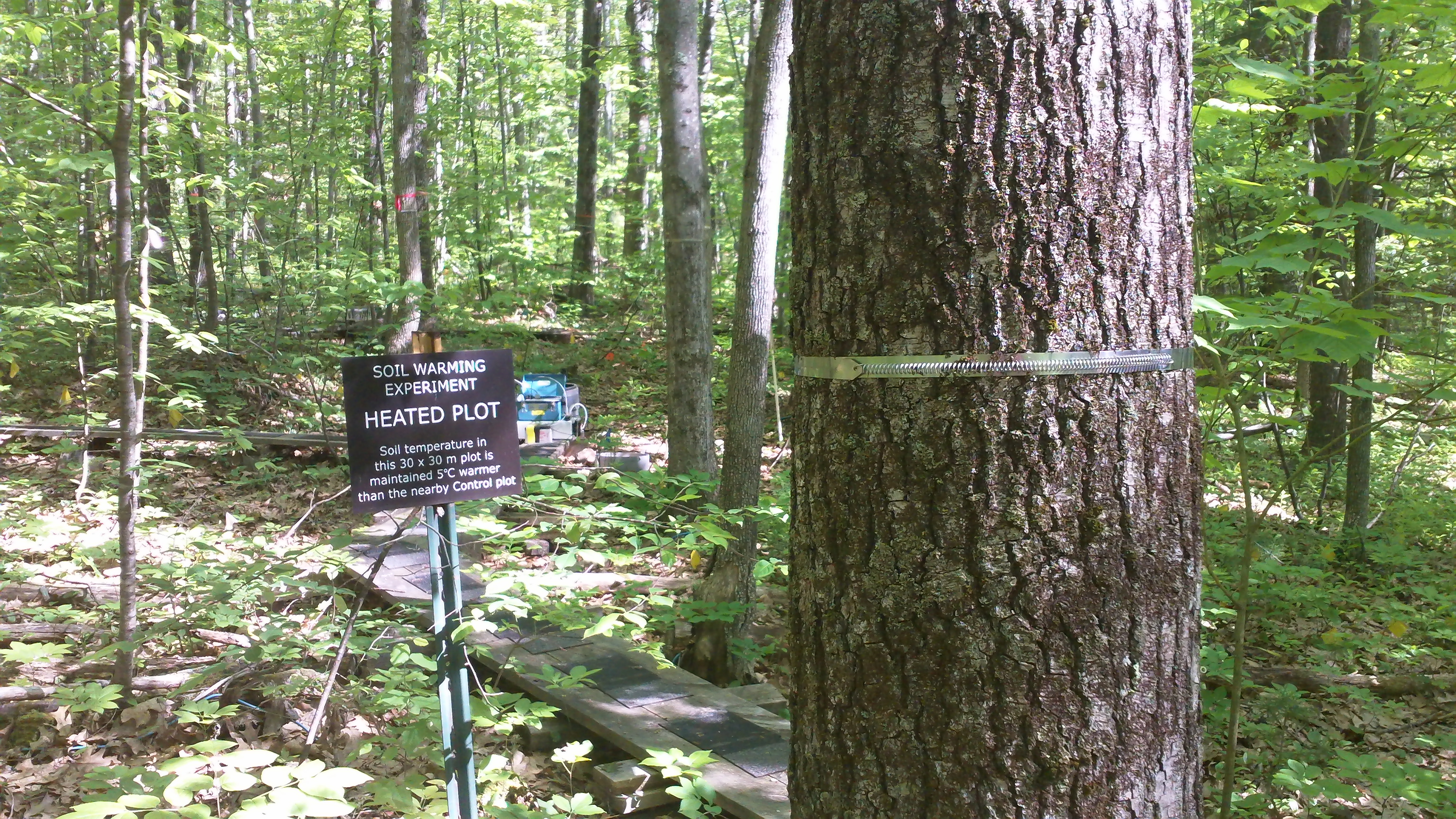
In a research forest, you'll often see some kind of marker on the trees showing where this official "breast hight" is, so people can quickly move through the woods, taking diameter measurements, without having to measure vertically on each tree. In some cases, DBH is marked with yellow spray paint. In others, metal bands. These metal bands actually help measure diameter, too. Set with springs, the bands expand as the tree does, so all researchers have to is measure the distance between two dots on the band and see how far apart the dots have moved since last time.

Read all the Dispatches from Harvard Forest

Maggie Koerth-Baker is the science editor at BoingBoing.net. She writes a monthly column for The New York Times Magazine and is the author of Before the Lights Go Out, a book about electricity, infrastructure, and the future of energy. You can find Maggie on Twitter and Facebook.

Maggie goes places and talks to people. Find out where she'll be speaking next.

MORE:  behind the scenes • ecology • Harvard Forest • MBL Science Journalism Fellowship • Science • trees

More at Boing Boing

Eurovision 2013: An American in London

The technology that links taxonomy and Star Trek

  • Paul Renault

    Er… “adult breast height” also varies greatly from 18 to 80, no?

  • snagglepuss

    Metal bands have been known to measure more than one babes, er, “diameter” as well.

  • t3kna2007

    > If you measured one tree at the wide base and the other further up the trunk, where trees usually get narrower, the comparison wouldn’t mean much.

    See also Adenium obesum, the Desert Rose tree of Socotra island, featured in a recent National Geographic  issue.

    http://www.birdsofkuwait.com/blog/wp-content/2008/12/desert_rose.jpg

  • http://pulse.yahoo.com/_EEMBEZWHDPEKERFVN5G6QAJAFY jeb

    This reminds me of the time I needed a table of a certain height.  It had to be taller than the usual coffee table(18-21″), but shorter than a table of normal height (31″).

    I was looking for a ball-height table.  I walked through a number of antique and second-hand stores surreptitiously standing way too close and personal to likely candidates.

    • Beanolini

      “I surmise, Watson, that this print was left by a man of lower than average height… or one with a very saggy scrotum”.

      The standardised DBH reminded me of the standardised ‘present time‘ in archaeology. As this was 1950, we are currently 62 years in the future, and accelerating gradually away.

      • dragonfrog

        Maintaining a constant speed, I should think, not accelerating?

        • Beanolini

           Well, yes. But that doesn’t sound as good, does it?

      • TWX

        I really hope that he was not wearing a kilt when making this measurement…

    • http://www.jjsaul.com Jim Saul

      Careful about that height. I recently regretted that a table in my workroom is just that height when a drill bit got caught in a pine knot, making the wood whipspin around to give me a resounding sack-smack before I could react.

    • pjcamp

       I think I know what *you* were up to.

  • Wishbones

    Variable radius sampling by means of a glass prism is an interesting part of the timber cruiser’s job, I’ll let wikipedia explain: 
    http://en.wikipedia.org/wiki/Wedge_prism

  • Mark Johnstone

    As a trainee rural chartered surveyor, I was taught how to value a standing forest. We had special tape measures that were marked with DBH units rather than the circumference – i.e. they had already divided the circumference measurement by pi so that you could shout out the number to your colleague to record it. 

    We also measured top heights with a hooked tape measure attached to a belt – hooking the tip into the bark of a tree we would stride away from it for, say, 50m and then use a clinometer aimed at the top of the tree to give a Tan multiple to be applied to the horizontal distance to calculate the top height. 

    By measuring the DBH of every 10th tree or so and using a simple average, together with the average top height for every 30trees or so and the planting density, you could use species dependant tables to calculate the volume of standing timber in the forest. You also got to spend a summer’s day walking though the shady woods which was very nice indeed.

  • leaded

    i recently learned about dbh the hard way.  the maple tree in our front yard in toronto has a dbh such that we had to give the city a $15000 deposit so we could renovate our front porch. 

  • http://imcravingpresidency.tumblr.com/ SedanChair

    I’m here because somebody said “breast”

  • http://www.aarongilliland.com/ Aaron Gilliland

    I am reading this.

  • chgoliz

    1.4 meters = 4.6 feet (a little over 55″).

    Average height for a woman: 5’6″ (66″).

    I am 5’6″.  1.4 meters hits me at my throat.

    In other words, the standard is set to be breast height on an adult man, not an “adult”.

    • Antinous / Moderator

      Actually, a 6′-2″ adult, which is considerably taller than the average man.

      • chgoliz

        I see….so we’re look for a Dutch man as our standard.  (I think the Germans are right behind them in terms of height.)

  • foobar

    There’s a simpler solution that marking all the trees: buy a plain t-shirt, and mark on it where your breasts should be.

  • pjcamp

    Joke parade:

    1. Adult trees got boobs?

    2. I think all adults should go with metal bands around their breasts.

    3. Seems like a 1.4 m tall stick would be in order. With a tape nailed to the end.

    4. Or a 6’2″ naked woman .. um .. research assistant.

    5. When you band a tree, do you catch them again on the next migration?

    I’m here all night, folks.