Features Podcasts Family Video Comics Music Tech Science Books Film & TV Games ✚

Jill

Typecasting in the typosphere

Cory Doctorow at 2:50 pm Tue, Jun 19, 2012

— FEATURED —

Book Review

The Man Who Laughs: grotesque Victor Hugo potboiler was the basis for The Joker

Feature

Eurovision 2013: An American in London

Book Review

The Twelve-Fingered Boy - mesmerizing YA horror novel

— FOLLOW US —

Boing Boing is on Twitter and Facebook. Subscribe to our RSS feed or daily email.


— POLICIES —

Except where indicated, Boing Boing is licensed under a Creative Commons License permitting non-commercial sharing with attribution


— FONTS —

Tweet
Kindle


In Salon Jessie Schiewe writes about the "typewritter renaissance" -- the re-discovered delights of working on typewriters, or at least disassembling them for their parts.

Max likes to scan the documents he writes on his typewriter and post them to his blog. He’s not the only one who’s discovered this quirky pastime. Aficionados call it typecasting and they’ve named their Internet subculture “the typosphere.” According to a blog of the same name, it is “a term for bloggers who collect, use, and otherwise obsess over typewriters and other ‘obsolete’ technologies.” The site lists more than 80 typecasting sites, three typewriter-themed Yahoo! groups (with a collective membership of nearly 4,000 people) and one Facebook group.

Sporting clever names like “I dream lo-tech,” “Type Clack,” “Iron and Ribbon” and “Typesmitten,” most typecasting forums are typical fan sites that allow people to post comments on favorite models and recent acquisitions. Other sites, like 17-year-old Matt Cidoni’s Adventures in Typewriterdom, are more like personal blogs with posts about getting his driver’s license, senior prom and break-dancing.

Matt became interested in typewriters when he was in the seventh grade. “I thought it was fascinating,” he said in a phone interview. “I love how it’s right in front of you the minute you hit a key. You don’t have to wait for it to print, nothing crashes, and you don’t have to worry about power outages.”

Time for a typewriter renaissance?

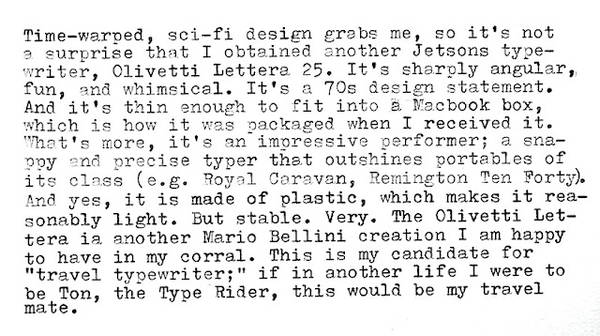
(Image: I dream lo-tech)

I write books. My latest is a YA science fiction novel called Homeland (it's the sequel to Little Brother). More books: Rapture of the Nerds (a novel, with Charlie Stross); With a Little Help (short stories); and The Great Big Beautiful Tomorrow (novella and nonfic). I speak all over the place and I tweet and tumble, too.

MORE:  Gadgets • Old school • web theory

More at Boing Boing

Eurovision 2013: An American in London

The technology that links taxonomy and Star Trek

  • http://twitter.com/jmtd Jonathan Dowland

    I’m sure there was something similar — a post-it note fad — ages ago.

    Edit: oh yeah, Nine Inch Nails did this for ages too, here’s an archive of their old typecast Q&As: http://www.ninwiki.com/Nin.com/access

    • Doug Black

      Do you suppose hipsters will resurrect Morse code next?  “Oh, that is so -.-. — — .-.. !” 

      • http://twitter.com/writebastard Ian Wood

         Resurrect? It’s not dead.

        -KB2GBV

        • http://idreamlo-tech.blogspot.com/ TON S.

          My thoughts exactly!

        • Doug Black

          I suppose ‘resurrect’ isn’t the right word.  It’s just that “engineer a resurgence in the popularity of” sounded too wordy.

  • Chris Pencis

    A typewriter renaissance post should also mention artists using them beyond type Example - 
    http://mariancall.com/ using typewriters in her performances…

  • martinhoward

    I love the phrase and idea of Typecasting in the Typoshpere.

    The indelible mark of the typewriter is alive and well, a generation past the appearance of the PC .

    This renaissance towards the typewriter with gatherings, expressions, and collectors warms my heart, as I know that I am not alone.

    I have been collecting 19th century typewriters for 20 years and the party is going strong.

    Cheers,
    Martin Howard

    http://www.antiquetypewriters.com

  • hymenopterid

    You should try my Martinelli.

    • Antinous / Moderator

      It really creeps me out when I hear an actor’s voice suddenly speaking in my head.

  • Boundegar

    Typewriters cannot be hacked.  Typewriters have no tracking cookies, and the NSA does not have a back door to your typewriter.  Law enforcement views them with suspicion today, perhaps moreso tomorrow.

    In accounting circles, a W-2 that is typed is considered a sign of fraud.  Perhaps rightly so, but still.  When typewriters are outlawed, only outlaws will have typewriters.

    • retchdog

      well it’s a convenient way to assert that fraud has gone down by thousands-fold in the past few decades.

    • http://twitter.com/matcatastrophe mat catastrophe

      Hey, wait. I’ve seen Columbo or whatever, you can totally trace something back to whatever typewriter it came from.

      No cookies, indeed.

      • http://twitter.com/BonzoDog1 BonzoDog1

        Single-strike carbon ribbon cartridges (like those used in the IBM Selectric) could be hacked, but the reversible cloth ribbons used in older typewriters would be tough.

    • sam1148

      When HIPAA rules came out one was that typewriter ribbons had to be shredded/destroyed, to prevent mythical people from taking a ribbon and getting information from it.

      • pKp

        Bruce Sterling begs to differ on the “mythical” part…
        “In one case, a tiger team of Arizona cops had trashed a local residence for four months. Every week they showed up on the municipal garbage truck, disguised as garbagemen, and carried the contents of the suspect cans off to a shade tree, where they combed through the garbage — a messy task, especially considering that one of the occupants was undergoing kidney dialysis. All useful documents were cleaned, dried and examined. A discarded typewriter-ribbon was an especially valuable source of data, as its long onestrike ribbon of film contained the contents of every letter mailed out of the house. The letters were neatly retyped by a police secretary equipped with a large desk-mounted magnifying glass.”
        STERLING B., The Hacker Crackdown.

    • Yacko

      Outlaws beware. Not so anonymous. Typewriters have font idiosyncrasies that makes them easy to trace whose machine was used to write what. Classic pre-1990 FBI detective work.

  • David Carroll

    I just finished listening to guest John Irving on Wait Wait… Don’t Tell Me!  He was using manual typewriters but tired of being a typewriter mechanic.  Now he’s back to longhand. “There’s very little that can go wrong with a pen.”

    • Doug Black

      His editor must hate him. 

  • DJ Tilley

    I’ve wanted to get a typewrite for a while, by the time I was old enough to learn to type they had been almost entirely phased out.  I’m just not sure which ones are the best value/still have ribbons being produced.  And I don’t want an electronic one, that seems to defeat the point of using one in a computerized era.

    • http://profiles.google.com/mpclemens Michael Clemens

      DJ, I’d suggest looking for a vintage machine before buying a recently made one (recent being 1970s onward.) In the U.S., a Smith-Corona portable typewriter from the 1950s would be a good starter machine: they’re plentiful (thus cheap), durable, and smooth, and have held up well over the decades. Summertime is a good time to hunt them down at yard sales and church bazaars. Some makes have plastic or rubber parts that haven’t withstood the test of time so nicely. Look for names like “Sterling”, “Super” and “Silent-Super.”

      Steer clear of machines that are mostly plastic bodies, or are being marketed a new. They are poor shades of their forebears, and not at all worth the money. You should be able to locate a decent portable machine for around $25, or even less. And when you find one, swing by the Typosphere. We’re friends to all Happy Mutants.

      • DJ Tilley

        Thank you!  This is great advice, I’m excited to start looking!

  • Joe Feldman

    In Victoria, BC  there is still a shop that repairs and sells typewriters. It’s called the Type N Write shop. Quadra near Hillside.

  • Frédéric Eloy

    this is really north american to fetish these recent technologies…

    get to some real old school blacksmithing shit you pussies!

  • http://twitter.com/ErnestValdemar Ernest Valdemar

    I learned “keyboarding” on an IBM Selectric, and got through college on a manual Olivetti portable. After I graduated, I got hold of a beautiful 30s-vintage Royal that was a joy to write on.

    Even though I make my living today as a writer (technical documents and training materials), I haven’t written passable fiction or poetry since I switched to computers in the late 80s. (One of my cherished memories is the three days I spent on that Royal cranking out a Kerouac-inspired stream-of-consciousness memoir of a single weekend spent in Kalamazoo.)

    Maybe someone could come up with a typewriter equivalent to MIDI, so I could bang away clickety-clickety-clickety on a manual typewriter and have my analog output digitized in real time.

    • http://profiles.google.com/mpclemens Michael Clemens

      Ernest, Google “USB Typewriter” and you’ll (almost) find what you were looking for.

  • http://idreamlo-tech.blogspot.com/ TON S.

    Many thanks for the feature, much appreciated!

  • http://lemoutan.blogspot.com/ Lemoutan

    Must … find … John Bull Printing Outfit, must …

  • http://dailygrail.com/ Red Pill Junkie

    I had one of those. In blue.

    A truly masterful piece of Industrial Design. I see the Olivetti and I grasp how Italy managed to resurface as an industrialized nation so quickly after WWII.

    But I don’t miss using it.

    Not.
    One.
    Bit.

  • http://twitter.com/writebastard Ian Wood

    I have a 1946 Royal Arrow, one model year later than the typewriter Hemingway used in Havana. The beautiful thing is that I bought it from the original owner: a WWII vet who used it to type a few letters home to his girl from the Pacific theater, during the mopping-up phase of the war. Original case, like new. I met him–and his girl, he’d married her when he came home–in 2006, and they wanted to know what I was going to do with the typewriter. Turns out that they’d had offers from Etsy jewelry makers who wanted them to snip off the glass keys and send them off in a padded envelope. Just trash rest of the machine! I was going to do no such thing–my intention at the time was to run a draft of my novel through it, to break the weirdness that software has on the editorial process. They were well pleased, and happy to sell it to me. But it turned out that manual typewriters are a fricking bear to operate, even with the adjustable touch feature (very modern in its day you know).

    I later found out that a 1946 Royal Arrow in this condition is worth ten times what I paid for it. Which doesn’t matter: it’s one of my most favorite objects, and I’d never sell it. That said, using it for bloggery–which I considered for awhile–is an invitation to carpal tunnel. I don’t understand how people used these things without crippling themselves.

    • http://idreamlo-tech.blogspot.com/ TON S.

      Carpal tunnel? You should try typing on the Swiss-made Hermes 3000. Buttery smooth and effortless.

  • http://www.mmdc.net/ Jim O’Connell

    I’ve tried it and recommend it.  The thing is, typing on paper is a different experience.  Compared to typing into a computer, it’s just a different way of thinking, of composing.
    It’s great for kickstarting your creative juices or dragging them out of a slump.

  • Chas. Owens

    If you love Olivetti typewriters, you will probably love having the font they used Pica 10 pitch (http://www.myfonts.com/fonts/bitstream/pica-10-pitch/pica/glyphs.html ), I know I do.  When I get particularly nostalgic, I replace my terminal font with it.  If only the zero was slashed…

    • http://idreamlo-tech.blogspot.com/ TON S.

      Great, thanks!

  • http://twitter.com/XanderPlooy ʎoolԀ ɹəpuɐχ ツ 

    Better be really good ALT attribute text on all those typewriter-using idiots’ posts.

    ;-) #accessibility!

    • Tim Drage

       says the guy with the upside down username :D

    • Alan Seaver

      Some of us like the fact that our typed posts can’t be data-mined (or at least, are far more difficult to).

    • http://www.mmdc.net/ Jim O’Connell

      My scanner could probably do OCR as I scan it to post, but I just used Google’s OCR as it works with Google Docs. Yes, it goes in as ALT text.

  • pjcamp

    Speaking as someone who grew up on typewriters, from lowly Smith Coronas through the highest end Selectrics, I really don’t miss them. I wasn’t able to afford my first computer until I was nearly done with my Ph. D. and I’m damn glad I wasn’t condemned to india ink hell to get the dissertation done. If you want to get actual work done, as opposed to making a fashion statement, nothing beats even the lowliest word processor.

  • stuck411

    In the 90s I cam close to buying a manual typewriter several times. Wish I had. Beautiful things. 

  • benher

    Typing on a MBP, but learned on a Selectrics! I get it ;)

  • http://profiles.google.com/churba Churba S

    I used to use an Imperial 300 Electric typewriter to type up my radio notes. I just Enjoyed it, to be honest – it’s not like anyone but my co-host saw them, other than myself. I enjoyed the tactile and auditory experience of it.

    If I’m doing any sort of serious writing work, I’ll use my computer – the Typewriter is simply for small scale or personal stuff. And I enjoy using it and maintaining it.

    To indulge in a little bit of florid, fanciful thought on it, it kinda helps me to write when I have a bit of writers block going on – the clacking and clattering kinda re-enforces the idea that words are like bullets, and with a well aimed shot, you can blow a kneecap off the world – to paraphrase Warren Ellis. All the more incentive to pick the right rounds and put them on the right targets.

  • http://profiles.google.com/mpclemens Michael Clemens

     Interestingly (to me) is that the variety of motion with a manual machine is greater than that of using a computer keyboard. Throwing the carriage at the end of the line and winding on a new piece of paper break up the monotony of typing. The current trend sees keyboards moving away from the ergonomic — look at the new Microsoft tablet — and maybe typing on any sort of keyboard is defunct.

    Typewriter manufacturers weren’t ignorant of the fact that someone was going to be using their machines for long periods of time, either, at least judging by the features they added over the years, like the touch control you mentioned (marginally tightens or loosens the typing action) and features like placing springs under keytops to cushion the blow, or even shaping the keys specially as not to destroy the manicure of the typists. (Yes, really.)  And machines meant for offices are far easier to type on than their portable counterparts. When manufactures weren’t forced to make tradeoffs for portability, you really saw them at their best. Portables were meant for home and student use, to peck out a letter or a paper. For day-after-day production — typing pool production — a typist would use an office model.

    From my own personal experience, I’ve participated in NaNoWriMo — the month-long novel-writing challenge — for a few years now, typing out the entire draft on manual machines. I have found that my hands don’t tire as much as I expect, and especially after a week or two of daily typing. My fingers have gotten stronger, and now I tend to punish the keyboards on my electronic devices. No carpal tunnel to speak of in either camp, though.

  • http://www.facebook.com/people/Theodor-Dampfknödel/100002101934435 Theodor Dampfknödel

    For a more militant point of view on typewriters, check out 
    typewriterinsurgency.webstarts.com