Features Podcasts Family Video Comics Music Tech Science Books Film & TV Games ✚

Jill

Why one mutation can protect people from HIV

Maggie Koerth-Baker at 7:26 am Sat, Jul 28, 2012

— FEATURED —

Science

Last chance to enter the Armchair Taxonomist challenge!

Book Review

Black Code: how spies, cops and crims are making cyberspace unfit for human habitation

Book Review

We Can Fix it! - a graphic novel time travel memoir

Science

The technology that links taxonomy and Star Trek

— FOLLOW US —

Boing Boing is on Twitter and Facebook. Subscribe to our RSS feed or daily email.


— POLICIES —

Except where indicated, Boing Boing is licensed under a Creative Commons License permitting non-commercial sharing with attribution


— FONTS —

Tweet
Kindle

We've talked here before about the importance of the protein CCR5 in HIV/AIDS treatment research. CCR5 is a protein on the surface of immune cells. Some people have a genetic mutation, called Delta-32, which alters how that protein works, how often it appears, or changes its structure. People with the mutation have immunity to some strains of HIV, the virus that causes AIDS.

CCR5 is the key to the Berlin Patient—Timothy Ray Brown—who, until recently, was the only person to ever be cured of AIDS. Brown received bone marrow transplants from people who had the Delta-32 mutation. His body has been HIV-free for five years. And, last week, researchers announced that two other people successfully received the same treatment.

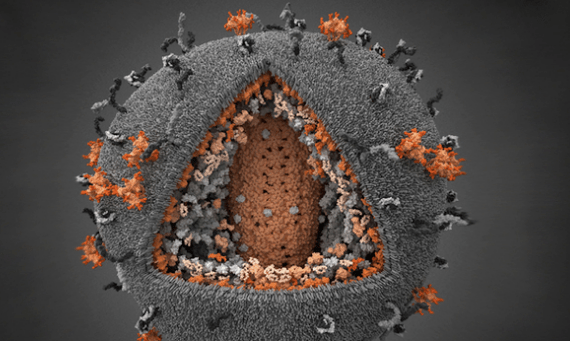
But here's the thing, until today, I didn't totally understand how the connection between CCR5, Delta-32, and HIV worked. There's a story (and some great digital illustrations) on NPR's Shots blog that makes the situation much more clear. HIV, apparently, have little spikes all over its surface. These spikes are how the virus injects itself into cells.

When it bumps into a T cell, a finger-like projection on the cell's surface, called CCR5, pushes down on the spike. This interaction pops open the HIV and releases the infectious genes into the cell. A gene therapy could protect T cells by inactivating the CCR5 gene.

Great "A-ha!" moment for me. Read the rest of the story and look at the illustrations. It'll make some thing make a lot more sense.

Read the rest at NPR's Shots blog

PREVIOUSLY:
If AIDS Has Been Cured, Why is the Victory Party So Small?
AIDS Research Done by 17-Year-Olds

Maggie Koerth-Baker is the science editor at BoingBoing.net. She writes a monthly column for The New York Times Magazine and is the author of Before the Lights Go Out, a book about electricity, infrastructure, and the future of energy. You can find Maggie on Twitter and Facebook.

Maggie goes places and talks to people. Find out where she'll be speaking next.

MORE:  AIDS • cures • hiv • medicine • microbiology • News • Science

More at Boing Boing

The technology that links taxonomy and Star Trek

Hackers prepare for first "national holiday" in their honor

  • RKTR ♫soundcloud.com/rktr

     Pretty cool to see that years of research are finally paying off!

  • Gilbert Wham

    JD Shapely…

    • Guido

      He died to provide us with the cure. Fundies made him a martyr.

  • BunnyShank

    I wonder if the Delta-32 mutation is the same mutation that makes people immune to bubonic plague, and if the cell process is the same as with HIV.

    • http://www.facebook.com/teleny Alissa Mower Clough

       It most certainly is, and that’s the basis for a story I wrote (SHAMELESS PLUG) called “Yersinia (a gram-negative romance).”

  • http://nelc.livejournal.com/ NelC

    Surely, springing open the HIV cell is only half the story? You also have to open the T-cell, so that the retroviral genes get into it?

  • http://twitter.com/trempls tré

    An a-ha moment, you say? http://youtu.be/djV11Xbc914

  • http://www.facebook.com/profile.php?id=1213106919 Christopher Jensen

    he’s merely pretty lucky. if the virus inside him wasn’t R5-tropic, the effect wouldn’t have made a difference.

  • danegeld

    That rendering looks like a plushy-aids virus. Can we get the knitted?

  • luisella

    Well the cure for cancer has been discovered in 2006. It’s a dirty chip drug used for diabetes, but no Big Pharma would support the trials because its patent expired in 2002.

    http://edition.cnn.com/2012/04/05/health/diabetes-drug-fights-cancer/index.html

    • Antinous / Moderator

      It’s not a cure. It’s a drug that might have some effect in some cases.

  • billstewart

    Bone-marrow transplants are pretty radical treatment.  Now that we know how this works, does that mean it’d be possible to make a CCR-5 blocker drug that would help people with normal T-cells?

  • Patrick J. Szucs Jr.

    The two new patients did not receive the Delta-32 mutation according to an NPR article.

    “Not necessarily, the Boston researchers say. The donor cells their patients got did notlack the receptor. So what’s happening with them must be different from the Berlin patient.”  Richard knox.

  • http://www.facebook.com/teleny Alissa Mower Clough

    Now how can people get tested for the mutation if they want to become bone marrow donors?

  • Flarn Buckholter

    We’ve suspected  this CCR/HIV connection for years, but blocking a chemokine receptor (CCR5 is C-C motif chemokine receptor) affects an immune cell’s ability to respond to signals.  APCs might not migrate properly or phagocytose properly in response to infection.

    You’d beat HIV and fall victim to a bacterium…Global blocking of a chemokine receptor is not good.

    • gehringer

       Hmm…any known way to temporarily turn the receptor off, wait for the HIV to flush out of the system, and then let the receptor turn back on?