Features Podcasts Family Video Comics Music Tech Science Books Film & TV Games ✚

Jill

The most polluted place in the world

Maggie Koerth-Baker at 12:54 pm Mon, Oct 8, 2012

— FEATURED —

Book Review

Black Code: how spies, cops and crims are making cyberspace unfit for human habitation

Book Review

We Can Fix it! - a graphic novel time travel memoir

Science

The technology that links taxonomy and Star Trek

— FOLLOW US —

Boing Boing is on Twitter and Facebook. Subscribe to our RSS feed or daily email.


— POLICIES —

Except where indicated, Boing Boing is licensed under a Creative Commons License permitting non-commercial sharing with attribution


— FONTS —

Tweet
Kindle

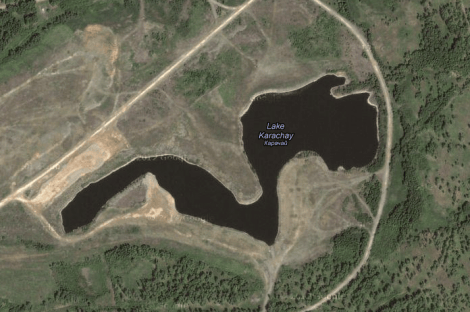
At Grist, Jess Zimmerman has an interesting piece about a lake near a notoriously leaky former Soviet nuclear research site, where the radiation level is so high that an hour on the beach can be enough to kill you.

You can’t really blame Lake Karachay for acting up — it comes from a really rough area. The lake is located within the Mayak Production Association, one of the largest — and leakiest — nuclear facilities in Russia. The Russian government kept Mayak entirely secret until 1990, and it spent that period of invisibility mainly having nuclear meltdowns and dumping waste into the river. By the time Mayak’s existence was officially acknowledged, there had been a 21 percent increase in cancer incidence, a 25 percent increase in birth defects, and a 41 percent increase in leukemia in the surrounding region of Chelyabinsk. The Techa river, which provided water to nearby villages, was so contaminated that up to 65 percent of locals fell ill with radiation sickness — which the doctors termed “special disease,” because as long as the facility was secret, they weren’t allowed to mention radiation in their diagnoses.

Read the rest at Grist

Maggie Koerth-Baker is the science editor at BoingBoing.net. She writes a monthly column for The New York Times Magazine and is the author of Before the Lights Go Out, a book about electricity, infrastructure, and the future of energy. You can find Maggie on Twitter and Facebook.

Maggie goes places and talks to people. Find out where she'll be speaking next.

MORE:  History • Mayak • pollution • radiation • russia • Science • Soviet Union

More at Boing Boing

The technology that links taxonomy and Star Trek

Hackers prepare for first "national holiday" in their honor

  • andyw87

    Just recently read a different article on this location over at Damn Interesting http://www.damninteresting.com/in-soviet-russia-lake-contaminates-you/

    • Manue

      I spent a few days not far from there two weeks ago and I didn’t know (it was so polluted).  Thanks, I’ll read both articles. 

  • Ashen Victor

    A wonderful place to get a nice glowing tan.

  • Kevin White

    This area provides the title of, “One Hour by the Concrete Lake”, an album by Swedish progressive metal band Pain of Salvation. The album’s themes involve the destruction of the environment and harm of society by environmental damage. 

    I’m a fan of theirs and it is quite a good album, if somewhat prog-preachy. 

  • http://redesigned.com redesigned

    i’d love to read about anything that does successfully live in the lake or area.  could be interesting place to study extremophile organisms.

    • TWX

      I wouldn’t be surprised if a lot of things live there- the reference picture here shows a lot of plant life.  Remember, increases in the incidences of diseases doesn’t mean that every organism suffers from those diseases; in fact when numbers like a 50% increase in incidence are noted that means half-again as many people have it over baseline.  That certainly doesn’t mean that it’s good, but it doesn’t necessarily mean that 50% of the population has the disease.  If ten in 10,000 have leukemia normally, then it’d be 15 in 10,000 if the rate was 50% higher.

      And back to your earlier point, wildlife is apparently thriving in the Chernobyl Exclusion Zone.  Birds even roost in the structure of the Sarcophagus.

      I certainly wouldn’t want to live at either place, nor do I think the dangers are overstated, but some forms of life are hardy and can tolerate it, to an extent.

      • ocker3

         I wonder if the birds are smart enough to realise their life spans have been shortened?

        • Beanolini

          It’s possible that the lifespans of some species haven’t been shortened, if their normal lifetime is shorter than the time taken to develop cancer.

          • ocker3

            Interesting, I guess it makes sense. Just like a lot of humans Have cancer, but may not suffer from it or actually die from it before they die from something else

  • http://codeflow.org/ Florian Bösch

    3 2 1… atomic energy apologists and plutonium worshiper who think stuff’s healthy as cranberry juice.

    • Clevername

       The contamination here is due to plutonium production for weapons not energy. The early Mayak reactors didn’t even have turbines, the river just flowed in one end of the reactor and out the other, coming into contact with the fuel assembly and then flowing directly into that lake.

      • http://codeflow.org/ Florian Bösch

        Thank you to make my point.

        • Drew_Gehringer

           He didn’t prove your point at all.

          Mayak was, even by the standards of the time it was built, a horrfyingly unsafe facility by non-Soviet standards.   Basically no-one but the soviet union ever built nuclear stuff that unsafe, and I doubt anyone ever will.

          …Except maybe for the North Koreans, they have a nuclear weapons program that seems incompetent enough.

          • http://codeflow.org/ Florian Bösch

            -> apologist bait -> apologists -> qed

            You can say the dumbest things on the internet (and here) and people will ignore you. But dare you criticize the atomic industry, even implied, even wrongly, you’ll get an endless stream of imbecility, void arguments and attacks. Again, thank you for participating in this social experiment. All paid bloggers by the atomic industry, please go somewhere else to comment.

          • Clevername

            Saying that this the result of “the atomic industry” is like saying that the gulags were the result of our prison system. Where do I sign up to get paid for this?

            PS I am not apologizing for anything, this is one of Stalin’s many inexcusable crimes.

          • http://codeflow.org/ Florian Bösch

            @boingboing-4d96a03adf73ea2dc121851ac7b0e0df:disqus 

            Apply at TEPCO

          • TWX

            The only void arguments are yours.  I saw no statements endorsing nuclear power or any other use of nuclear technology, only attempts to clarify.  Come to think of it, I don’t think that there were any endorsements of nuclear power or other nuclear technology in this entire discussion at the time I make this reply.  At most, there were attempts to clarify the horror of this and other installations because of their military production nature, and how that nature significantly worsens such sites as compared to sites that generate power for the civilian population.

            Don’t like nuclear technology?  Fine.  There are probably millions like you.  But stay out of civilized discussions attempting to address, pragmatically, the ramifications of a system that we find to already be in place, odious as many consider it to be.  You’re not going to wave a magic wand and end the use of nuclear technology in an instant, and in the meantime there are real and important arguments to be made to shore up safety, clean up contamination, and curtail proliferation before one could even consider rolling back usage.  Unless, of course, you want to see every nuclear-powered nation suffer a new Chernobyl or Fukushima-Daiichi.  In fact, between books by Grigori Medvedev and the papers and effects Valeri Legasov left after his suicide, of the original 26 RBMK reactors built or in construction, only ten remain operational, with four of those scheduled for permanent shutdown within the next five years, and all RBMKs shutdown within the next fifteen.  The successor reactor design, MKER, has never been built and probably won’t be, so within the near future, as far as civil engineering projects go, we’ll be free from all those dangerous graphite-moderated high-positive-void-coefficient reactors.

            I don’t see your red-herring arguments having contributed to this pending achievement.

        • Rindan

          I think that nukes suck and that if we build any, it should be few and in places where we are okay with voiding the real estate value of everything in a hundred mile radius.

          That said, pointing to the absolute worst the mother fuckin’ Soviet Union can do with nukes as proof that nukes are teh 3vil is just stupid.  It is like pointing Nazi Jew incinerators as to the reason why we can’t use garbage incinerators.

          Pointing out that people are going to call you an idiot doesn’t prove that you are not an idiot.

    • ocker3

       Strawman: Atomic energy can be done safely, we just haven’t found out how yet. Whether we keep trying and what methods we are trying should be up for debate. Just as with any technology, we can look backwards and see horrible mistakes, some which cost lives, or in some cases a huge number of lives. We shouldn’t shun technology, we should work to guide it’s development and use.

    • http://www.genreville.com/ Josh Jasper

      So any response that does not agree with you proves your point to your satisfaction? Well done, Another self awarded first prize.

  • Richard Lindstrom

    I worked in the Cheliabinsk region for several summers starting in 1991. My first summer there I had fresh crawfish from a nearby river while camping. It wasn’t until later I heard that these were the first crawfish anyone had seen in decades, and that lake Karachay was upstream. I use this as the standard excuse for my current lack of hair. And of course I say that the crawfish boiled themselves when tossed in a pot.

  • http://twitter.com/amerikanmajava HK

    Radiation is harmful to all flora and fauna (not totally true some fungi aren’t bother by radiation) but we (humans) are an exception because we value our lives so much. We will try to get away from a place that might give us incurable and painful diseases.

    But animals aren’t able to detect this kind of danger. If the radiation is too much they will just die. But if the radiation is mild enough they will be able to breed and live there quite decently.

    Many animals are pretty happy living in a place without any humans. For many that is more important than longer lifespan.