Features Podcasts Family Video Comics Music Tech Science Books Film & TV Games ✚

Jill

Temple Grandin's brain doesn't just think differently, it is physically different

Maggie Koerth-Baker at 5:33 am Sat, Oct 20, 2012

— FEATURED —

THE LATEST

Guatemala: Nation's highest court throws out Ríos Montt genocide trial verdict and prison sentence

Feature

Eurovision 2013: An American in London

Book Review

The Twelve-Fingered Boy - mesmerizing YA horror novel

Book Review

Black Code: how spies, cops and crims are making cyberspace unfit for human habitation

— FOLLOW US —

Boing Boing is on Twitter and Facebook. Subscribe to our RSS feed or daily email.


— POLICIES —

Except where indicated, Boing Boing is licensed under a Creative Commons License permitting non-commercial sharing with attribution


— FONTS —

Tweet
Kindle

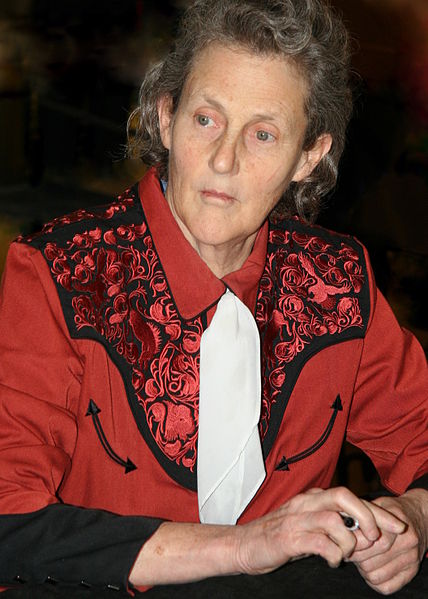
This is kind of neat. Scientists conducted several psychological and neuro-imaging tests on Temple Grandin — the woman who has used her own autism as a model for designing better livestock control systems. What they found is that Grandin's brain looks different, structurally, from that of a neuro-typical person.

Grandin’s brain volume is significantly larger than that of three neurotypical controls matched on age, sex and handedness. Grandin’s lateral ventricles, the chambers that hold cerebrospinal fluid, are skewed in size so that the left one is much larger than the right. “It’s quite striking,” Cooperrider says. On both sides of her brain, Grandin has an abnormally large amygdala, a deep brain region that processes emotion. Her brain also shows differences in white matter, the bundles of nerve fibers that connect one region to another. The volume of white matter on the left side of her brain is higher than that in controls, the study found.

Grandin isn't the only person with autism to have had their brain scanned. But the differences that have been found aren't always consistent from one study to another. That, of course, makes some sense, given the fact that the word "autism" encompasses a whole spectrum of differences and disabilities which may or may not represent one single thing. But there have been several studies that did find differences similar to the ones found in Temple Grandin.

And here's the really interesting thing. Some scientists think that the common differences we do keep seeing — especially the bit about the larger brain volume — might be a clue that what eventually becomes autism actually begins in the womb. Here's a quick excerpt from a story that Carl Zimmer wrote about this stuff last spring:

When autistic children are born, Courchesne’s research suggests, they have an abundance of neurons jammed into an average-size brain. Over the first few years, the neurons get bigger and sprout thousands of branches to join other neurons. The extra neurons in the autistic brain probably send out a vast number of extra connections to other neurons. This overwiring may interfere with normal development of language and social behavior in young children. It would also explain the excess brain size seen in the MRI scans.

Read the story about Temple Grandin's brain

Read Carl Zimmer's story on structural differences in brains of people with autism

Special thanks to GrrlScientist!

Image: Photograph by Jonathunder for Wikipedia, used under CC license.

Maggie Koerth-Baker is the science editor at BoingBoing.net. She writes a monthly column for The New York Times Magazine and is the author of Before the Lights Go Out, a book about electricity, infrastructure, and the future of energy. You can find Maggie on Twitter and Facebook.

Maggie goes places and talks to people. Find out where she'll be speaking next.

MORE:  anatomy • autism • brains • Science

More at Boing Boing

Eurovision 2013: An American in London

The technology that links taxonomy and Star Trek

  • acerplatanoides

    Everyone should watch this, too. She’s amazing.

    http://www.ted.com/talks/temple_grandin_the_world_needs_all_kinds_of_minds.html

  • Pope Ratzo

    “Temple Grandin’s Brain” was the name of my band when I was in college.

  • edubs

    Just remember that more isn’t necessarily better. Humans undergo synaptic pruning during their development. This is in part how learning occurs, some connections are strengthened and others weakened through experience and neurons without sufficient connections or signaling strength are “pruned.”

    • http://twitter.com/beep54orama B E Pratt

       Needless to say, that reminds one of Bruce Sterling’s short story, “Our Neural Chernobyl” and makes me crave a Dr Brown’s soda.

    • http://www.guiwald.info Guiwald

      Everything different is good.

  • http://www.facebook.com/daniel.ehrnlund Daniel Ehrnlund

    I look forward to reading this article!

    Last night I finished An Anthropologist On Mars in a insomiac haze.

    Interesting book.

  • John Verne

    I thought “neuro-typical” was actually not very typical at all. Just saying.

  • http://twitter.com/jmaynard8888 Joe Maynard

    FWIW, according to a commenter who was at the conference, the control group they were comparing her to was comprised of a whopping three people… and the differences between each brain in the group and any other was just as significant as the differences between Temple Grandin’s brain and those of the ‘control’ group… if true, the scientific validity of this is obviously questionable…

    • BunnyShank

       yeah, a “control” group of three, er….

  • Mark_Frauenfelder

    I had a 15 minute conversation with Ms. Grandin at TED a few years ago. She was pleasant and fun to talk to.

    • http://www.facebook.com/mdwillington Matthew David Willington

      I’ve had dinner with her mother, she’s fun to talk with too.

  • jhavatar

    ah, k. so that explains all his song ideas.

  • Marcie Fehr

    While this is indeed interesting, it’s important to remember to be cautious with discoveries of how the brain develops in the womb — this could lead to eugenics, and the absence of specialized brilliance for the sake of supposed normalcy. 

    • wysinwyg

      So…don’t study the brain because it could lead to eugenics?

      As we’ve seen from history people will use any stupid excuse to justify eugenics.  I tend to think insights like this actually make it less likely.

  • kent williams

    I was at a talk Ms. Grandin gave at the University of Iowa College of Medicine earlier this year. She was very proud of the DTI (Diffusion Tensor Imaging) images of her brain, and compared them with images of normal brains.  DTI images outline the white matter fiber bundles of the brain, showing interconnections between different parts of the brain.

    I actually work in a lab that processes a lot of DTI Images.  In terms of the real science of brain imaging, I think some healthy skepticism is in order.  We can now generate and process detailed images of brain anatomy, and observe phenomena like Ms Grandin’s very different brain interconnections.  What is not clear is what that means exactly.  What’s even less clear is the therapeutic and scientific value of these observations.

    Even as a mountain of research into the human brain accumulates, we are just beginning to grope towards useful insights regarding it.  Yes, Temple Grandin’s brain is different than yours or mine, but you didn’t need an MRI scanner to know that. 

    • wysinwyg

       Well, yeah I did.  It’s completely possible that people could think and behave very differently while having very physically similar brains.  The fact that behavioral differences correlate to physiological differences may be intuitive but you still need to actually do the studies before you can conclude it’s true.