Features Podcasts Family Video Comics Music Tech Science Books Film & TV Games ✚

Jill

RIP Stanford Ovshinsky — inventor with an eye on energy and communication

Maggie Koerth-Baker at 9:40 am Mon, Oct 22, 2012

— FEATURED —

Book Review

The Man Who Laughs: grotesque Victor Hugo potboiler was the basis for The Joker

Feature

Eurovision 2013: An American in London

Book Review

The Twelve-Fingered Boy - mesmerizing YA horror novel

— FOLLOW US —

Boing Boing is on Twitter and Facebook. Subscribe to our RSS feed or daily email.


— POLICIES —

Except where indicated, Boing Boing is licensed under a Creative Commons License permitting non-commercial sharing with attribution


— FONTS —

Tweet
Kindle

America lost a great Maker last week. Stanford R. Ovshinsky was a self-taught engineer and inventor who held more than 400 patents when he died on October 17th at the age of 90. The name may not be familiar to you, but his work is. Ovshinsky is credited with inventing key technologies behind flat-panel liquid crystal displays that we use to watch TV, work on the Internet, or play with our phones.

He was also the inventor of the nickel-metal hydride battery — a rechargeable battery that now powers everything from laptops to the Prius. Ovshinsky (along with his wife, Iris, who held a Ph.D. in biochemistry and was his research partner for much of his life), began working on improved versions of batteries, solar cells, and other energy technologies beginning in the early 1960s. More than a decade before climate change became a well-established fact, Ovshinsky was concerned about the pollution and political instability that went along with fossil fuels. He spent the rest of his life developing better alternatives.

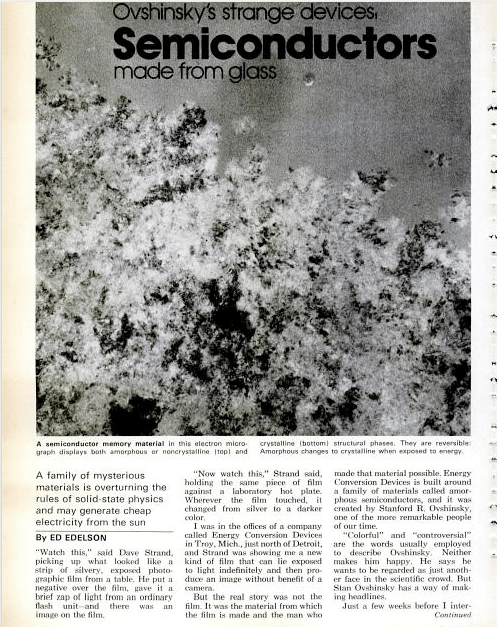
For a good introduction to how truly groundbreaking Ovshinsky's ideas were, check out a 1978 article from Popular Science, all about his invention of amorphous silicon semiconductors — a technology that today forms the basis behind both thin-film solar panels and smart phone displays. At the time though, it made Ovshinky a controversial figure.

• Michigan Public Radio's obituary
• A good explanation of the inner workings of nickel-metal hydride batteries
• Popular Science's obit (with a link to the 1978 story)

Thanks to Art Myatt for the heads up on this!

Maggie Koerth-Baker is the science editor at BoingBoing.net. She writes a monthly column for The New York Times Magazine and is the author of Before the Lights Go Out, a book about electricity, infrastructure, and the future of energy. You can find Maggie on Twitter and Facebook.

Maggie goes places and talks to people. Find out where she'll be speaking next.

MORE:  cell phones • deaths • Energy • inventors • makers • Science

More at Boing Boing

Eurovision 2013: An American in London

The technology that links taxonomy and Star Trek

  • Ito Kagehisa

    Didn’t Ovshinsky lament at one point that he’d foolishly sold the rights to produce his more recent battery technologies to companies that failed to bring them to market effectively?  He was severely disappointed by the whole EV-1 fiasco, too, wasn’t he?

    • Kommkast

      He went into a deal with a large oil company and they endd up pulling the carpet out from under the whole thIng… My mom actually created the machines that made those batteries.

  • pizzicato

    I read up a bit about his invention because I was once a shareholder of ECD… 

    Imagine before NiMH battery were available, you have to NiCd, and I don’t have to say much about Cadmium. He also invented a type of programmable ROM which uses phase change material that changes resistance with application of heat due to its crystalline structure, it has potential but seems always never quite close to commercial viability.

     Much has also been said about those roll to roll flexible solar cell with steel substrate, again the low efficiency of amorphous silicon cell wasn’t a problem if you can see pass their better performance at higher latitude, often dull cloudy condition, where it does better than polysilicon cell. 

    And yup those Thin Film Transistors you’re starring at right now.

  • ArmchairAstronomer

    I worked for the company Stan founded, ECD, for about 3 years around the time he “left to pursue other opportunities” (corporate code for “was forced out”). It WAS the ultimate maker paradise. Buildings full of scientific equipment and machine tools. Stan was trained as a  toolmaker and he loved all of that stuff. And, he had an uncanny understanding of the periodic table and the properties of materials. In reality it was all too much to keep control of and so in the end not much of anything got done. Plus, Stan kept making deals with big companies that didn’t have the same passion for the products he did. Often times they just tried to bury it as in Sony and the amorphous CD/DVD technology. The Chevron (Cobasys) NiMH relationship is a study in how two companies can work against one another in a partnership so neither succeeds. I need to write the book but I don’t think I have the heart to relive it all again.

    • Ito Kagehisa

      Plus, Stan kept making deals with big companies that didn’t have the same passion for the products he did.

      That’s exactly the impression I got from the outside.  It seemed like he wanted to get the technology into the hands of giant companies that had the capital to mass produce them rapidly, but those companies always turned out to have vested interests that might be harmed by these disruptive new technologies so they never really wanted to push them – once their initial enthusiasm wore off, they’d realize they could just do nothing at all at no risk to their bottom line, since they’d bought the rights to production.  I wonder what would have happened if Ovshinsky had gone with less exclusive licensing arrangements…