Features Podcasts Family Video Comics Music Tech Science Books Film & TV Games ✚

Jill

Radar imaging of Hurricane Sandy reveals the power in its core

Maggie Koerth-Baker at 11:02 am Tue, Oct 30, 2012

— FEATURED —

THE LATEST

Guatemala: Archive of documents from Rios Montt genocide trial, overturned 10 days after guilty verdict

THE LATEST

Guatemala: Nation's highest court throws out Ríos Montt genocide trial verdict and prison sentence

Feature

Eurovision 2013: An American in London

Book Review

The Twelve-Fingered Boy - mesmerizing YA horror novel

Book Review

Black Code: how spies, cops and crims are making cyberspace unfit for human habitation

— FOLLOW US —

Boing Boing is on Twitter and Facebook. Subscribe to our RSS feed or daily email.


— POLICIES —

Except where indicated, Boing Boing is licensed under a Creative Commons License permitting non-commercial sharing with attribution


— FONTS —

Tweet
Kindle

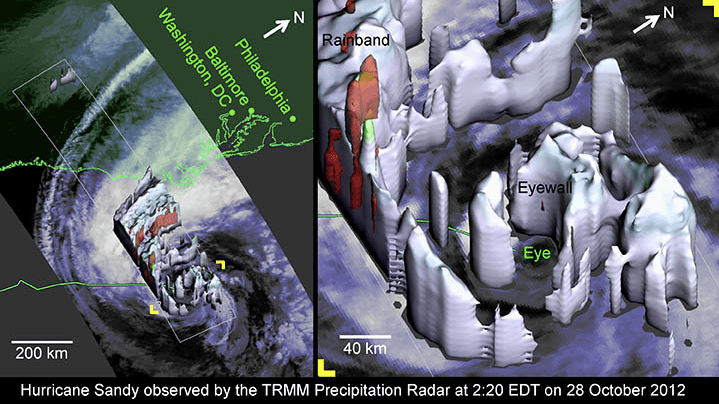
The images above — prepared by NASA hurricane researcher Owen Kelly — were taken on Sunday, before Hurricane Sandy made landfall on the United States' Northeast coast. They're made from radar data collected by the Tropical Rainfall Measuring Mission (TRMM) satellite, and they show a feature of this storm that helps explain why it's caused much more destruction than you might expect from a Category 1 hurricane.

In the right-hand image, showing a close-up of the storm's eye, you can see a feature labeled "eyewall". Those are vertical cloud walls that surround the eye, and they're the spot with the strongest winds in the whole storm.

Placed in context, the TRMM-observed properties of Hurricane Sandy’s eyewall are evidence of remarkable vigor. Most hurricanes only have well-formed and compact eyewalls at category 3 strength or higher. Sandy was not only barely a category 1 hurricane, but Sandy was also experiencing strong wind shear, Sandy was going over ocean typically too cold to form hurricanes, and Sandy had been limping along as a marginal hurricane for several days.

That eyewall, says NASA and New Scientist, is the result of Sandy's Frankenstorm nature. Despite all the factors that should have made this storm weak, it represented the merging of several storm systems. Because of that, Sandy was stronger than a Category 1 storm normally is.

Read the full story on this at NASA and New Scientist

Via Michael Marshall

Maggie Koerth-Baker is the science editor at BoingBoing.net. She writes a monthly column for The New York Times Magazine and is the author of Before the Lights Go Out, a book about electricity, infrastructure, and the future of energy. You can find Maggie on Twitter and Facebook.

Maggie goes places and talks to people. Find out where she'll be speaking next.

MORE:  Hurricane Sandy • meteorology • News • satellites • Science • storms

More at Boing Boing

Eurovision 2013: An American in London

The technology that links taxonomy and Star Trek