Features Podcasts Family Video Comics Music Tech Science Books Film & TV Games ✚

Jill

What makes wind?

Maggie Koerth-Baker at 12:54 pm Wed, Oct 31, 2012

— FEATURED —

THE LATEST

Guatemala: Nation's highest court throws out Ríos Montt genocide trial verdict and prison sentence

Feature

Eurovision 2013: An American in London

Book Review

The Twelve-Fingered Boy - mesmerizing YA horror novel

Book Review

Black Code: how spies, cops and crims are making cyberspace unfit for human habitation

— FOLLOW US —

Boing Boing is on Twitter and Facebook. Subscribe to our RSS feed or daily email.


— POLICIES —

Except where indicated, Boing Boing is licensed under a Creative Commons License permitting non-commercial sharing with attribution


— FONTS —

Tweet
Kindle

It can be a nice breeze, or a destructive storm, but either way wind is just moving air. And moving air is just moving molecules.

In an explainer for kids that's actually pretty helpful for grown-ups, too, Matt Shipman reminds us that the air around us isn't totally weightless. It weighs something, because molecules all weigh something:

They don't weigh very much (you couldn't put one on your bathroom scale), but their weight adds up, because there are a LOT of molecules in the air that makes up our atmosphere. All of that air is actually pretty heavy, so the air at the bottom of the atmosphere (like the air just above the ground) is getting pressed on by all of the air above it. That pressure pushes the air molecules at the bottom of the atmosphere a lot closer together than the air molecules at the top of the atmosphere.

And, because the air at the top of the atmosphere is pushing down on the air at the bottom of the atmosphere, the air molecules at the bottom REALLY want to spread out. So if there is an area where the air molecules are under high pressure (with a lot of weight pushing down), the air will spread out into areas that are under lower pressure (with less weight pushing down).

Read the full story at Carolina Parent

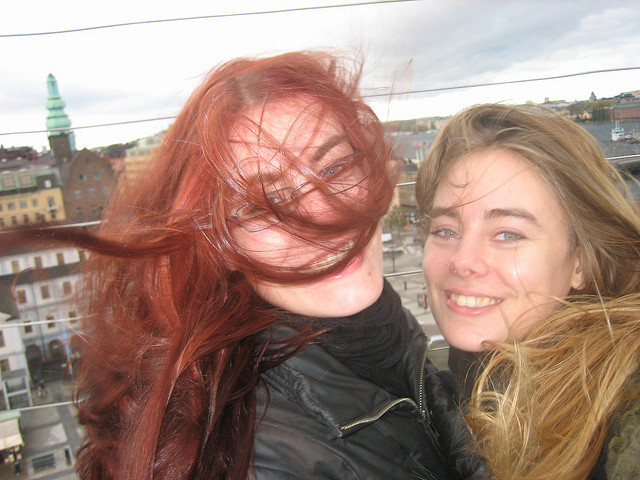
Image: wind, katarinahissen, a Creative Commons Attribution Share-Alike (2.0) image from mararie's photostream

Maggie Koerth-Baker is the science editor at BoingBoing.net. She writes a monthly column for The New York Times Magazine and is the author of Before the Lights Go Out, a book about electricity, infrastructure, and the future of energy. You can find Maggie on Twitter and Facebook.

Maggie goes places and talks to people. Find out where she'll be speaking next.

MORE:  Hurricane Sandy • meteorology • physics • Science • weather • wind

More at Boing Boing

Eurovision 2013: An American in London

The technology that links taxonomy and Star Trek

  • Mark Dow

    Blow dryers cause wind, not moving hair. It’s a red earring.

    • Just_Ok

      It’s not blow dryers, per se. It’s the difference between the number of blow dryers and vacuums. That’s why the wind changes direction.

  • rattypilgrim

    Pinto beans.

    • Antinous / Moderator

      Dried apricots

  • Daemonworks

    Butterflies.

  • slythesly

    The wind comes from the trees agitating their branches. It’s common sense ! Just look outside !

  • chenille

    Or trees sneezing – perhaps not really, but the truth is more complicated.

    It’s a good start, but it seems strange to explain wind without at least mentioning the difference between day and night, tropics and poles, or the earth turning. Those are why the pressure changes show up, and we get the winds we do. I am sure an interested kid would understand them.

  • Henry Pootel

    Oh a mighty winds a blowin’, it’s kickin’ up the sand,
    It’s blowin’ out a message to every woman, child and man
    Yes a mighty winds a blowin’, cross the land and cross the sea,
    It’s blowin’ peace and freedom, it’s blowin’ equality.

  • http://www.facebook.com/andy.pathiakis Andy Pathiakis

    On a serious note, that an amazing lesson… it really makes complete sense to me now. For 33 years, I had no idea what created wind. No I know.