Features Podcasts Family Video Comics Music Tech Science Books Film & TV Games ✚

Jill

Visit to the Body Farm

David Pescovitz at 12:09 pm Tue, Oct 30, 2007

— FEATURED —

Science

Last chance to enter the Armchair Taxonomist challenge!

Book Review

Black Code: how spies, cops and crims are making cyberspace unfit for human habitation

Book Review

We Can Fix it! - a graphic novel time travel memoir

Science

The technology that links taxonomy and Star Trek

— FOLLOW US —

Boing Boing is on Twitter and Facebook. Subscribe to our RSS feed or daily email.


— POLICIES —

Except where indicated, Boing Boing is licensed under a Creative Commons License permitting non-commercial sharing with attribution


— FONTS —

Tweet
Kindle
 Content Bill Bass  Content Body Farm Gate
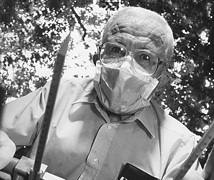
In 1971, anthropologist Dr. William Bass (seen above) founded the University of Tennessee's Forensic Anthropology Facility, aka the "Body Farm." On those three acres in Knoxville, dozens of lifeless human bodies lie in various states of decomposition in the name of science and education. Alan Bellows of Damn Interesting paid a visit. From the article, which is not for the squeamish:
From a short distance the male figure almost appeared to be napping among the hummingbirds and squirrels, draped as he was over the pebbled ground. But something about his peculiar pose evoked a sense of grim finality– the body language of the deceased...

The students knelt alongside the slumped form, seemingly untroubled by the acrid, syrupy tang of human decay which hung in the air. They remarked on the amount of decomposition that had become evident since their last visit, such as the sloughed skin and distended midsection. The insects which feasted upon the decommissioned man were of specific interest, prompting a number of photographs and note-jottings. After surveying the scene to their satisfaction, the students strolled across the glade to examine a considerably more decayed corpse in the trunk of an abandoned car. Their lack of alarm wasn't altogether surprising, for they were part of the organization responsible for dumping these corpses– along with dozens more– throughout the otherwise serene forest....

As the lifeless subjects are interred into the grisly forest hideaway, each is assigned an anonymous identification number. Some are situated to provide interesting decomposition vectors, while others are used to reconstruct specific circumstances for police investigations. At any given time, several dozen perished persons are scattered around the hillside within automobiles, cement vaults, suitcases, plastic bags, shallow graves, pools of water, or deposited directly upon the earth. Except when clothing is necessary for a particular study, cadavers are disrobed, and frequently certain factors such as fire and chemicals are introduced to measure their effects. Grad students and professors return periodically to check on the subjects' progress, with occasional visits from police officers or FBI agents undergoing training.
Link

Previously on BB:
• Vultures halt "body farms" plans Link
• Forensic anthropology in Glenn and Helen Show podcast Link

David Pescovitz is Boing Boing's co-editor/managing partner. He's also a research director at Institute for the Future. On Instagram, he's @pesco.

More at Boing Boing

The technology that links taxonomy and Star Trek

Hackers prepare for first "national holiday" in their honor

  • Joe MommaSan

    I have to wonder how many of these cadavers were people who thought they were doing a good deed by donating their bodies to science. Not to mention how many would still do the same if they knew this was where they’d end up.

  • Ape Lad

    Out of morbid curiosity, it would be interesting to see the satellite view of this place on google maps.

  • Deb

    I went to a talk held by Dr. Kathy Reichs, the noted author and forensic anthropologist. In response to a question I asked to her about how the Body Farm helps professionals in the different fields she said that it was invaluable. Before Dr. Bass set it up, there was real guess-work as to how long a body was there before it was found. With the data they have collected and catalogued at the Farm there is a very wide range of knowledge as to time of death of corpses. It’s no longer a guessing game. In Canada for instance, Steven Truscott, a boy that was charged at the age of 14 with the rape and murder of a 12 year old girl, it would have saved 47 years of agony knowing he was innocent all that time. But a pathologist who confirmed the time of death to within a half hour period sadly sealed his fate. That testimony was later completely quashed. Mr. Truscott very nearly was hung for murder. http://en.wikipedia.org/wiki/Steven_Truscott If it was not for bold moves like the Body Farm, more people would be likely charged because there wouldn’t be that body of knowledge.

  • Deb

    In response to Joe’s comment on Oct 30th, couples have asked to be placed there, according to Patricia Cornwell’s novel “The Body Farm”. I do believe it’s a specific request before bodies are placed there. i.e. the people know ahead of time that yes, their bodies will exposed, examined, and used to determine scientific information.

  • Peter Larsen

    You can see a lot of this place in “What Remains,” an HBO documentary on photographer Sally Mann’s long-running documentation of — and meditation on — death and decay. Came out about a year ago now….

  • Nomascerdo

    I agree with the earlier post about Mary Roach’s book Stiff. She discusses all of this stuff in detail and it actually has been very useful for forensic science, solving crimes etc. There is no other way to know how long a body has been decomposing without observation and measurement.

    The book is great and despite feeling nauseous about 50% of the time while reading it, it is actually very fun.

    It also discusses some new methods for disposing of human remains (not available in US yet) which would be of interest to people who are environmentalists and should be opposed to modern embalming methods and cremation. One of them involves freeze drying the body, then using vibrations to turn it into a fine dust, then mixing it with soil and then using the soil to plant a memorial tree in that person’s honor. I personally think that sounds pretty cool. I wonder if the embalming lobby will ever let it come to our shores ; )

  • Micah

    Ape Lad. Unfortunately there’s not much to see:

    http://virtualglobetrotting.com/map/18050/

  • bullitt_5

    Zombie moviemakers dutifully take note….

  • Anonymous

    “I have to wonder how many of these cadavers were people who thought they were doing a good deed by donating their bodies to science. Not to mention how many would still do the same if they knew this was where they’d end up.”

    Some would argue that donating your body to something like this could benefit hundreds, if not thousands of people while organ donation would benefit relatively few.

  • Halloween Jack

    Also WRT whether people would want to have their corpse placed there, from the last paragraph of the article:

    While the prospect of having one’s naked, lifeless husk flung into the woods lacks general appeal– most people opting to decompose with dignity in the privacy of an overpriced crate– there is nevertheless an ever-growing waiting list of enthusiastic, not-yet-deceased Body Farm volunteers.

    Like any exclusive club, there’s a waiting list.

  • Blackbird

    @Deb,
    I doubt the info from the Body Farm would have been of any value to the Truscott case. Since time of death had been established by the stomach contents (at the time there had been some research done into it) the state of hte body itself makes no here or there. However, in the science at the time in regards to stomach contents it was stated that it could only give a basic time of death (range of 1.5 – 3 hours, within eating AND time of death). The medical examiner of course gave a timeframe well below the threshold. This was done partly due to incompetence and largely (in my view…being skewed because of ‘personal involvement’ to the case) due to the fact that the police KNEW who had done it based on faulty evidence gathering and not following up on leads.
    It’s sad that it took 47 years for justice to ALMOST get done. Remember, he still isn’t ‘innocent’ of the crime. My grandmother went to her grave feeling guilty for sending him to prison. Even though it was a over-aggressive prosecutor who only hand-picked the evidence she gave, she still felt guilty. I’ve read her original statement to the police…and about 75% of it confirms his innocence, the other 25% ‘could’ be circumstantsial evidence at best. Guess which part the prosecution used!

  • doktor tchock

    stiff: the curious lives of human cadavers has a bit about the body farm. if this stuff interests you, give the book a read…it’s quite enjoyable for those who can stomach it.

  • generousmedium

    Or you can read the book!

    What Remains by Sally Mann ISBN: 0821228439

  • Samurai Gratz

    I grew up in Knoxville, and every Halloween some teenagers would decide to go find the body farm and take a look. As you can see from the pictures, they’ve gotten way better about security.

  • standingstill

    Hey! I went to UTK from 91-98 (long term student)…and I took one of Dr. Bass’s classes. Specifically, Anthro 459 Human Identification. At the end of the semester he gives you a walking tour of the body farm…lots of fun…but doesn’t smell too good. It was an awesome class, very popular as you can imagine. The first 90mins was lecture on osteology, physiology, muscles, bones, etc. The last 90mins was slide shows from his career as the state medical examiner. Those were the best. After about two months of classes and getting pretty good at determining the cause of death at the end of his slide shows, he threw a real stumper at us. It was four successive slides that showed a yellowish smudge on a grassy lawn. The smudge was about a meter in diameter, but they were irregularly shaped. Then he asked us what they were. No one could figure it out…and we were getting pretty good at this point with the gore. Then he showed us the next slide and its a severely mutilated body. That’s when he says “Those yellow smudges are the marks a human body makes as it skips across the grass like a stone skipping on water.” It was a casualty from a big fireworks factory explosion about six years earlier in middle tennessee. Then he showed us the next two slides. One was a picture of the persons legs and feet. He had work boots on. The body was destroyed. But the last slide was a picture of the feet with the boots removed. Not a single bruise or cut or scrape on them. Then he propped up his foot on the table and says “CAT workboots…I swear by them.” Dr. Bass is a fun guy.

  • Anonymous

    The year the farm was established was actually 1981, as indicated on Damn Interesting… not 1971. The Wikipedia article on the Body Farm had the incorrect year, but I just fixed it.

    See Dr. Bass’ page for verification:

    http://www.jeffersonbass.com/photos_da.php?id=4

  • standingstill

    BTW…if you want to Google Earth the Body Farm, its on UTK campus behind the hospital.

  • ill lich

    uhhhh . . . shouldn’t they more accurately call it “The Maggot Farm”? It ain’t bodies that are being raised there.

    Sure beats being filled with formaldehyde and buried in an air tight container to sit and wait for the day the container bursts and contaminates the groundwater.

  • iguanoid

    That would be a strangely undepressing place to be (not)buried.

    People would come and visit you and see how you are doing for quite some time and you would have lots of smell company. Way better than being stuffed in a lonely box.

  • leftybuick

    Awesome story! Also, Vice and Dell Lounge just did a really cool series on the Body Farm: http://delllounge.com/blogs/bodyfarm/archive/2009/03/02/part-1-the-deadest-zone.aspx