Features Podcasts Family Video Comics Music Tech Science Books Film & TV Games ✚

Jill

Home made spectrometer tells you what rainbows mean

Maggie Koerth-Baker at 6:00 pm Tue, Nov 30, 2010

— FEATURED —

THE LATEST

Gweek 098: Win Hugh Howey's Paperwhite Kindle!

Book Review

Lexicon: smart, sharp technothriller from Max "Jennifer Government" Barry

Book Review

The 'Geisters: spooky, scary novel

Science

Ants and Stars: Bruce Sterling and Jasmina Tesanovic visit the Sardinia Radio Telescope in Italy

— FOLLOW US —

Boing Boing is on Twitter and Facebook. Subscribe to our RSS feed or daily email.


— POLICIES —

Except where indicated, Boing Boing is licensed under a Creative Commons License permitting non-commercial sharing with attribution


— FONTS —

Tweet
Kindle
spectro_FIN.jpg

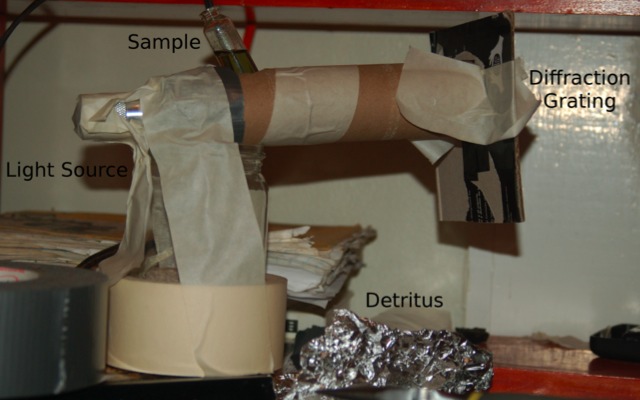
Don't tell the Double-Rainbow guy, but all those beautiful colors really can have a deeper meaning. That's because different chemicals reflect and absorb different wavelengths of light, leaving tell-tale patterns in the rainbow. If you know what colors specific chemicals absorb, you can look at the light reflected off a sample and use the rainbow to figure out what you've got. That's basically what a spectrometer does. And blogger Charles Soeder made his own.

The light source is an LED flashlight. The light shines through the sample (in this case a vial of chlorophyll) and gets broken up by a diffraction grating. This produces a spectrum which gets projected onto the photosensor. I pulled the sensor out of an automatic night light. It is mounted on a stand, which is taped to a TI89 which is taped to the table- so I can slide the sensor back and forth along the spectrum to get readings at different frequencies. I measured the frequency of light hitting the detector by noting where its shadow falls on the ruler in the background. The resistance of the sensor changes depending on how much light falls on it (which is an indication of how much light gets absorbed by the sample); I measure this with a multimeter.

There's more photos of all the different parts in his set-up. My favorite features the helpful caption, "This is where the rainbow goes."

(Thanks to Kevin Zelnio!)

Maggie Koerth-Baker is the science editor at BoingBoing.net. She writes a monthly column for The New York Times Magazine and is the author of Before the Lights Go Out, a book about electricity, infrastructure, and the future of energy. You can find Maggie on Twitter and Facebook.

Maggie goes places and talks to people. Find out where she'll be speaking next.

MORE:  Science

More at Boing Boing

Ants and Stars: Bruce Sterling and Jasmina Tesanovic visit the Sardinia Radio Telescope in Italy

The Snowden Principle

  • js7a

    Cool in concept but ~25-50 nm resolution might not be identifying anything. If he used a little fiber optics to reduce the width of the source he could increase the resolution.

    • bklynchris

      and to pjcamp

      Yeah, but, but…but, you know what?!?! If I were to choose who I had to be deserted on an island with out of all y’all, it would be Chuck!

      Dudes has got his MacGyver on. And, indeed, the detritus label was thoughtful…I know any number of post docs who would think that did have a purpose in the over all intent of DIY. ANd I bet you could fill a whole blog full of such stories….

  • Anonymous

    The Project Star spectroscope is closer to $35.

    This is called absorption spectroscopy. He needs to separate out the effect of the light source’s spectrum and the spectral response of the photosensor, otherwise it’s not going to be clear if the increased absorption is because the light source dips at that frequency or the photosensor has a lower response at that wavelength.

    This guy’s site shows how to make a wavlength calibrated spectrometer using a digital camera. He’s gets much better looking pictures.

    http://jethomson.wordpress.com/spectrometer-articles/
    http://jethomson.wordpress.com/spectrometer-articles/how-to-build-a-spectroscope/

  • silkox

    With all due respect to the esteemed Maker, as this is definitely an achievement, the project seems like a spoof on all the meticulously documented, high-production-value projects out there. You know, the ones that seem to have been executed by people who have too much time, money, and feelings of self-worth and should really be using their assets to cure world hunger. I mean, masking tape, not gaffer’s tape? A TP tube, not a hunk of PVC? Latin labels?

    He did it for the lulz!

  • snakedart

    Does it tell you how magnets work? I know a couple of gentlemen who are dying to find out.

  • Anonymous

    Wow! Thanks for the Boing and for all the great comments!

    re: resolution. There is an (unpictured) slit in the diffraction grating; the limiting factor in the resolution was my patience in dividing up the spectrum. I chose 5mm units rather arbitrarily.

    re: detector response. The graph I showed has been normalized to the detector response of a blank sample.

    re: light sources. For a long time, I avoided LEDs for exactly this reason: I assumed they were all narrow-band(there is a hilarious story for another day about trying to use a similar flashlight to hack an IR detector) But when i actually looked at the flashlight’s spectrum, it’s pretty broadband; it looks like a full spectrum with a slight dimming in the blue. I thought it was strange that it would have a dip in the blue considering its bluish tinge, but your explanation of their construction makes sense. I’ll post a picture of the spectrum soon.
    There are good reasons not to use a halogen, at least in the setup pictured. You need something that’s bright enough to trigger the detector* even after its been split, passed through a sample, and spread out across space (each step dims the light.) However, you also need something that won’t melt your diffraction grating or boil the sample or burn down your house. Early experiments with a halogen failed this step >_<
    * the detector probably needs an amplifier of some sort as well but that’s another story….

    and

    re: doin it fer the lulz: There are other reasons to do things? ;D

  • ill lich

    Fine, but when are we going to get a homemade device that explains how those f%#king magnets work?

  • Anonymous

    You mean deconvolved not normalized.
    If the light source is X and H is the system function without a sample. Then Y = H*X. Then adding a sample creates a filter, F. So, Z = F*H*X. Then F = Z/Y = F*H*X/(H*X). That’s deconvolution which is division in the frequency/wavelength domain.

  • Anonymous

    edit: I found this spectrum of a white LED online:

    http://sci-toys.com/scitoys/scitoys/light/cd_spectroscope/white_led_spectrum.jpg

  • KeithIrwin

    Unless I’m missing something here, the choice of an LED flashlight as a light source seems, well, terrible. As I understand it, “white” LEDs are actually blue LEDs with a phosphor coating which absorbs some of the blue and emits red and green (well, two different phosphor coatings, actually, one for red and one for green). As such, they don’t actually produce the full spectrum of colors, only producing a single frequency in the blue range and small ranges down in red and green. They look like white to the human eye due to the specifics of our eyes, but they aren’t really white.

    In fact, looking at the article, it’s sort of weird that he shows the spectrum of a halogen lamp and of an incandescent bulb, but not the spectrum of the light source he actually uses.

    So, is there something I’m missing here or would this project be much better served by using the halogen lamp or some other source of light?

    • dr.psilo

      I must agree with KeithIrwin: LED light sources produce light at discrete wavelengths and would be insufficient for spectral analysis.

  • Jake0748

    Thanks for pointing out the detritus, it would have been a hassle to re-create that exact shape of crumpled foil while attempting to reconstruct the experiment.

    :D

  • chixon

    Wait, so does this mean that the Sprinkler Rainbow Conspiracy is actually true?

    http://www.youtube.com/watch?v=9sq9PhFH9Bs

  • pjcamp

    Nice. But given that you can buy the main part of this (calibrated, no less) from Project Star for $25, I don’t see the percentage in slapping one together out of toilet paper and masking tape.