Features Podcasts Family Video Comics Music Tech Science Books Film & TV Games ✚

Jill

Hybrid sharks in the south Pacific

Maggie Koerth-Baker at 1:09 pm Tue, Jan 3, 2012

— FEATURED —

THE LATEST

Guatemala: Archive of documents from Rios Montt genocide trial, overturned 10 days after guilty verdict

THE LATEST

Guatemala: Nation's highest court throws out Ríos Montt genocide trial verdict and prison sentence

Feature

Eurovision 2013: An American in London

Book Review

The Twelve-Fingered Boy - mesmerizing YA horror novel

Book Review

Black Code: how spies, cops and crims are making cyberspace unfit for human habitation

— FOLLOW US —

Boing Boing is on Twitter and Facebook. Subscribe to our RSS feed or daily email.


— POLICIES —

Except where indicated, Boing Boing is licensed under a Creative Commons License permitting non-commercial sharing with attribution


— FONTS —

Tweet
Kindle

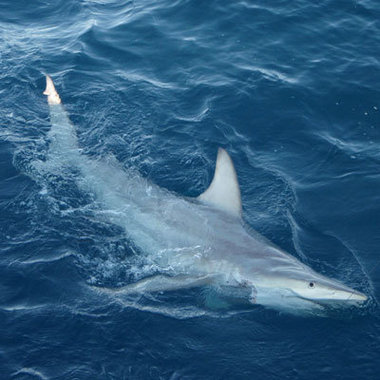
The Australian blacktip shark lives in tropical waters. The common blacktip shark prefers its water subtropical and temperate. Because of the difference in habitat, these two animals have become separate subspecies with distinct physical differences.

However, there are some places where their habitats overlap. And here, along the eastern coast of Australia, there is interspecies nookie. And hybrid baby sharks.

Now, none of that is particularly shocking. Hybrid zones, where the habitats of two genetically compatible species overlap, aren't ridiculously common, but scientists have documented quite a few. What makes this finding interesting is that the two species and their hybrid have been genetically documented. Hybrid zones can be fuzzy places. What happens there calls into question how sure we can be that that what we call species really are all that different from one another.

What makes this study interesting is that researchers actually performed genetic testing on sharks caught in the hybrid zone. They found distinct genetic differences between the blacktip and Australian blacktip sharks, especially in their mitochondrial DNA. And the hybrids were identified based on genetics as well. That's something that's a lot more rare in the study of wild hybrids. The information gathered here could end up having a lot to teach us about how evolution happens and what speciation really means.

Via Mo Costandi

Maggie Koerth-Baker is the science editor at BoingBoing.net. She writes a monthly column for The New York Times Magazine and is the author of Before the Lights Go Out, a book about electricity, infrastructure, and the future of energy. You can find Maggie on Twitter and Facebook.

Maggie goes places and talks to people. Find out where she'll be speaking next.

MORE:  evolution • hybrid • Science • sharks • species

More at Boing Boing

Eurovision 2013: An American in London

The technology that links taxonomy and Star Trek

  • Chuck

    But we can still attach frickin’ laser beams to their frickin’ heads, right?

  • Ramone

    It’s true, a shark will nail anything that swims. And then eat it.

  • Aeron

    Started to lose interest.

    “interspecies nookie”

    Kept reading. Oh Boing Boing, you please me so.

  • RedShirt77

    Wouldn’t the term “subspecies” mean they are in the same species and that their nookie, isn’t interspecies?

    This is more like a Lab and a poodle producing labradoodles.

    • Jonathan Micancin

      This intertaxon tapping phenomenon is looking more common as more biologists put their filthy brains to work finding examples.

      The old-school definition of subspecies: morphotypes/ecotypes of a species that do not overlap with each other. Within the range of the blacktip species, the habitat overlap (an ecotone) is associated with overlap in the phenotypes of the subspecies (can geographically separate subspecies “hybridize”)?
      “Lab and poodle” is closer to the truth, but not perfect.  Wolves, domestic dogs, and coyotes interbreed.  The dog is Canis lupus familiarus, a subspecies of the wolf.  But the dog and wolf overlap in their ranges, so the subspecies definition doesn’t work. 

      Species concepts are imperfect…I mean subspecies concepts are imperfect…I mean the whole system of taxonomy and nomenclature is imperfect.  

  • pablohoney

    My understanding is that hybrids are almost always sterile, so you can’t end up with gene-pool pollution. Chromosomal mismatch makes it impossible for the hybrids to produce viable offspring. 

    • AnthonyC

      Usually but not always.

      My favorite examples of where the term “species” becomes hard to define are ring species: http://en.wikipedia.org/wiki/Ring_species

      Also, the entire bacterial world, where asexual reproduction means there are no set interbreeding populations, but pretty much any two individuals can exchange plasmids and other snippets of DNA.

      • retepslluerb

        I wonder if they think of this as trading card games,

    • Beanolini

      The European edible frog is a hybrid with an interesting solution to your ‘chromosomal mismatch’- it only passes on the genome of one of its parent species.

      This means it can live alongside one of the parent species (pool frog or marsh frog) as a sort of ‘parasitic’ species, breeding with the parent species to produce more edible frogs.

  • MrBillWest

    Maggie, you need not look any further than your own back yard for a very popular hybrid known as the tiger muskie. It is the product of “nookie” between a true muskie and a northern pike. I have heard they even reside in Lakes Calhoun and Harriet.

  • Chris Lites

    “What makes this study interesting is that researchers actually performed genetic testing on sharks caught in the hybrid zone.”

    [No it doesn't.]

    • Beanolini

      [No it doesn't.]

      You’re right, it’s not this that makes it interesting. What makes it interesting is that nobody knew that these two species were hybridising until the genetic testing was done, nobody even knew this was a hybrid zone.

      The summary above really doesn’t make this clear (and the subspecies/species confusion is a bit embarassing).

  • snakepunk

    The correct term for crosses between subspecies is intergrade. 

    Within the reptile-breeding hobby, true hybrids from different species are not only common, but even crosses from different genera from other parts of the world produce fertile offspring.   Although the practice is very controversial amongst breeders, I personally find it fascinating.