Features Podcasts Family Video Comics Music Tech Science Books Film & TV Games ✚

Jill

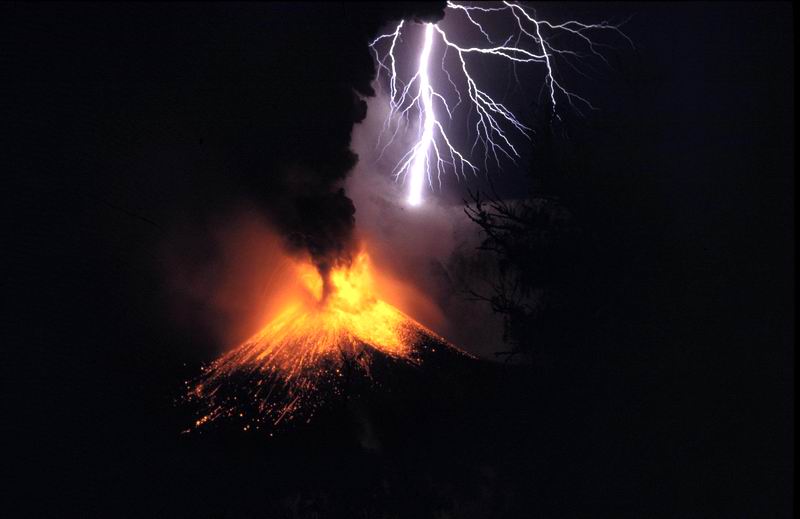
A practical use for volcanic lightning (besides metal album covers)

Maggie Koerth-Baker at 4:46 pm Wed, May 23, 2012

— FEATURED —

Book Review

The Man Who Laughs: grotesque Victor Hugo potboiler was the basis for The Joker

Feature

Eurovision 2013: An American in London

Book Review

The Twelve-Fingered Boy - mesmerizing YA horror novel

— FOLLOW US —

Boing Boing is on Twitter and Facebook. Subscribe to our RSS feed or daily email.


— POLICIES —

Except where indicated, Boing Boing is licensed under a Creative Commons License permitting non-commercial sharing with attribution


— FONTS —

Tweet
Kindle

Here's a story that combines two favorite bits of volcano news into one interesting discovery. You know those great, freaky photos of volcanic lightning? (In case you don't, I've got one posted above.) Remember how the Icelandic volcanic eruptions totally screwed up everybody's airplane travel plans?

Apparently, studying volcanic lightning could lead to better eruption detection systems that could make it easier to predict how big a plume of ash off that volcano will be—knowledge that can help airlines and travelers be better prepared. At Nature, Richard Monastersky reports:

The researchers found that the amount of lightning correlated with the height of the plume, something they could not test using more limited data collected during an eruption at Alaska’s Mount St Augustine in 2006. This observation is important, says Behnke, because systems to monitor lightning could provide an estimate for the size of an eruption, which is not always easy to assess for remote volcanoes.

During a previous eruption at Mount Redoubt in 1989 and 1990, for example, the size of the plume wasn’t known and a plane nearly crashed after passing through the ash cloud and temporarily losing all power from its engines. Behnke and her colleagues suggest that VHF stations similar to the ones they installed at Mount Redoubt could be used to monitor volcanoes to give early warning of an eruption and an estimate of its size.

Read the rest at Nature.com

Via Graham Farmelo

Image: Oliver Spalt via CC

Maggie Koerth-Baker is the science editor at BoingBoing.net. She writes a monthly column for The New York Times Magazine and is the author of Before the Lights Go Out, a book about electricity, infrastructure, and the future of energy. You can find Maggie on Twitter and Facebook.

Maggie goes places and talks to people. Find out where she'll be speaking next.

MORE:  airplanes • awesome • lightning • metal • Science • volcanoes

More at Boing Boing

Eurovision 2013: An American in London

The technology that links taxonomy and Star Trek

  • Bill Beaty

    You can personally monitor volcano lightning in realtime at the U of Washington VLF detector network site:  http://flash3.ess.washington.edu/USGS/Global/

    (Also storm lightning: http://webflash.ess.washington.edu/ )

  • msbpodcast

    If this works out, its an awesome way of gauging the potential size of the disruption that an eruption will cause.

    It could be directly observed from space by weather satellites. (The most recent eruption in Mexico could be used to see if the theory holds true.)

  • http://www.theblacklaser.net/ Joe The Wizard

    Uh, why would you ever use them for anything but metal album covers?? Seems like it’s the perfect fit to me.