Features Podcasts Family Video Comics Music Tech Science Books Film & TV Games ✚

Jill

Great moments in pedantry: How do you grow wine in a land without predictable seasons?

Maggie Koerth-Baker at 4:25 pm Mon, Dec 10, 2012

— FEATURED —

Book Review

Black Code: how spies, cops and crims are making cyberspace unfit for human habitation

Book Review

We Can Fix it! - a graphic novel time travel memoir

Science

The technology that links taxonomy and Star Trek

— FOLLOW US —

Boing Boing is on Twitter and Facebook. Subscribe to our RSS feed or daily email.


— POLICIES —

Except where indicated, Boing Boing is licensed under a Creative Commons License permitting non-commercial sharing with attribution


— FONTS —

Tweet
Kindle

Winter is here. Which means it's time once again to start science-wanking the climate of George R.R. Martin's "Game of Thrones" series. Back in May, i09 had a great piece on possible astronomical explanations for Westeros' weird seasons, where Summer and Winter can each last a decade. The hard part (which prompted lots of great conversations here) is that the lengths of the seasons are apparently totally unpredictable. Here's an eight-year-long Summer. There's a Winter that lasts five years and another that lasts a generation. The implications for food storage, alone, are enough to drive one batty.

Word of Martin says this is magic. But it presents so many science-related questions that it's really, really fun to speculate about how you might explain the differences between that world and ours in purely naturalistic terms.

Now, at The Last Word on Nothing, Sean Treacy brings up a different sort of food-related problem that I'd not even considered while I was busy trying to figure out the volume of the average Westerosi grain silo. How do you grow wine grapes without predictable seasons?

... grapevines have a life cycle that depends on regular seasons. In winter, grapevines are dormant. Come spring they sprout leaves. As summer begins, they flower and tiny little grapes appear. Throughout the summer the grapes fill up with water, sugar and acid. The grapes are finally ready for picking in early autumn, then go back to sleep in winter. This cycle is why wineries can rely on a yearly grape yield. Obviously, in Westeros, something must be different about how grapes work.

But it turns out there is a real-world way to produce wine throughout an endless summer. São Francisco Valley is a wine-growing region in tropical Brazil that is only about 600 to 700 miles south of equator. Despite the constant warmth, they pump out two and sometimes three grape harvests a year. How? By depriving the vines of water and removing their leaves after every harvest, which forces them to hibernate. “They trick the plant into thinking it’s wintertime,” Busalacchi said.

The whole post is really interesting and you should read it. Who knew that the Arbor would lead me to be more educated about real-world booze?

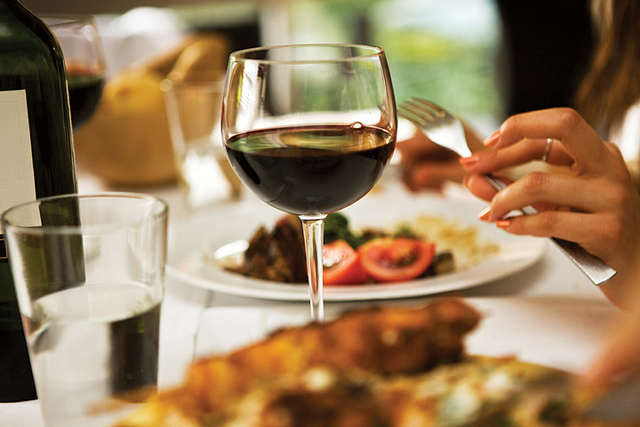
Image: Wine, a Creative Commons Attribution (2.0) image from isante's photostream

Maggie Koerth-Baker is the science editor at BoingBoing.net. She writes a monthly column for The New York Times Magazine and is the author of Before the Lights Go Out, a book about electricity, infrastructure, and the future of energy. You can find Maggie on Twitter and Facebook.

Maggie goes places and talks to people. Find out where she'll be speaking next.

MORE:  agriculture • booze • fanwanking • game of thrones • Science • wine

More at Boing Boing

The technology that links taxonomy and Star Trek

Hackers prepare for first "national holiday" in their honor

  • LYNDON

    Vintner is coming.

    • Brainspore

      A Lannister always pays his bar tab.

      • Tynam

        …then steals the bar.

        • Brainspore

          He doesn’t steal the bar. He seizes control of it, then spends the rest of the day f***ing the bar wenches.

  • Editz

    So many questions.

  • feetleet

    Worshippers of the Old Gods just smoke monster.  

  • Ian Osborne

    The answer is to grow wine [sic] in a land with predictable seasons.  

    Thanks, I’m turning in my 2 weeks notice. I need to re-evaluate my life and your world in it. Science is hard, so are rocks.  So my colleagues, stay strong, stay hard, go long, go deep, but not too deep.  It hurts the lymbic.  

  • John Smith

    I knew there was a good reason not to watch this.

  • $19428857

    Westeros is only Earth-like, not Earth. Why would Westeros grape vines have to respond to seasons like Earth grape vines? Wouldn’t the wild grapes in Westeros have evolved under the conditions of extended seasons and be presumably fit for that environment? What brings people to argue counterfactuals about a work of fiction (counterfictionals?) is beyond my ken.
     I once listened to an extended argument about the impossibility of warp drive and therefore Star Trek was stupid. This is the same sort of thing, just more relaxed.

    • Shane Simmons

      Maybe it’s because my fantasy experience is colored by fantasy like Lord Valentine’s Castle, but given the number of Earth-like creatures on the planet in addition to fanciful creatures, as well as an intelligent race which obviously hasn’t fully adapted to this world, I always assumed this world was a bit like Majipoor, hospitable to humans but not humanity’s origin, possibly mineral-poor, with this race’s possible extraterrestrial origin being lost in the mists of time.

      Or maybe the weather got funked up by the Doom of Valyria.

      It’s fun to speculate about how a fictional world, one which the author likely just waved the hands and left it to the reader to think about, could work.

  • http://twitter.com/alchematter Alchematter

    Sabeletodo has a pretty fair point. Seasonal ripening is really only “necessary” for plants which are in temperate climates — but there are plenty of tropical fruits which set fruit, develop, and ripen without significant swings in temperature or day length. Even, apparently, grapes!

    http://rfcarchives.org.au/Next/Fruits/Grapes/TropicalGrapes1-81.htm

    Weirdly, though, there don’t seem to be any fruits or seeds which take more than one year to ripen (Arbutus unedo is one which has new flowers and ripe fruit on at about the same time, with a 1-year ripening time). So that does seem to suggest that, at least as far as life on earth is concerned, it would be very unlikely that a plant would be able to evolve a ripening cycle that was greater than 1 year (otherwise, it would have happened in the tropics, where just about any differentiation can confer an advantage to somebody).

    In any case, the highly erratic nature of the seasons on this hypothetical world would make it difficult to imagine an evolutionary route which would result in complex plants at all (those with differentiated systems like flowers and seeds which take time to mature, and therefore require some consistency)

    Unless these plants could predict the weather. Then that would work :)

    • chgoliz

      One Earth year = one pass around the Sun.  It would seem the orbit of Westeros is different.

  • http://imcravingpresidency.tumblr.com/ SedanChair

    We’re sure as hell about to find out.

  • welcomeabored

    I’ve been trying to figure out, how to baby a french lavender we planted this spring, through the cold and dry of a Colorado winter.  I understand that this is a variety of lavender that dies back to the ground.  We put up a cloche to protect it from the northern winds.

    It makes sense to me that Westeros could make wine from a variety that dies back to the ground (however weird that would be here on Earth).  What stretches the imagination of my inner gardener however, is the notion of a plant whose roots remain viable for a ‘generation’. The definition of a ‘generation’ varies on google between 20-25 years.  A seed could last that long… but a root?  So, I’m going to go with the magic theory.

  • http://profiles.google.com/gtbear gt bear

    I have heard somewhere of marijuana growers doing something similar, using light fluctuations to have a year cycle in two months.

  • http://daruiburns.tumblr.com/ Dlo Burns

    Those grapes are being abused like foie gras geese.

  • http://profiles.google.com/leon.peon leon peon

    In the books they are always drinking mead, not “wine”, which is derived from honey, no?