Today on NPR "Day to Day," the fourth of a 5-part report I brought back from Central America — "Guatemala: Unearthing the Future." In the series, we learn how new technology is being used to solve old problems, and this fourth segment is all about infrastructure tech devices hecho a mano — made by hand — in Guatemala.
Link to today's episode, "Grassroots Technology at Xela Teco," with streaming audio (Real/Win), and some short video clips. MP3 Link. Link to narrated slideshow. Here are more photos: Link.
Link to series home page.
"Xeni Tech" home, and podcast feed. Here's a reporter's notebook blog with more background on these stories: Link.


Many of Guatemala's rural indigenous communities lack infrastructure basics such as clean drinking water, sanitation and electricity.
A group of American eco-engineers in the United States from the Appropriate Infrastructure Development Group (AIDG) is working with a number of Mayan villages to change that.
At Xela Teco, a workshop in the town of Quetzaltenango (or Xela for short), tech-minded Guatemalans build eco-friendly devices. The workshop is a small business supported by the U.S.-based nonprofit Appropriate Infrastructure Development Group.
Xela Teco builds environmentally friendly technology that can be used to bring survival basics to poverty-stricken villages in the Mayan highlands: clean water, electricity and fuel.
While Americans are part of the Xela Teco effort right now, their goal is to step aside. The hope is that arming rural communities with certain skill sets will help break a cycle of poverty, disease and malnutrition.
If the effort is successful, Xela Teco may end up becoming a blueprint for the future of development work.

IMAGES: 2007, Xeni Jardin. SPECIAL THANKS to Alex Lee, a longtime BoingBoing reader who emailed and suggested this story in the first place! (Link)
Previously:

Reader comment: Jeff says,
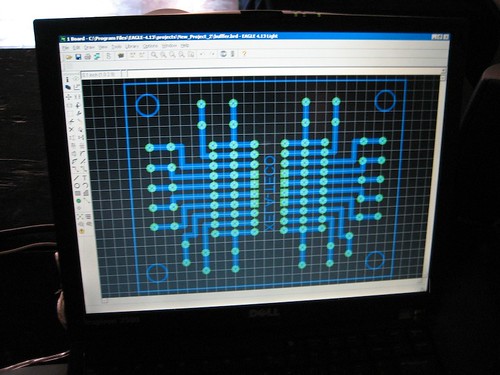
Why does Xela Teco use a flying spaghetti monster logo? What's with the dual flying spaghetti monster's fighting it out head-to-head in the screenshot photo? Is this some kind of mayan manichean splinter-cult? Do FSM true believers need to take action?
Peter Haas, director of AIDG (the organization that "incubated" the Xela Teco workshop) says,
No need to worry for the FSM followers, Xelateco is a non-denominational enterprise. That picture on the screen is in actuality a blow up of a circuit diagram of an interface for a buffer circuit for a sound card oscilloscope program. See the final figure on the following page: Link. Hope this clears up any confusion.