Features Podcasts Family Video Comics Music Tech Science Books Film & TV Games ✚

Jill

How EFF saved Indymedia from an unconstitutional subpoena for all its visitors' IP addresses

Cory Doctorow at 11:35 pm Mon, Nov 9, 2009

— FEATURED —

Book Review

The Man Who Laughs: grotesque Victor Hugo potboiler was the basis for The Joker

Feature

Eurovision 2013: An American in London

Book Review

The Twelve-Fingered Boy - mesmerizing YA horror novel

— FOLLOW US —

Boing Boing is on Twitter and Facebook. Subscribe to our RSS feed or daily email.


— POLICIES —

Except where indicated, Boing Boing is licensed under a Creative Commons License permitting non-commercial sharing with attribution


— FONTS —

Tweet
Kindle
When the US government demanded the IP address of every visitor to Indymedia's website (and ordered Indymedia to keep the request secret), Indymedia called the Electronic Frontier Foundation. EFF fought the subpoena -- which was grossly unconstitutional -- and won. Here's the story of how it happened, and remember, if you ever get a crazy, unconstitutional request from a G-man, stop and call a lawyer or get in touch with EFF.

The government added insult to injury by also inserting this language on the first page of the subpoena: "You are not to disclose the existence of this request unless authorized by the Assistant U.S. Attorney. Any such disclosure would impede the investigation being conducted and thereby interfere with the enforcement of the law."

The problem? The law doesn't require the recipient of a federal grand jury subpoena to keep the subpoena secret (which is why, typically, subpoenas often will "request" -- but not require -- a recipient's silence). There are certainly secrecy requirements for participants in the grand jury -- such as the jurors and the prosecutors -- but those requirements do not extend to witnesses (or potential witnesses such as a subpoena recipient). And although the SCA does provide the government with the option of obtaining a court order under 18 U.S.C. § 2705(b) requiring silence when the recipient's disclosure would have an adverse affect on an investigation, the government in this case did not obtain any such gag order.

In sum, without any legal authority to back up their purported gag demand, the government ordered Ms. Clair not to reveal the existence of the subpoena, a subpoena that as already described was patently overbroad and invalid under the SCA. This is exactly the kind of unjustified demand of silence that creates a fog around the government's often-overreaching surveillance activities. How many other subpoena recipients have remained silent over the years in response to such bogus demands, and how many of them violated their users' privacy by handing over data that the government wasn't entitled to? We simply do not know, and because of a lack of meaningful reporting about the government's use of the SCA, we cannot know.

We were determined that our client would not be one of the silenced, and that this illegal subpoena would eventually see the light of day.
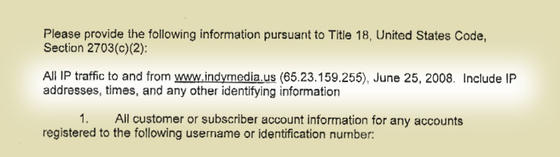
From EFF's Secret Files: Anatomy of a Bogus Subpoena

I write books. My latest is a YA science fiction novel called Homeland (it's the sequel to Little Brother). More books: Rapture of the Nerds (a novel, with Charlie Stross); With a Little Help (short stories); and The Great Big Beautiful Tomorrow (novella and nonfic). I speak all over the place and I tweet and tumble, too.

MORE:  Action • Civlib • privacy

More at Boing Boing

Eurovision 2013: An American in London

The technology that links taxonomy and Star Trek

  • lubertdas


    How long are we going to sit idly by and allow the Bush administration to assault our rights?

    • Notary Sojac

      Great post. The silence is deafening, innit??

    • Anonymous

      Yes, because less than 10 days after starting in office Obama had ANY effect on the actions of agencies like this.

      Sheesh.

  • Loraan

    No, no, no. If you get a crazy unconstitutional request from a G-man, comply, and they’ll give you retroactive immunity when it later comes out.

  • ArtistInEurope

    So what was the Justice Dept. trying to get? What was so special about that day?

    Why did it take the Obama Justice Dept and Attorney General Eric Holder so long to withdraw this request? (It was issued when Obama took office, perhaps a carry over from the previous admin. But why wasn`t it stopped once Attorney General Eric Holder was in office?)

  • Anonymous

    Warrant canaries need to flourish:

    http://en.wikipedia.org/wiki/Warrant_canary

    Only one in use currently, it seems:

    http://www.rsync.net/resources/notices/canary.txt

  • Anonymous

    @ArtistinEurope:

    The DOJ is still way behind on filling seats. As of September they were only at 31%, mostly due to Republicans holding up Obama confirmations. How can we expect the AG to personally handle every single case in the U.S., especially when he is so under staffed?

    The subpoena was entered into court records on 1/23/2009 and served 1/30/09. The enter date is 3 days after Obama took office. That means it was a Bush decision, unless Obama magically took the oath, got a prosecutor and had a federal grand jury seated and then they approve the subpoena in record time.

  • Anonymous

    “What was so special about that day?” Agreed, this is v. important.

    Unfortunately, the Wayback Machine has no record of the Indymedia site from that day — closest is at web dot archive dot org/web/20080430131630/http://indymedia.us/ — in fact, the Internet Archive has no record of the site for any day since.

    And at this moment, the Indymedia server seems to be down.

  • Anonymous

    lubertdas said “Yes, because less than 10 days after starting in office Obama had ANY effect on the actions of agencies like this.”

    Do not underestimate the power of a Presidential utterance. If the President says “do this” his aides turn around and immediately do it. It is possible that something like this could have been discussed on Obama’s first day in office. And in 3 days a subpoena could be issued.