Features Podcasts Family Video Comics Music Tech Science Books Film & TV Games ✚

Jill

Official Kansas state smackdown: Pteranodon vs. Xiphactius audax

Maggie Koerth-Baker at 11:43 am Thu, Feb 3, 2011

— FEATURED —

THE LATEST

Gweek 098: Win Hugh Howey's Paperwhite Kindle!

Book Review

Lexicon: smart, sharp technothriller from Max "Jennifer Government" Barry

Book Review

The 'Geisters: spooky, scary novel

Science

Ants and Stars: Bruce Sterling and Jasmina Tesanovic visit the Sardinia Radio Telescope in Italy

— FOLLOW US —

Boing Boing is on Twitter and Facebook. Subscribe to our RSS feed or daily email.


— POLICIES —

Except where indicated, Boing Boing is licensed under a Creative Commons License permitting non-commercial sharing with attribution


— FONTS —

Tweet
Kindle
DWMiller X-Fish.jpg

Finally, a science debate in the Kansas state legislature that doesn't make me want to beat my head against a desk.

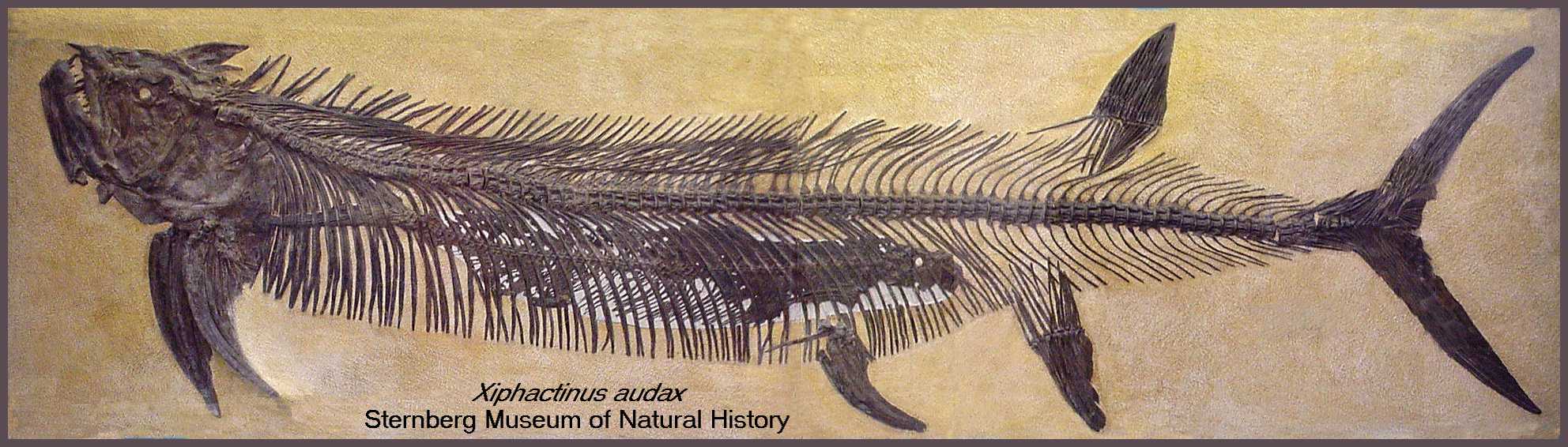
So, Kansas is apparently in the process of picking a state fossil. The original candidate, named in the House bill introduced on the 24th of January, was Xiphactius audax—best known for being the big fish of the famous little-fish-inside-a-big-fish fossil that resides at the Sternberg Museum of Natural History in Hays. Since the bill was introduced, however, there have been rumblings favoring a completely different fossil, the flying reptile Pteranodon.

Two fossils enter the statehouse. One leaves. But it's not entirely clear yet which will be the victor. Pteranodon has a much bigger public profile—it was in Jurassic Park, after all, and has featured prominently in many children's books about dinosaurs. Plus, according to the adjunct curator of paleontology at the Sternberg Museum, high-quality pteranodon fossils are almost exclusive to Kansas.

But, speaking as a former fossil-obsessed Kansan child, Pteranodon wasn't there to comfort me when I realized my state had been underwater for much of its deep pre-history and, thus, that I was unlikely to find a T. rex in my backyard. No. It was Xiphactius audax that dried my tears and made me hopeful again. Xiphactius audax that got me over my first bout with Midwestern inferiority complex. And it was Xiphactius audax—or, at least, its huge, pointy teeth—that gave me a wonderful, terrified thrill every time I went into the basement of KU's Dyche Museum.

Besides, as you can clearly see from the artistic rendering above, Xiphactius audax would totally kick Pteranodon's ass.

Detail of a painting of Xiphactius audax by D.W. Miller.

Maggie Koerth-Baker is the science editor at BoingBoing.net. She writes a monthly column for The New York Times Magazine and is the author of Before the Lights Go Out, a book about electricity, infrastructure, and the future of energy. You can find Maggie on Twitter and Facebook.

Maggie goes places and talks to people. Find out where she'll be speaking next.

MORE:  politics • Science

More at Boing Boing

Ants and Stars: Bruce Sterling and Jasmina Tesanovic visit the Sardinia Radio Telescope in Italy

The Snowden Principle

  • regeya

    My kids love Dinosaur Train, so I’m pulling for Team Pteranodon!

  • ogvor

    As a life-long Kansas resident, I’d give my vote (if it were up to one) to Xiphactinus. This is based on the bad ass name and the fact that it’s a giant carnivorous fish.

  • flatfive

    Xiphactius audax wins purely for its name. So metal. (Or Seussian. Either way, really.)

  • Mister44

    What about the Mosasaur?

  • Brainspore

    Kansas is picking a state fossil…

    Too late for making a Bob Dole joke?

    • Anonymous

      I’m afraid those of us whose first thought was

      “Kansas state fossil? Bob Dole!”

      thus qualify as fossils ourselves.

  • shadywood

    I can tell you that not only did Xiphactinus have incredible teeth (I have a few from here in Texas that are 3″ long and a beautiful polished black color), but they are one of the few prehistoric fish whose vertebrae fossilize really well.

    From our local creeks I have picked up verts that are 4″ diameter and 2.5″ thick, and still preserve every fine detail, right down to their growth rings. Pretty cool to be able to count how many years a giant carnivorous fish lived, back in the Late Cretaceous!

    • Mister44

      You know… my dad found over a foot worth of spine one time. IIRC it was fossilized, though when he found it it was freed from rock. There were a few ribs – but they were too fragile to bring back. Your tale of finding them in creeks makes me wonder if that is what he found. It seemed really detailed, iirc.

      Also – that new filter feeding fish found in W. Kansas was featured in Discover last year.

  • Anonymous

    XiphactiNus. nerdcomment forthcoming.

    Technically, neither of these creatures are dinosaurs. Xiphactinus belongs to the Osteoglossomorpha family (bony fishes, essentially). While Pteranodon was certainly important, it’s not even a dinosaur. It’s a reptile. Dinosaurs belong to the groups Saurischia and Ornithischia; this exludes pterosaurs. Pteranodon is a popular choice, of course, but Xiphactinus represents a bigger find. Technically, the Sternberg specimen is two fossils, and it gives a lot of information on how fishes of that age fed.

    I vote Xiphactinus.

  • Anonymous

    The obvious choice: http://www.flickr.com/photos/fromagenoir/5414334592/

  • Daddyology

    Anon beat me to it — as my six-year-old would quickly point out, neither of these are dinosaurs. One is a fish, the other a flying reptile.

    But given that it’s coming from the folks on the other (some might way “wrong”) side of State Line Road, not all that surprising.

    • Maggie Koerth-Baker

      I don’t think I called either of them dinosaurs. Now I’m going to have to go back and check.

      Kansas didn’t call them dinosaurs, either. They’re up for State Fossil, not State Dinosaur.

      • Daddyology

        **crawls back under lurker rock**

        • Maggie Koerth-Baker

          Don’t hide! I just wanted to clarify. :)

  • Anonymous

    Kansas is not ALLOWED to pick a state fossil!

    Fossils are not REAL animals – they are GOD’S TRICKS to test our Holy FAITH!

    The earth is 6000 years old!

  • PaulR

    That Xiphactius audax only looks bad-assingly menacing because of the foreshortening.

  • Anonymous

    It might be argued that the fusulinid has more of a claim to the title. We sure have a lot of them in the steps of the KU Natural History Museum.

    • scottfree

      I was about to make a pedantic comment on the use of a word further up the front page. I’m glad I scrolled down.

      Let’s hope the debate is as passionate and well argued as your effort!

  • Anonymous

    I’d like to second the correction to Xiphactinus. It comes from Greek xiphos = sword and aktis = ray. Pteranodon is from pteron = wing and anodon = toothless, which is maybe not quite as neat.

    The main thing, though, is that Pteranodon is already known and enjoyed everywhere. Xiphactinus deserves the press a little more, and would be a lot more distinctive. Go for the fish, Kansas.

  • Anonymous

    Posted this on the kusports.com message board got some good responses.
    http://boards.kusports.com/showflat.php?Cat=0&Number=1936768&page=0&fpart=all&vc=1