Features Podcasts Family Video Comics Music Tech Science Books Film & TV Games ✚

Jill

The history of timelines

Maggie Koerth-Baker at 9:42 am Wed, Feb 8, 2012

— FEATURED —

THE LATEST

Guatemala: Archive of documents from Rios Montt genocide trial, overturned 10 days after guilty verdict

THE LATEST

Guatemala: Nation's highest court throws out Ríos Montt genocide trial verdict and prison sentence

Feature

Eurovision 2013: An American in London

Book Review

The Twelve-Fingered Boy - mesmerizing YA horror novel

Book Review

Black Code: how spies, cops and crims are making cyberspace unfit for human habitation

— FOLLOW US —

Boing Boing is on Twitter and Facebook. Subscribe to our RSS feed or daily email.


— POLICIES —

Except where indicated, Boing Boing is licensed under a Creative Commons License permitting non-commercial sharing with attribution


— FONTS —

Tweet
Kindle

The earliest timelines, published in the 1500s and 1600s, were difficult-to-follow mashups that attempted to place all of human history into a list of numbers or an elaborate graphical metaphor. (I imagine the people who made these being somewhat stoned ... "So the fourth millennium before the birth of Christ was totally like a dragon! Here, let me show you ...")

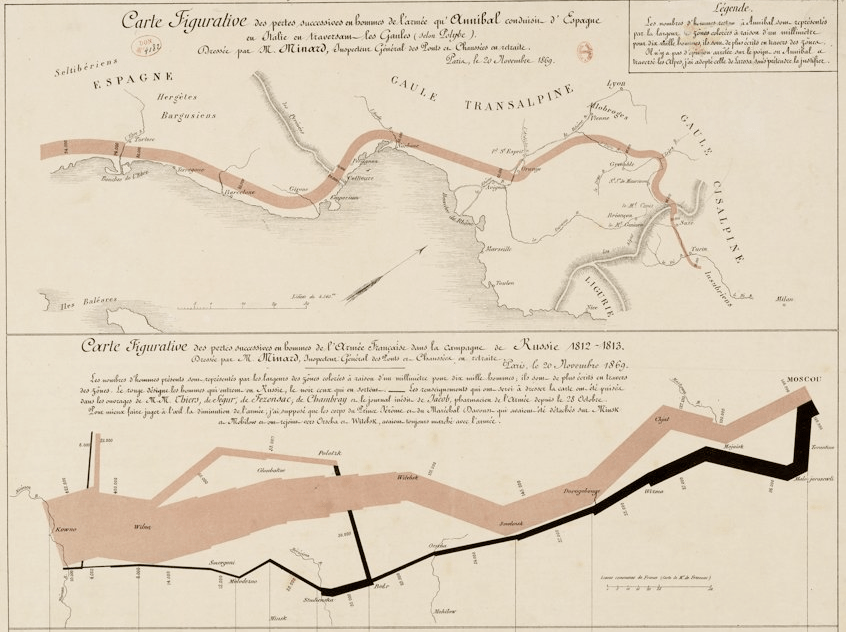
By the 19th century, though, the art of the timeline had progressed significantly, and people like French engineer Charles Joseph Minard were creating infographics that look recognizably like infographics. This one, from 1869, traces the routes taken by Hannibal on his march through the Alps and Napoleon on his march into Russia, showing, through the thickness of the bars, how both armies dwindled during the journey.

This is from a great collection of historic timelines published on The Morning News website. Definitely worth flipping through the entire slideshow!

Via Philip Bump

Maggie Koerth-Baker is the science editor at BoingBoing.net. She writes a monthly column for The New York Times Magazine and is the author of Before the Lights Go Out, a book about electricity, infrastructure, and the future of energy. You can find Maggie on Twitter and Facebook.

Maggie goes places and talks to people. Find out where she'll be speaking next.

MORE:  Art and Design • History • infographics • information • Science

More at Boing Boing

Eurovision 2013: An American in London

The technology that links taxonomy and Star Trek

  • Alan Olsen

    These timelines look like they were taken from “The Visual Display of Quantitative Information” by Edward R. Tufte.  (A very good book and highly recommended.)

    • Jeb Adams

      The amount of information in that latter timeline is mindboggling. It shows the size of the army vs time, some geography, the distance from France, the fucking weather! It’s amazing. Where’s the Visio template for this?

      • jimh

        A major point of Tufte’s work is concerned with data resolution. A basic timeline with events superimposed on a graphic depiction of dates along an axis is a low-resolution figure. We only learn when certain things happened. He believes that any information designer worth his or her salt will provide at least two (and perhaps more) levels of resolution, and that anything less is a waste of space.

        He uses the Napoleonic march to Moscow as an example of high resolution- as you point out, we learn a lot more about that journey than one element by studying the figure.

    • Fang Xianfu

      I love that book, and I love that map even more – it’s beautiful! And one of the very first examples of a graph, too.

      Highly recommend Tufte’s book for anyone trying to visualise large quantities of data (there’s a fantastic star map in there too), or anyone who’s ever been frustrated by people demanding that all numbers be displayed with a pie or bar chart.

  • carabosse

    For anyone interested in maps or information design, I heartily recommend buying their book http://amzn.com/1568987633  It’s beautifully put together, one of my favorite cartography books.  Now that GIS software has evolved to a new level of integrating time and space, these design ideas are especially worth revisiting for inspiration.

    p.s.  I like this even better than Tufte’s books.

    • http://optic.livejournal.com/ Optic

      would you mind fixing that link, or giving the title of the book? That one is a 404 for me. Thanks!

  • fromnabulax fromnabulax

    Just as a point of interest, the explanation of the Napoleon time line is a bit too simple. The table shows in brown the population of Napoleon’s army on their march to Moscow, while the incredibly fast dwindling black line displays the French on their retreat.

    • IronEdithKidd

      Funny how the megalomaniacal pretenders to world domination ignore the historic outcomes of invading Russia in the fall. 

      • kerowhack

        That should be right behind “never get involved in a land war in Asia.”

        • IronEdithKidd

          That goes without saying.

  • mkultra

    Someone really should do an infographic timeline of infographic timelines,  which could then place a smaller version of itself at the end.

    • kerowhack

      Yo dawg I heard you like timelines, so I put a timeline in your timeline so you can visualize chronology while you visualize chronology!

  • Mujokan

    When I see that Napoleonic one I feel like I’m watching men in rags trying to cross a half-frozen river.

  • http://www.facebook.com/postelwait Cameron Postelwait

    no timeline of timelines?  disappointing.

  • http://twitter.com/Selkiechick Selkiechick

    I have this book:
    http://books.google.com/books?id=5qx2AAAAMAAJ&pg=PA48-IA2#v=onepage&q&f=false
    And I love paging through it as a kid, trying to get a feel for what things were happening at the same time in the things we were discussing at school. Now that I am older, I want to spend a little time looking over the political parties chart on page 48.

  • Mussels

    For those interested in mapping, the above two maps (along with 68 others that do similar, but not identical mapping tasks) are on display at Northeastern University’s Snell Library in the traveling Places and Spaces: Mapping Science exhibition. Very cool exhibit!

  • http://www.facebook.com/profile.php?id=4807842 DJ Schuldt

    Cartographies of Time: A History of the Timeline by Anthony
    Grafton and Daniel Rosenberg from Princeton Architectural Press is definitely my favorite book on the history of timelines. And it an absolutely stunning book.
    http://www.papress.com/html/book.details.page.tpl?isbn=9781568987637

  • http://profile.yahoo.com/2UQHDZASWBS5BWDI33JKD2FZ6Y KonstantinS

    my fave infograph is found here : http://earthquake.usgs.gov/earthquakes/recenteqsww/

    it’s mesmerizing how the globe with the colored rectangles and their size can pass all the necessary information. it’s my small fetish and i view it on daily basis :)