Features Podcasts Family Video Comics Music Tech Science Books Film & TV Games ✚

Jill

Hypercard at 25

Rob Beschizza at 7:53 am Thu, May 31, 2012

— FEATURED —

Science

Last chance to enter the Armchair Taxonomist challenge!

Book Review

We Can Fix it! - a graphic novel time travel memoir

Science

The technology that links taxonomy and Star Trek

Book Review

Odd Duck: great picture book about eccentricity and ducks

— FOLLOW US —

Boing Boing is on Twitter and Facebook. Subscribe to our RSS feed or daily email.


— POLICIES —

Except where indicated, Boing Boing is licensed under a Creative Commons License permitting non-commercial sharing with attribution


— FONTS —

Tweet
Kindle

Matthew Lasar at Ars: "Where does HyperCard fit in the narrative of innovation? It's always tempting to go the condescending route and compare the program to, say, the optical telegraph, which was the magnetic telegraph's largely forgotten predecessor; or to John Logie Baird's mechanical television set, a forerunner to electronic TV; or to the cable/satellite music download experiments of Bill Von Meister, all of which tanked but eventually inspired America Online. But these were all flops. In its two decade life span, HyperCard was enormously successful, and it succeeded all over the world."

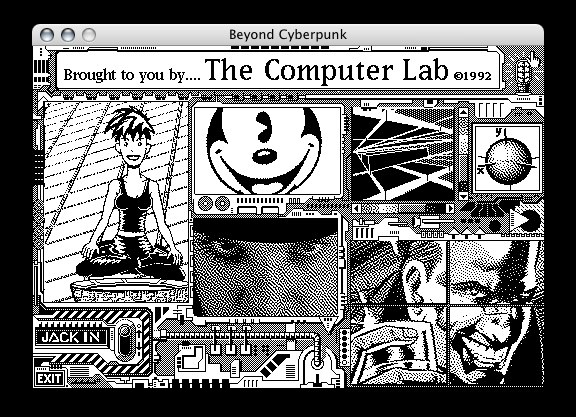
P.S. Spot anything interesting about his choice of screenshot?

⟿ Follow Rob Beschizza on Twitter.

MORE:  hypercard

More at Boing Boing

The technology that links taxonomy and Star Trek

Hackers prepare for first "national holiday" in their honor

  • Rich Keller

    The  cartoon figure in the lotus position reminds me of an early bOING bOING cartoon spokesperson. Is that the interesting thing? Actually, the whole image is pretty fun.

  • millie fink

    P.S. Spot anything interesting about his choice of screenshot?

    The perennial appeal to geek boys of boobage? 

    Oh wait, that wouldn’t be anything new/interesting…

  • hbgvfcdxsz hbgvfcdxsz

    P.S. Spot anything interesting about his choice of screenshot?
    nope

  • Chuckhazard

    Well it has a modern mac osx titlebar…

    • http://pulse.yahoo.com/_OAUXAA362EXWLYVMPJOKLFB5JQ Incipient Madness

      I’ am sure this is what we were supposed to notice. Maybe this means there are OSX versions of Hypercard.

      First time I ever used a web browser I thought to myself, “This is  a lot like Hypercard.”

  • gramturismo

    The interesting thing is that I always enjoy Rob’s posts about retro computing, they always capture that magic.

  • drzz

    Don’t flip that switch, or you’ll have a mess on your hands.

  • Karl S.

    Screenshot looks like a series of images taken from Mondo 2000. Uh, R.U. Sirius?

    • Ultan

       But it feels like it should have a grainy animated-gif version of the flip-book cyber wang/yin-yang that was in the corner of Semotext(e) SF.

  • Ito Kagehisa

    “”Where does HyperCard fit in the narrative of innovation?”

    In the same place as Sony Betamax home video recorders…  vastly overrated.  HyperCard was elegant and interesting, but not nearly as groundbreaking or world-changing as its’ hyperfans insist.

    As Lasar points out, it’s tempting to be condescending, and I’ve never been good at resisting temptation.

    • Mitchell Glaser

      Hypercard was astonishingly cool, anyone who really used it sees that. Among other amazing features, it had an object-oriented programming language that was completely in english (Hypertalk) that can’t be beat, even 25 years later.

      The only thing that kept it from eating the world was that it was trapped in Apple land. Sure, there were Hypercard clones created for windows, but they all either worked poorly or cost money. Some of the clones are still around today. Every year or so I get the urge to recreate Hypercard using javascript in a browser. 

      • Ito Kagehisa

         I used it.

        • Massive Missive

          You didn’t use it to do anything interesting, or you wouldn’t have that attitude. HyperCard was an incredible environment for creatives, a far better technology than BASIC for teaching kids to program, and a far more productive programming environment than Visual Basic, which came after it.
          The worst thing Apple did with it was fail to immediately follow it up with a color version (the Mac II was introduced in 1987, and so was HyperCard). It might have otherwise been the development environment for the iPad.

          It’s not often noted, but HyperCard was also Bill Atkinson’s second paint program, the sequel to MacPaint. The painting tools in HyperCard were limited by modern standards, but much faster to use than MacPaint due to some thoughtful shortcuts, such as single-key keyboard access.

          Oh, and the clones I used all missed the point entirely. HyperCard was a really slick rapid development environment — it was really easy to modify objects on the fly while you were using them. SuperCard, last I checked, had a separate IDE. Dumb.

      • http://www.raines.com/ raines

        An iPad app that is very HyperCard-ish is imminent…. Infinite Canvas can digest a series of image files or HTML 5 pages and provide interactive navigation, be it comic-book reader or offline RPG app.
        http://www.infinitecanvasapp.com/

  • gorfulator

    In thought the smiling guy had an aerosol spray can of UBIK!!

  • http://www.markcrummett.com crummett

    Kata Sutra, I do miss you.

  • http://www.millsworks.net/blog Robbo

    I love Hypercard! We made an interactive childrens storybook called “Ali Baa Baa & The Forty Winks” about a toy sheep who had an Arabian Nights adventure on a desert/bedspread landscape (it was released in 1989 around the same time as “Inigo” and “Manhole”, the precursor to “Myst”) and it was just SO COOL to have the tools to create with graphics, audio and hyperlinks. A very liberating and creative experience. Thank you Hypercard.

  • Sparrow

    I heard you like Beyond Cyberpunk, so I put Beyond Cyberpunk in your bOINGbOING and bOINGbOING in your Beyond Cyberpunk so you can hypercard while you surf

    http://boingboing.net/2005/09/21/beyond-cyberpunk-hyp.html
    http://www.streettech.com/bcp/BCPgraf/CyberCulture/boingboing.htm

    • Stephen Young

      I did that port!
      http://www.streettech.com/modules.php?op=modload&name=News&file=article&sid=820

      edit: for some reason that link wont work. you have to click the address and hit enter.

  • Uhclem

    I think the image is a screenshot from an old set of boingboing floppy disks I had, back before the internet, on a really early Mac…

  • petsounds

    I think Ars tried to push a connection to the WWW way too heavily. HyperCard (people, it’s camelcased — it was the 80s, after all) was of much closer kin to Macromedia Director and then Flash than it was to web browsers. Director was the spiritual successor to HyperCard, including its own human-readable OOP language. The article lamented HyperCard’s lack of purpose, but Director had one: create and play interactive multimedia experiences on the newfangled CD-ROMs of the 1990s. Apple was sadly just too lost in the weeds at that point to see HyperCard’s potential.

    As a kid I made an RPG in HyperCard on my Mac Plus. I had to draw all the graphics with my mouse, but it had a full combat system, inventory, and contextual clicking and hovering for the mouse. The only way I could distribute it was to upload to local Mac BBSes, but if memory serves the HyperCard stacks didn’t compress in Stuffit very well, and so it was a very glacial upload time on my 2400 baud modem.

    Oh also, Rob…is that your crazy eyes in the dithered black & white photo?

    • http://www.facebook.com/profile.php?id=760930627 Michael George

      Nah. That’s Alex from “A Clockwork Orange”.

  • http://orbitnet.com JIMWICh

    That was the opening screen.  When I was designing it, I took bits from the desktop image I’d created called CyberPort:

    http://www.anigami.com/jimwich/jimwich_desktops/CyberPort_v2_1024x768.html

    Plus Kata Sutra of course…

  • hutchfx

    I heart HyperCard! I had the immense pleasure of seeing Bill Atkinson demo it at UC Berkeley, when it first came out. I used it for all kinds of things.

    SuperCard http://www.supercard.us/ still exists, with an OSX Lion version recently released. I frequently use it to bang out quick  projects, mostly when I need to put changing graphics on a screen in a TV show set.

    LiveCode http://www.runrev.com/ also came out of HyperCard. It’s cross platform, including mobile OSs. You can develop on one platform and deploy on many. After many years in the Mac world I have to admit, I had a strange sense of joy the first time I saw one of my apps run on a Windows machine!

    I believe that both of the above have tools for converting HyperCard stacks.

    • http://www.raines.com/ raines

      I assume you got to see it at a Berkeley Mac Users Group (BMUG) meeting? You’re Welcome [to quote John Hodgman].

      Srsly, HyperCard was big in my life… as an accessible authoring platform, a database with a visual overlay, and a public viewer bundled on the platform.

      At the rollout at Macworld Expo/Boston, I won Danny Goodman’s HyperTalk scripting book at a User Group breakfast raffle, and then I soaked it up at the Newport Jazz Festival shortly afterwards. To this day I associate that music with developing stacks.

      We got early exposure to it because BMUG and BCS/Mac, two prominent user groups, were listed in the manual as fallback support resources in case you didn’t have a local user group. Thank you, Apple User Group coordinator Ellen Leanse!

  • http://twitter.com/WikiTruths Wiki-Truths

    I made a game in way back in high school – for me it was mind blowing as I could draw my comic characters – scan them in – shade them – and then process to bang out the game play. I did something similar to Dragon’s Lair where you had to do a certain action to progress – with clicks on certain areas of the screen (instead of directions) then you could flip through cards to make it animate – I wish I still had a copy of that game! Like html with those hotspots over images. I recently made an iPhone app in Cocos and just wished the entire time I could do it in hypercard instead as it was a pretty basic slideshow type game.

  • http://twitter.com/MoonpieNobot Moonpie Nobot

    There is a lot that is interesting about the screenshot. What were you thinking of specifically?

  • VaughnMarlowe

    I bought a Mac Plus and printer back then so I could have a desk top printing press. I threw all that other shit out.

  • buchacho

    Does anyone know where a copy of the original hypercard stack can be found?

    • Stephen Young

      I still have the disks,  I bought them off ebay to do the web port,  but I don’t know if I can read them(I don’t have the quadra 800 anymore).  I may have the images still.  I will look.

    • Stephen Young

      http://home.comcast.net/~kuangmk11/bcp/bcp.htm

      • buchacho

        Thanks so much!  I am sort of a stack collector.  I am looking for one called ”Smut Stack” or “SmutStack” which is supposed to be cutting edge for its time.  There’s something about 1-bit graphics… My current rig is an SE/30. 

  • MajorD

    Someone created a “Whirlitzer of Wisdom” hypercard game based on the ZBS radio play Fourth Tower of Inverness.  It branched off into a number of separate puzzles, some of which I eventually solved — though not all. Parts of it remain puzzling to me even today, and I’ve never found another ported version online anywhere else.  It still haunts.

  • http://www.facebook.com/people/Gareth-Branwyn/540057072 Gareth Branwyn

    The above screen cap is from Beyond Cyberpunk!, the 1992 5.5MB HyperCard stack about cyberpunk sci-fi and the then-burgeoning cyberculture that I created with Mark Frauenfelder, Peter Sugarman, and the mysterious Ward Parkway (aka Jim Leftwich). It included contributions from Bruce Sterling, Rudy Rucker, Steve Brown, Mike Gunderloy, Hakim Bey, Richard Kadrey, RU Sirius, and a whole bunch of other amazing people. It had hundreds of articles, animations, sounds, events, a spoken glossary, and Kata Sutra, the female leader of the neoWobblies (seen in the image above), a cyber-anarchist poetic terrorist group, and her search engine AI, a lazy trickster of a cyber-dog named codeHound. They haunt the stack, causing mayhem.

    In 1993, an update stack was produced, called What Ever Happened to the Future Since the Last Time We Talked. We also released a mini comic that Mark and I did and full and 1/4 page ad comics that appeared in Mondo 2000, Boing Boing, and other zines.

    BCP got wildly favorable reviews in the New York Times, Washington Post, Journal of Sci-Fi Studies, MacWorld, MacWeek, Mondo 2000, Wired, and elsewhere. It was also featured in the TIME magazine Cyberpunk cover story. Interesting people called up to order it from me, including Billy Idol, Lily Tomlin and Jane Wagner, John Hughes, and William Shatner’s assistant. Robin Williams was also a fan.

    You can see the online text and B&W images of it as well as some other stuff (like John Bergin’s sketches for the CD box we were planning to do — with the original and update stacks together), here:

    http://www.streettech.com/bcp

    • buchacho

       That’s exciting!  If the CD could also run on 68K Macs with running stacks, that would be huge.  It would probably be the biggest software release for those machines in over a decade.

      Is the “What Ever Happened to the Future Since the Last Time We Talked” stack available for DL or purchase?

  • kosmograd

    Hey I can barely remember my kids’ names, but I instantly recalled Kata Sutra from the bOING bOING fanzine, and that she was the leader of the neoWobblies.