Features Podcasts Family Video Comics Music Tech Science Books Film & TV Games ✚

Jill

Where the colors of fireworks come from

Maggie Koerth-Baker at 10:51 am Tue, Jul 3, 2012

— FEATURED —

Science

Making sense of the confusing Supreme Court DNA patent ruling

Book Review

The 'Geisters: spooky, scary novel

Science

Ants and Stars: Bruce Sterling and Jasmina Tesanovic visit the Sardinia Radio Telescope in Italy

Feature

The Snowden Principle

— FOLLOW US —

Boing Boing is on Twitter and Facebook. Subscribe to our RSS feed or daily email.


— POLICIES —

Except where indicated, Boing Boing is licensed under a Creative Commons License permitting non-commercial sharing with attribution


— FONTS —

Tweet
Kindle

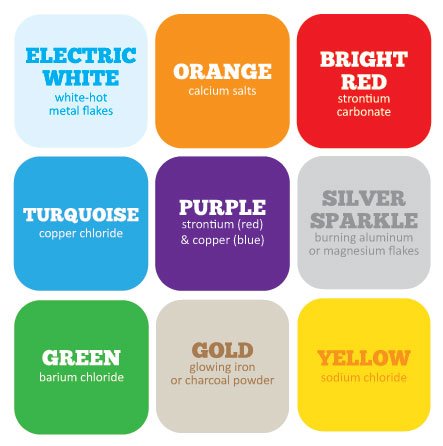
The Works is a kids science and tech museum in Bloomington, Minnesota, just a few miles from where I live in Minneapolis. Today, they had this cool chart up on their Facebook page, explaining which chemicals produce the colors you see in fireworks. How cool is that? Tomorrow, when the rockets glare red, you'll know that's actually strontium carbonate.

More about The Works

Thanks, Nicole Wieler!

Maggie Koerth-Baker is the science editor at BoingBoing.net. She writes a monthly column for The New York Times Magazine and is the author of Before the Lights Go Out, a book about electricity, infrastructure, and the future of energy. You can find Maggie on Twitter and Facebook.

Maggie goes places and talks to people. Find out where she'll be speaking next.

MORE:  4th of July • fireworks • holidays • Science

More at Boing Boing

Ants and Stars: Bruce Sterling and Jasmina Tesanovic visit the Sardinia Radio Telescope in Italy

The Snowden Principle

  • bcsizemo

    Just remember kids, never stare directly at burning magnesium…

    (Also when brazing aluminum, make sure it really is an aluminum part and not magnesium….)

  • archanoid

    Salt? Yellow comes from salt? waddayaknow…

    • dutchs

       Same color as in sodium vapor lights. For the same reason.

  • fyodordos

    Polluting your air with heavy metals in the name of entertainment …………….. how cool is that?

    • http://www.facebook.com/profile.php?id=13718286 Jonathan Jaekle

       None of the metals in the chart are heavy metals.  Calcium, magnesium, sodium, and iron are all natural parts of our body chemistry.

      • Douglas Stuart

        From wikipedia:  Barium’s name originates from the alchemical derivative “baryta”, which itself comes from Greek βαρύς (barys), meaning “heavy.”

        Barium is not only a heavy metal, it is indeed toxic in water soluble forms. Classic example I use for teaching solubility rules.

        • http://www.facebook.com/people/Oliver-Schmieding/100000452523362 Oliver Schmieding

          quoting it’s etymology from wikipedia does NOT make barium a heavy metal – a density of  more than 5  g/cm³ would.

          • cellocgw

            No, I think you have to turn the amps up to eleven to qualify as heavy metal

          • Douglas Stuart

             There is no accepted IUPAC definition for “heavy metal,” and  here is a link to the Dufus article.

            http://iupac.org/publications/pac/74/5/0793/

            The density of barium is <5 g/cm3, and I would think that by any of the many other "definitions" of heavy metal, barium would be considered a heavy metal.

    • http://pulse.yahoo.com/_3OLJHLNUYNQOVIVUX4VYPMN2BE c

       Pretty damn cool I’d say. Now go home and cry yourself to sleep.

    • http://www.facebook.com/profile.php?id=1147127257 Michael D. Williams

      A little clarification here, the term “heavy metals” is just that, a term.  Heavy metals refer to many of the chemical elements in the middle part of the periodic table.  The heavy is not a reference to density per say to begin with.  Barium and Strontium are elements in the “Calcium” family (column) and not in that middle area of the table.  Also known as transition elements.  Barium is not toxic in the sense or way that Chromium VI or Lead ions are, causing chronic disease like gradual brain damage or cancer.  Barium posioning is acute like cyanide.  It makes you ill by interfering with or competing with Potasium and Calcium utilization or metabolism in the body.  The technical reason for the arrangement of elements on the periodic table or chart is the arrangement of electrons in each type of element.  It is too complex to discuss here but briefly, and you can research it further if you are interested.  Atoms have s, p, d, and f orbitals.  Electrons fill these in a complex order, in varius and different shapes.  The “Sodium” and “Calcium” families have s bonding or valence orbitals, the nonemetals, Boron thru Fluorine to Neon have p bonding orbitals, the Transition elements have d orbitals, and the strange two row below the rest of the table are the “Rare Earth” or Lanthanide elements and Actinide elements, these have the strange f orbitals as their outer electrons.  The Actinides are all redioactive!  You also must remember that much of the naming of the elements is based on history.  The elements that are less reactive may be found in or seen in nature easily in their native or pure form uncombined with other elements.  These are the metals known to bronze and earlier aged man and have non “-ium” or “-um” ending names:  Iron, Copper, Gold, Silver, Lead, Zinc, Cobalt, Nickle, etc. (and of course the non-metal sulfer).  Several of the first “scientifically” discovered elements also have common or “English” names, Carbon, Oxygen, Chlorine, Iodine, Neon, etc.  Eventually it was decided to name elements with an “-ium” ending.  Note the chemical symbol for many elements is taken from their Latin names and not the “English” or official name used for the element; examples of this are Iron=Fe (Ferrum), Postasium=K (Kalium), Gold=Au (Aurum), Silver=Ag (Argentum).

      Yes, Sodium, Calcium, Magnesium, and Iron are all found in and neccessary for animal (and human) life.  Strontium and Barium are not.  Aluminum and Copper may be or are needed in tiny trace amounts only as dietary “minerals”.  Radioactive Strontium 90 and Iodine 131 are dangerous and “poisonous” as produced by nuclear reactors or atomic bombs.  Strontium is deposited in bone like Calcium and Magnesium.  Iodine collects in and is used by the thyroid gland. 

      • dutchs

        Good post. I’d add that the elements known in ancient times all have “weird” symbols because the symbols are based on Latin (Fe for Ferrum, iron, etc.) The metals mentioned in the Bible are Au, Ag, Cu, Fe, Pb and Sn. Hg was also known in ancient times. Most of these either occur in unalloyed form in nature (Au) or were easily smelted (Pb). The big mystery is tin. Others were known as compounds like Na (Natrium = lye), K, Sb. (You can count Sb as a Biblical metal if you read the Bible in Spanish – Jezebel painted her eyes with “antimonio”) You covered some of this. Nickel gets its name from kupfernickel or “Old Nick’s (devil’s) copper because nickel sulfides look like ore but didn’t smelt easily. Cobalt comes from “kobold,” or gremlin, for similar reasons. Tungsten has the symbol W from its alternate name wolfram, which has a complicated and not entirely clear etymology.

    • dutchs

       I’d worry a lot more about combustion residues from the propellant and the casing. And the second hand smoke from the spectators.

      • Douglas Stuart

         I read that Disney use compressed air to launch their rounds. And a lower smoke (and thus more expensive) explosive formula.

  • billstewart

    When we made fireworks when I was a kid, the answer to where red came from was “road flares”.  (I knew it was some kind of strontium compound, but probably couldn’t have told you which one.)

  • timquinn

    name of my next album; “Glowing Iron”

  • zish

    When I think of The Works, my mind tends toward the toilet cleaner with the same name, and some aluminum foil. Put them both in a 2 liter soda bottle, and get some distance away. Lots of fun! There are plenty of Youtube videos of the same, if one were wondering about the wonder of said wonderment.

  • Mike The Bard

    Ah, nothing like the rockets’ strontium carbonate glare.

  • jazzhunt

    Years ago I knew someone who tried to develop coloured flames in candles by impregnating wicks. She quit once she realised most of what she was using produced noxious fumes, which wasn’t quite the atmosphere she was trying to create. She would love this list.

    • Douglas Stuart

       They sell color flame candles at the grocery store.

  • http://www.facebook.com/people/Bozanfè-Bon-Oungan/100001040498735 Bozanfè Bon Oungan

    Red violet = potassium permanginate

    • Douglas Stuart

       KMnO4 + glycerol and you can have your own mini-volcano at home =)

  • The Works

    Thanks for reposting, Boing Boing!