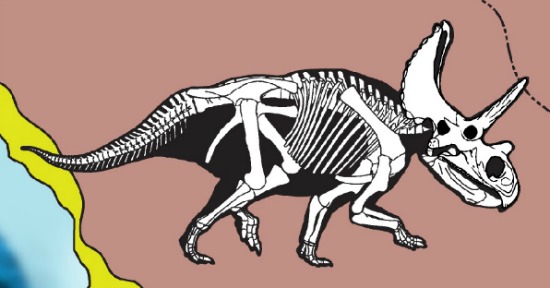
At The Dinosaur Tracking blog, Brian Switek is starting a cool, new series meant to highlight the lesser-known dinosaurs that the public as long ignored. Sure, it's a bit easier to pronounce Tyrannosaurus, but Agujaceratops and Zalmoxes still deserve their 15 minutes of fame.
The alphabetical series kicks off today with the aforementioned Agujaceratops. Found in Texas, Agujaceratops is distinctly different, in several ways, from its cousins that have been found in the northern part of North America. In fact, writes Switek, Agujaceratops is so different, that it's making paleontologists reconsider ancient North American geography.
At the species and genus levels, the southern dinosaurs are different. The big question is, why? Paleontologists know that a shallow, vanished seaway separated dinosaurs on eastern and western subcontinents for millions of years, but on that western subcontinent called Laramidia, there was apparently some other kind of barrier that isolated northern and southern dinosaur populations.
The hypothesis relies on basic evolutionary theory. Isolate populations of an ancestor species in different regions, and through factors such as natural selection and genetic drift, those populations will evolve in different ways. The fact that Agujaceratops, Kosmoceratops and Utahceratops are so different from Chasmosaurus and other northern cousins are a sign that such a barrier was in place. No one has found it yet, though, and a great deal of work remains to be done on whether all these dinosaurs were really contemporaries or reveal a much more complex evolutionary pattern. As these investigations continue, though, Agujaceratops will continue to play an important role as a symbol of isolation and evolution.
Follow along with the Dinosaur Alphabet at the Dinosaur Tracking blog


