Features Podcasts Family Video Comics Music Tech Science Books Film & TV Games ✚

Jill

HOW TO: Fish in the desert

Maggie Koerth-Baker at 5:06 am Sat, Oct 27, 2012

— FEATURED —

Book Review

The Man Who Laughs: grotesque Victor Hugo potboiler was the basis for The Joker

Feature

Eurovision 2013: An American in London

Book Review

The Twelve-Fingered Boy - mesmerizing YA horror novel

— FOLLOW US —

Boing Boing is on Twitter and Facebook. Subscribe to our RSS feed or daily email.


— POLICIES —

Except where indicated, Boing Boing is licensed under a Creative Commons License permitting non-commercial sharing with attribution


— FONTS —

Tweet
Kindle

In the United Arab Emirates, a freshwater lake has appeared in the middle of the desert. The oasis is beautiful and full of life, and it's risen 35 feet since 2011. It's also probably accidentally man-made.

Hydrologists believe the lake formed from recycled drinking water (and toilet water). The nearby city of Al Ain pumps in desalinated sea water, uses it for drinking and flushing the toilet, cleans it in a sewage treatment plant, and then re-uses it to water plants. All of that water ends up in the soil and, at the lake site, it comes back up.

The water is clean, writes Ari Daniel Shapiro at NPR. Don't worry about that. Instead, the major side-effect of the lake is change, as scientists watch the desert ecosystem that used to exist on the site decline, and a new one rise to take its place. It's a great story that shows how complicated discussions about ecology can be. On the one hand, you're losing something valuable. At least in this one spot. On the other hand, you're definitely gaining something valuable, too.

"With every species that we lose, it's like rolling the dice. The whole ecosystem could crash down," Howarth says.

But Clark, with the U.S. Geological Survey, says he's not so worried about the desert ecosystem. He says the lake is tiny compared to the vast amount of desert in this part of the world. "If I look through the binoculars, there's, like, seven different kinds of herons. There's greater cormorants. There's ferruginous ducks, which are another very rare worldwide species," Clark says. "There's about 15 of them out here."

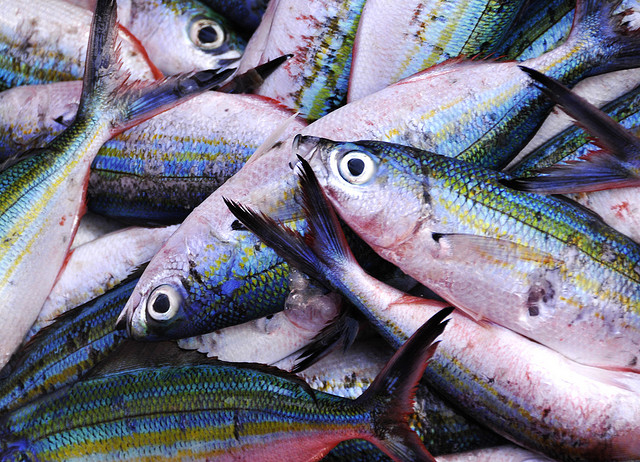
This year, three types of birds bred at this lake. They've never been able to breed before in the United Arab Emirates. But this lake, and the others like it, have changed all that. There are fish appearing in these lakes as well. Fish eggs cling to the feet and legs of the herons. So as the birds shuttle between old and new lakes, the eggs fall off and hatch. That's how you get fish in a desert.

Read the full story at NPR

Image: fish, a Creative Commons Attribution (2.0) image from wattsdave's photostream

Maggie Koerth-Baker is the science editor at BoingBoing.net. She writes a monthly column for The New York Times Magazine and is the author of Before the Lights Go Out, a book about electricity, infrastructure, and the future of energy. You can find Maggie on Twitter and Facebook.

Maggie goes places and talks to people. Find out where she'll be speaking next.

MORE:  change • ecology • Environment • oasis • Science • UAE • water

More at Boing Boing

Eurovision 2013: An American in London

The technology that links taxonomy and Star Trek

  • http://twitter.com/fossilfuels Funk Daddy

    The song is “Love will find a way” but the truth is that life will find a way, even if it means spizatzing on a heron’s leg

  • shutz

    But, what will happen to the sandworms?  And to the spice?  The spice must flow!

  • welcomeabored

    Did I understand this correctly… a possible new ecology in the desert based on desalinated gray water?  The mind boggles and the imagination leaps in terraforming.  The return of the forests.  Lebanon cedars.  Lakes on Mars.  Forests on Mars.  Forests of cedar on Mars. (boggle!)

    Meanwhile, up the road a bit from our house, there is a small lake outside a water reclaimation plant that we pass on our way to the freeway on-ramp.  Around the lake this summer, as the water warmed and evaporated, were rings of heavy salts indicating the content of the water, and on top, a thick carpet of algae.  When the algae ran out of (likely) oxygen, the carpet died back and the birds that will tolerate the salts, returned.  It is an altogether sad sight to see.  We roll up our windows and shut off the air intake till we’re past the stink of the feedlot as well.  It’s worth suffering the heat, not to gag on the smell.

    • http://thisisonlya.blogspot.com robcat2075

      If we can just get the UAE to send all their gray water to Mars…

      Interesting how the fish manage to cross the land barrier.  Growing up in Minnesota (“Land of 10,000 Lakes”) I never heard much of an explanation of how that worked.

  • http://bradhicks.livejournal.com/ J. Brad Hicks

    So, basically, it’s the eastern-hemisphere Salton Sea? That’ll end well.

    • http://horseisahorse.myopenid.com/ HorseIsAHorse

      All that’s ever rewatered the Salton since the original inundation (besides the occasional rainstorm) is agricultural wastewater. The water source for this lake is considerably cleaner. So as long as Al Ain keeps a-flushin’ and a-waterin’, that lake may do pretty well.

      • http://bradhicks.livejournal.com/ J. Brad Hicks

        Which will last exactly as long as that country can afford to operate that desalinization plant.

  • anansi133

    Looking for the water body on Google earth, not finding it. They may not have updated the imagery since the lake occurred.

  • welcomeabored

    (in response to robcat2075)

    A second cup of java hitting my nervous system, fuels a flight of fancy.

    But isn’t there suppposedly a lot of water locked up on Mars in the form of ice?  I haven’t kept up… and won’t live long enough to see what may be made of terraforming on another planet.

    Meanwhile - baby steps, man, baby steps.  To save our remaining forests and their vital functions on our little blue planet, I’ll be visiting a voting booth, to say ‘yay’ on the legalization and regulation of marijuana in the ssomething I may live long enough to see come to fruition.tate of Colorado.  By decriminalizing pot, I hope to see the return of hemp as a major, multi-use crop in our country, within my life time.

  • winkybb

    Howarth seems a bit of a damp squib. Talk about glass half empty. She’s worried about the change to a tiny bit of desert in the UAE? Really? Are there not larger environmental issues to spend time on? What about the environmental cost of producing all that water using fossil fuels?