Features Podcasts Family Video Comics Music Tech Science Books Film & TV Games ✚

Jill

What we can learn about volcanic eruptions from the vehicles trapped in their path

Maggie Koerth-Baker at 7:19 am Fri, Feb 8, 2013

— FEATURED —

Book Review

Black Code: how spies, cops and crims are making cyberspace unfit for human habitation

Book Review

We Can Fix it! - a graphic novel time travel memoir

Science

The technology that links taxonomy and Star Trek

— FOLLOW US —

Boing Boing is on Twitter and Facebook. Subscribe to our RSS feed or daily email.


— POLICIES —

Except where indicated, Boing Boing is licensed under a Creative Commons License permitting non-commercial sharing with attribution


— FONTS —

Tweet
Kindle

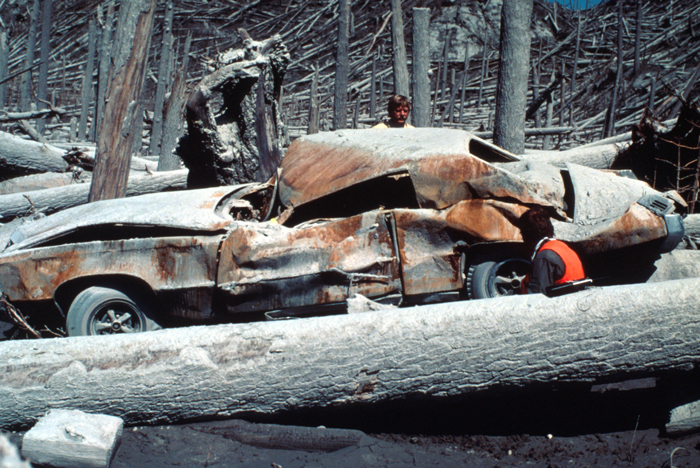
The car in this photo was 13 kilometers northeast of Mount St. Helens when that volcano erupted on May 18, 1980. This photo was taken about a month later by researchers from the United States Geological Survey. At the Rosetta Stones blog, Dana Hunter has a really fascinating story — with more eerie photos — about why geologists would want to study totaled vehicles and what we can learn from machines that we can't learn from people.

Maggie Koerth-Baker is the science editor at BoingBoing.net. She writes a monthly column for The New York Times Magazine and is the author of Before the Lights Go Out, a book about electricity, infrastructure, and the future of energy. You can find Maggie on Twitter and Facebook.

Maggie goes places and talks to people. Find out where she'll be speaking next.

MORE:  geology • History • mt. st. helens • Science • volcanoes

More at Boing Boing

The technology that links taxonomy and Star Trek

Hackers prepare for first "national holiday" in their honor

  • Bevatron Repairman

    I think the “unidentifiable” photo is metal around an instrument panel and the center post of the steering column.  Looked like a cylinder gasket at first, but was not symmetrical.  

    • TheMadLibrarian

      I think you may be right, although I’m surprised something that is largely plastic wasn’t turned into a fused lump.  It would help to have a larger context with positioning, rather than a closeup.

      • Donald Petersen

        If I’m not much mistaken, the car appears to be something like a 10-year-old Mercury Cougar.  My 1970 Cougar came with wheels exactly like those, although the beltline and apparent lack of side marker lights would suggest a ’67.

        In any case, whatever it is, it’s from the late 60s.  That instrument cluster would have plastic lenses, but most of the rest of the visible portion of the instruments would be metal.

        Weird that the tires are still more-or-less intact.

  • http://www.youtube.com/user/PipLagenta Pip_R_Lagenta

     If we learned anything from Louisiana Governor Bobby Jindal, it is that volcano research is, like, *totally* stupid.

  • http://www.facebook.com/people/Shane-Simmons/100000053744641 Shane Simmons

    I went on a family vacation about 10 years after that happened.  It was astounding to be several states away, and see Mt. St. Helens ash on the ground.  The area itself was mind-blowing to see.  I have no idea what it looks like in person 20 years later, but judging from photos, it hasn’t changed much.  You drive down roads that are mostly used for logging, and drive through this green forest until you hit the devastation.  At first, you think you’ve driven back into the desert, but no.

  • http://www.disoriented.net/ angusm

    The main thing we learn from studying vehicles trapped in the path of a volcanic eruption is that you should try very hard not to get trapped in the path of a volcanic eruption.

  • Preston Sturges

    I saw an interview with a survivor who fled the pyroclastic flow.  IIRC  He said he was doing about 110 when he passed a station wagon doing about 85.  Then they showed the scorched station wagon in a pile of tree trunks.  The road itself was invisible.   

  • johnphantom

    What is that a Camaro? Why are the tires still on it?

  • http://www.facebook.com/people/Rick-Adams/100000053021803 Rick Adams

    I was born about twenty miles from the mountain just eight days before it blew. I can tell you that growing up around the area and watching the blast zone change has been one of the most fascinating parts of my life. If you ever have a chance to go, it’s still a very cool thing to see. I’ve been on top of the mountain twice, looking down into the crater and out into the blast and the effect is incomprehensible.