Features Podcasts Family Video Comics Music Tech Science Books Film & TV Games ✚

Jill

Space vehicles, to scale

Maggie Koerth-Baker at 11:33 am Mon, Jun 18, 2012

— FEATURED —

Book Review

Black Code: how spies, cops and crims are making cyberspace unfit for human habitation

Book Review

We Can Fix it! - a graphic novel time travel memoir

Science

The technology that links taxonomy and Star Trek

— FOLLOW US —

Boing Boing is on Twitter and Facebook. Subscribe to our RSS feed or daily email.


— POLICIES —

Except where indicated, Boing Boing is licensed under a Creative Commons License permitting non-commercial sharing with attribution


— FONTS —

Tweet
Kindle

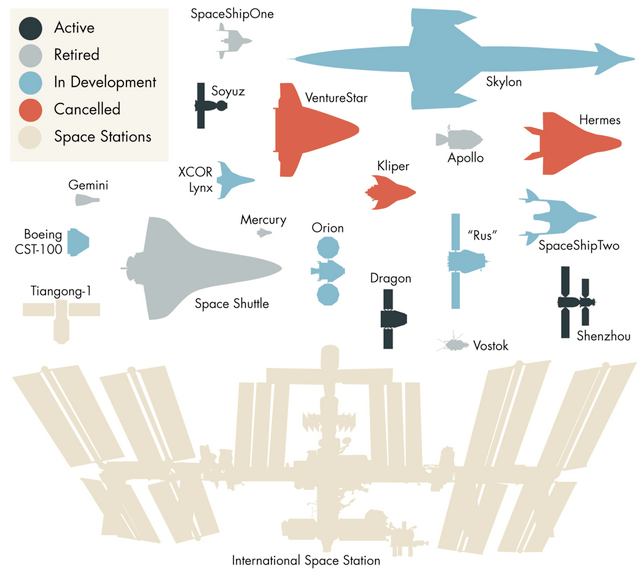
Digging this drawing by astronomy blogger Invader Xan, showing spaceships of the past, present, and (possible?) future lined up side-by-side for size comparison. I, for one, just learn that the Space Shuttle Orbiter was larger than I thought in comparison to the International Space Station.

Also cool: Skylon—a rather terrifying name for a spaceplane that's currently in the early stages of development by a private company. Interestingly (or, perhaps, even more terrifyingly—seriously, this thing is going to need a new name, like woah), Skylon would not have a human pilot but would be capable of hauling humans into space, carrying up to 24 in a special box loaded into the payload bay.

Check out Invader Xan's blog, Supernova Condensate, for more information, including a version of this graphic that includes the Starship Enterprise.

Via Ananyo Bhattacharya

Maggie Koerth-Baker is the science editor at BoingBoing.net. She writes a monthly column for The New York Times Magazine and is the author of Before the Lights Go Out, a book about electricity, infrastructure, and the future of energy. You can find Maggie on Twitter and Facebook.

Maggie goes places and talks to people. Find out where she'll be speaking next.

MORE:  cool • graphics • Science • Space • space ships • unfortunate names

More at Boing Boing

The technology that links taxonomy and Star Trek

Hackers prepare for first "national holiday" in their honor

  • chenille

    Very neat! It reminds me of Starship Dimensions for fictional spaceships.
    If you don’t like the name Skylon, they could always go with Cynet.

    • MarcVader

      Or just call it Toaster.

  • Nadreck

    Well, if the “Skylon” could lose that tail out the back we could call it “Fireball XL-5″.

    • http://www.matthewpetty.com/ Matthew Petty

      Fireball XL5 meets SR71

  • awjt

    Get off my Skylon.

  • http://twitter.com/motionview motion view

    We picked Skylon.  Don’t piss us off already.
    -Your new robot overlords

    • MarcVader

       I for one…

  • http://www.facebook.com/profile.php?id=507894702 Adam Coe

    did they know that skylon is the name of the not-so-impressive tower next to Niagara Falls?

  • http://twitter.com/incarnedine_v Dan Hibiki

    something tells me Soyuz will still be in service long after Skylon is retired after several design flaws are revealed following several tragic incidents.

  • jgs

    How can Skylon fail? Their Chief Engineer is not merely Mr. Scott, he’s Mr. Scott-Scott.

  • stumo

    It’s a British company, so I assume that http://en.wikipedia.org/wiki/Skylon_(tower) is the inspiration for the name. 

  • baronkarza

    …No love for Skylab? It had a pretty spectacular retirement! I’d be curious to see how its size would have compared.
    http://mattstodayinhistory.blogspot.com/2006/07/skylab-falls-to-earth-july-11-1979.html

    • http://twitter.com/incarnedine_v Dan Hibiki

       http://historicspacecraft.com/Diagrams/S/ISS_Size_Comparison_1200x700_RK2011.jpg

      • http://www.madmadrasi.net/ mad.madrasi

        here is an extended version showing Skylab, Salyuts and Mir
        http://i.imgur.com/UKkSC.png 

        • niktemadur

          Ah yes, thank you, I was looking for Mir.

          Now where’s the Death Star and The Culture Orbitals, dammit! ;-)

          • http://www.madmadrasi.net/ mad.madrasi

            not to forget 
            Millennium Falcon
            8-)

    • jgs

      The artist does address this in the comments thread: “this graphic is intended to showcase spacecraft capable of orbital and suborbital manned flights. Space stations don’t really belong here as they were assembled in orbit, and wouldn’t survive atmospheric reentry. The two space stations shown are purely for scale.”

      • StreetEight

         ”spacecraft capable of orbital and suborbital manned flights”

        Hmmmph,  no love for the X-15 I guess.

        • jgs

          If you click through to the article you’ll see the artist apologizes for missing the X-15, promises to update the graphic, and also links to a “cool remix” http://i.imgur.com/sHws5.png that does include both the X-15 and Skylab, Mir et al.

  • http://beautifulsynthesis.com Andrea

    Mercury was so tiny…

    Brings home the amount of guts it took to go up in that thing.

  • Jay Converse

    Where’s the NCC-1701?

    • Antinous / Moderator

      All of these would fit in Ten Forward.

      • MarcVader

         You are of course now referring to the NCC-1701-D. Mercury would probably fit in a large Jeffries tube. シ

      • jgs

        Enterprise is here: http://25.media.tumblr.com/tumblr_m4aodvO0gT1qa0fruo1_1280.png

        It doesn’t say which NCC-1701 variant it is, but by the looks of it the Shuttle wouldn’t even fit in the shuttle bay. Awkward, that.

  • Sebastian Lambinon

    Where’s Mir?

  • Ryan Lenethen

    “Skylon would not have a human pilot but would be capable of hauling humans into space, carrying up to 24 in a special box loaded into the payload bay.”

    Then one day the autonomous Skylon realized that it could use its special box for fuel, the earth changed that day.

  • http://twitter.com/BongBong BongBong

    That “Skylon” vehicle is almost a direct copy of the royal Naboo space crusiser (Queen Amidala) from Star Wars. This project smells “scammy”.

  • WaferMouse

    Skylon is actually based on the older HOTOL research.  They recently successfully tested some key enabling technologies for the engine cooling system, which is where much of Skylon’s planned SSTO magic lies.

    Terrifying as the name is, I think the technology’s worth pursuing, and I’d love to see something designed in Britain make it into space. It does kinda remind me of the massive plane from Thunderbirds, though.

    • nartacht

       Skylon – terrifying? Not when we already have SKYNET (British military SATCOM constellation)…

    • http://twitter.com/lessernerds Carlson & Crashboy

       Is it even possible to enter orbit by flying at an angle? I always thought you tried to go “straight up” because that would be the most fuel efficient way to fight gravity.

      • WaferMouse

        I honestly do not know. It IS rocket science, after all :) But they’re trying, and I dig their single-engine approach.

        And besides, it’s plain old exciting :)

      • Exo

        All orbital vehicles enter space at an angle.  The space shuttle, for instance, used to take off the pad vertically and then roll over and fly to orbit at an increasingly  shallow angle as altitude is gained.  There are many reasons for this, but the main one is that when something is orbiting the Earth it is actually constantly falling AROUND the Earth. 
         Imagine you could throw a ball so hard that it landed in the next State over.  It goes up in a curve… and comes down in a curve.  Now throw it even harder and Faster and it will make it to the next Continent, well over the horizon, in a even bigger arc.  Throwing it fast enough and high enough to enter orbit means that  when the ball starts falling back to the Earth, the earth “falls away” in the same arc.  IE, the curvature of the earth is the same ‘curve’ that the falling ball has.  So the ball just goes round and round.  It hasn’t escaped gravity at all, it’s just going so fast that it is falling around the earth instead of coming back down to the surface.
        So…. If rockets just flew straight up away from the Earth, they would fall straight back down to the surface as soon as they run out of fuel.  Even if they are in space.  Instead, orbital vehicles fly up in that big ballistic curve, and when they reach the top of the curve (the apogee) they are hauling ass and are moving “horizontally” compared to the earth’s surface.  And since they are beyond our atmosphere, there is nothing to slow them down, so they just keep going and going.

        http://www.youtube.com/watch?v=GE_USPTmYXM&feature=related  Good example of the pitch-over of the spaceshuttle.  Look at  that curve!

      • http://glitch.tl/ Michael Smith

        The Apollo lunar module ascent stage flies an almost horizontal trajectory from a few seconds after liftoff. Launches from Earth go a lot higher initially to get above some of the atmosphere.

  • Boundegar

    Whose idea was it to render the ISS in white-on-white?  I thought it was a graphics glitch at first.

  • Donald Petersen

    Am I the only one to remember the Skylons from the old Land of the Lost TV show?  When I was six years old, my favorite football team was the Pittsburgh Steelers for the sole reason that their logo slightly resembled the Skylons that controlled the weather in one particular episode of that show.

  • http://twitter.com/rachelpearce Rachel Pearce

    What is wrong with the name Skylon? The only connotation I know is the Festival of Britain one.

    • http://maggiekb.com/ Maggie Koerth-Baker

      It sounds distressingly like the love child of two different fictional killer AI systems: Cylons and Skynet. 

      • Felton / Moderator

        Fracking skylons!

  • Ms. Anne Thrope

    Where’s Serenity??

  • http://www.facebook.com/grafixrj Roger Jones

    I’d like to see them add the larger NCC-1701-D in comparison