Features Podcasts Family Video Comics Music Tech Science Books Film & TV Games ✚

Jill

Pyura Chilensis, the living rock

Maggie Koerth-Baker at 11:53 am Thu, Jun 28, 2012

— FEATURED —

THE LATEST

Gweek 098: Win Hugh Howey's Paperwhite Kindle!

Book Review

Lexicon: smart, sharp technothriller from Max "Jennifer Government" Barry

Book Review

The 'Geisters: spooky, scary novel

Science

Ants and Stars: Bruce Sterling and Jasmina Tesanovic visit the Sardinia Radio Telescope in Italy

— FOLLOW US —

Boing Boing is on Twitter and Facebook. Subscribe to our RSS feed or daily email.


— POLICIES —

Except where indicated, Boing Boing is licensed under a Creative Commons License permitting non-commercial sharing with attribution


— FONTS —

Tweet
Kindle

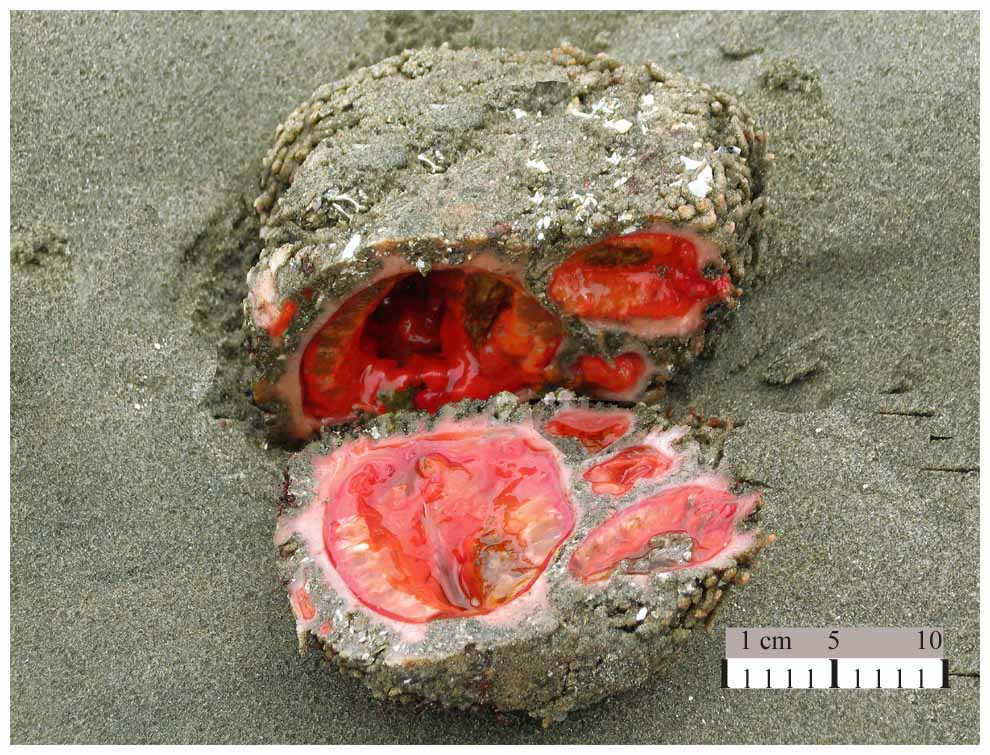
This is not a geode. It's an animal. An apparently delicious animals with clear blood, whose body is accumulates surprisingly large amounts of a rare metal used to strengthen steel.

This is Pyura chilensis—an immobile ocean creature. Besides the other traits I mentioned, P. chilensis is also capable of both sexual and asexual reproduction. At the Running Ponies blog, Becky Crew explains the results of a 2005 study that detailed the creature's breeding habits for the first time.

The results showed that P. chilensis is born male, before becoming cosexual – having both male and female gonads – in its adolescence as it increased in size. The researchers also found that given the choice – that is, if situated around other individuals – these organisms prefer to breed via cross-fertilisation, writing, “Given that more events of natural egg spawning followed by successful settlement and metamorphosis were recorded in our paired specimens and in our manipulated cross trials … it appears that cross-fertilisation predominates in this species.”

Manríquez and Castilla also found that a greater number of fertilised eggs resulted from the paired specimens, which suggests that cross-fertilisation, or reproducing with another individual, predominates because it is more effective. This assumption was strengthened by the fact that individuals that had cross-fertilised before being put in isolation took at least two months before successfully producing offspring via selfing. However, they were careful to note that while cross-fertilisation was preferred, selfing did not produce inferior offspring. “No perceptible differences in fertilisation, settlement and metamorphosis success among self and outcross progeny were found,” they reported. This suggests that when stuck alone in the ocean, selfing provides an advantageous opportunity for loner P. chilensis individuals to still pass on their genes.

Read the rest of Becky Crew's post to learn more about Pyura chilensis

Maggie Koerth-Baker is the science editor at BoingBoing.net. She writes a monthly column for The New York Times Magazine and is the author of Before the Lights Go Out, a book about electricity, infrastructure, and the future of energy. You can find Maggie on Twitter and Facebook.

Maggie goes places and talks to people. Find out where she'll be speaking next.

MORE:  animals • awesome • oceans • reproduction • Science • Weird

More at Boing Boing

Ants and Stars: Bruce Sterling and Jasmina Tesanovic visit the Sardinia Radio Telescope in Italy

The Snowden Principle

  • http://www.youtube.com/user/Freethinkersanon Christopher

    And looking at that picture the first thing that comes to my mind, naturally, is, “I’m a doctor, not a bricklayer.” 

    And after reading the article and learning that vanadium is the metal the animal accumulates, and that it’s eaten raw or in salads, what comes to mind is Spalding Gray and his macular pucker, caused, according to one of his doctors, by a buildup of vanadium in his system.

    • malindrome

      We need to get Leonard Nimoy over there stat if we want to communicate with this thing.

      • CognitiveDissident

        You’re third.
        (And Ryan Lenethen beat me to it, the darned tribble!)(That insult sounded better before I typed it.)

  • Nutrition Industry

    I predict rapid identification of the mechanism for selective vanadium uptake, followed by patents, and commercial vanadium production from seawater soon to follow.  Oh wait, I just made prior art – now its all open source FTW. :)

  • Jerril

    Was an animal. Now it looks like it’s on its way to becoming dinner.

  • William Ventura

    Oh please god no, what the hell is that don’t tell me.

    j burton

  • PeterCantropus

    Buargh…. Piure is disgusting. I really don’t understand how my grandma loves to eat that stuff so much. I believe it has to have one of the strongest odors among seafood and the taste is like drinking yodine.

    • Paul Renault

       You mean, it’s like eating dulse?

      • Antinous / Moderator

        Nachos and margaritas? No, we’re having dulse and screech.

        • Paul Renault

           Dulse and beer, my son!  It’s too salty for rum.

      • PeterCantropus

        People generally eat them mixed with onions, parsil and lots of lemon juice. Crazy people (and the divers that harvest the stuff) just open them and eat them directly.

    • http://twitter.com/dargaud Guillaume Dargaud

       Yeah, I remember eating some years ago. The shell had a consistence like a soft plastic covered in sand and the taste was so strong in iodine it required a lot of white wine to swallow.

  • Ian Hammond

    NO KILL I

    • Nutrition Industry

      They never did check if Horta were edible…

      • http://pulse.yahoo.com/_4EWIB4NVT4PQIONUL7CDZXHIXM RayA

         Looked like pizza. Probably tasted like it, too! :)

  • Rob

    Looks like someone killed a very cool creature for our viewing pleasure.

    It makes me sad.

    • http://pulse.yahoo.com/_4EWIB4NVT4PQIONUL7CDZXHIXM RayA

       It’s all good. Just eat it, or mount it on a wall! :)
      With some padding, it’d also make a decent ottoman.

    • sfnate

      Boing Boing, the snuff exotic creatures blog.

  • Angryjim

    Who needs science fiction aliens when we have stuff like this on earth.

  • wysinwyg

    I hate it and never want to see another one ever again.

    • Antinous / Moderator

      And keep nassssty chips?

  • Ryan Lenethen

    Reminds me of the Star Trek lava creature that spock communes with…

    • CognitiveDissident

      You stole my comment!
      I want it back!
      (The early word gets the yearn.)

  • http://www.facebook.com/cristian.g.ibanez Cristian Gutierrez Ibanez

    the other cool thing about this creature is that is a “close” relative to us, a tunicate,  the sister subphylum of vertebrata. 

    http://en.wikipedia.org/wiki/Tunicate 

    edit: this means that they are more closely related to us than a fly.

    • Awesomer

       Ah, you beat me to it. Isn’t that a cool fact? Yup, they’re chordates, which means they have spinal cords, but they’re invertebrates, so no spines.

      Speaking of weird sea creatures and what flies are more closely related to, barnacles are arthropods, meaning they’re much more closely related to flies than to clams, limpets, anemones, starfish, chitons… Counterintuitive, at least to me.

      • http://www.facebook.com/cristian.g.ibanez Cristian Gutierrez Ibanez

        yeah, that one always surprises  people (me included when I took  zoology many years a go). the telling thigns is the meat. if you eat barnacles you’ll see the meat is very much like crab meat. very tasty too. unlike piures which I hate.

  • beemoh

    Living rocks… we’re one step closer to finally having real Pokémon.
    Geodude, I choose you!

  • blueelm

    That is an awesome animal, but that image is so… disturbing.

  • Adam S.

    I don’t want to eat it. You eat it.

  • malindrome

    The Silicoids have the traits Lithovore, Repulsive, and Tolerant.  Unfortunately, we are unable to sign treaties with them.

  • Theh4x0r

    Awesome and gross.

  • Robert

    Oh god it’s a rock with meat in it must stab eyes out

  • keithfulkerson

    The story right above this one is about a woman getting her head cut off, then you scroll down and see that pic.  Oofah!

  • Shibi_SF

    I thought that it looked much more like the inside of a tomato than say… beef or meat.  Still, I think:  urk urk, DO NOT WANT.  (Plus, I don’t like tomatoes).

  • Hardley

    bloody ouch! what did you do that for?

  • Peter Yard

    Gees this takes me back to my school days. We had a science (biology) excursion and so our terrible adolescent bunch descended on a local (Sydney, Australia) tidal rock shelf and explored, doing untold damage. We were instructed to leave things where we found them but you know, 16 year old boys. The most fascinating were the turnicates (sea squirts) that had attached themselves onto the rocks in a carpet that was 10 – 20 centimetres thick. Aptly named “sea squirts” too. I didn’t realise they were edible but they are amazing critters. These days I live further north and although the water is warm and inviting the rock pool life is much poorer. Not many sea squirts. The lesson I took away from that day was that sometimes the most surprising things require you to look more carefully.

  • salsaman

    That’s what you look like if you got teleported into a rock by accident I think.

  • oscar

    Andrew Zimmern ate this on Bizarre Foods. And yes, he likened it to the Horta from Star Trek.

  • BombBlastLightingWaltz

    Just a flesh wound. It’ll grow a new, err, side.

  • timquinn

    Ooh, look, it was alive . . . 

  • Neuron

    Kinda surprised that this is a chordate. http://en.wikipedia.org/wiki/Ascidiacea

  • CognitiveDissident

    Strawberry or cherry?
    It would make a good topping for a Fear Factor Sundae.

  • http://www.facebook.com/mattsaling Matt Saling

    CYLON

  • wiz99

    What about all those rocks on Mars? 

  • headcode

    “An apparently delicious animals with clear blood, whose body is accumulates surprisingly large amounts of a rare metal used to strengthen steel.”

    I think this sentence needs just a little fixing up.

  • Kelli Halliburton

    I are not happy with is language to be translates badly.