Features Podcasts Family Video Comics Music Tech Science Books Film & TV Games ✚

Jill

Blackout tracker tells you where the electric grid is down

Maggie Koerth-Baker at 12:31 pm Fri, Jun 29, 2012

— FEATURED —

Science

Making sense of the confusing Supreme Court DNA patent ruling

Book Review

The 'Geisters: spooky, scary novel

Science

Ants and Stars: Bruce Sterling and Jasmina Tesanovic visit the Sardinia Radio Telescope in Italy

Feature

The Snowden Principle

— FOLLOW US —

Boing Boing is on Twitter and Facebook. Subscribe to our RSS feed or daily email.


— POLICIES —

Except where indicated, Boing Boing is licensed under a Creative Commons License permitting non-commercial sharing with attribution


— FONTS —

Tweet
Kindle

The other day, someone asked me what the most surprising thing was that I learned while writing Before the Lights Go Out, my book about America's electric infrastructure and the future of energy. That's easy. The most surprising thing was definitely my realization of just how precarious our all-important grid system actually is.

There are two key things here. First, the grid doesn't have any storage. (At least, none to speak of.) Second, the grid has to operate within a very narrow window of technical specifications. At any given moment, there must be almost exactly as much electricity being produced as there is being consumed. If that balance is thrown off, by even a fraction of a percent, you start heading toward blackouts. There are people working 24-hours-a-day, 7-days-a-week, making sure that balance is maintained on a minute-by-minute basis.

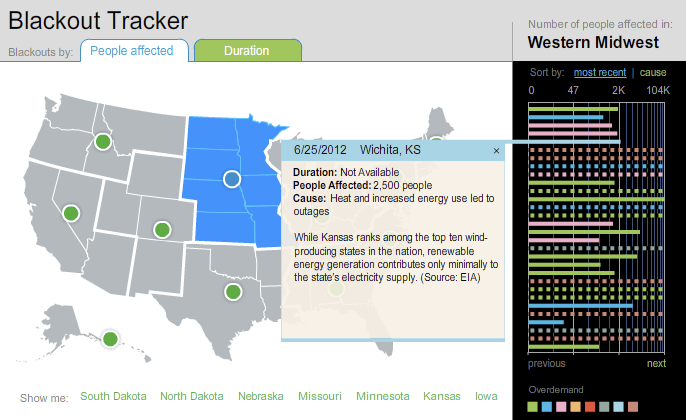
That's a long way of explaining why I find Blackout Tracker so fascinating. Put together by Eaton, a company that makes products that help utilities manage different parts of the electric grid, this little web app shows you where the electric grid has recently failed, and why. The Blackout Tracker doesn't claim to include all blackouts, but it gives you an idea of the number of blackouts that happen, and the wide range of causes blackouts can have. For instance, in the picture above, you can see that Wichita, Kansas, had a blackout earlier this week that was related to a heatwave—hot weather meant more people turned on their air conditioners in the middle of the day, and, for whatever reason, there wasn't enough electrical supply available to meet that demand. The result: Blackout.

One major flaw: Most of the time Blackout Tracker can't tell you how long a blackout lasted. But that's probably got more to do with what information the utility companies are willing to release than anything. Still, I think this program is a nice primer for people who aren't aware of all the hard work that goes on behind the scenes to make sure electricity remains flowing, nice and steady.

Check out Blackout Tracker (Also available for the UK, Canada, and Australia/New Zealand)

Learn more about how the grid works (and doesn't work) in my book, Before the Lights Go Out.

I don't remember where I picked this link up from, so if you're the one who sent it to me, please give me a little tap and I'll make sure you are properly thanked!

Maggie Koerth-Baker is the science editor at BoingBoing.net. She writes a monthly column for The New York Times Magazine and is the author of Before the Lights Go Out, a book about electricity, infrastructure, and the future of energy. You can find Maggie on Twitter and Facebook.

Maggie goes places and talks to people. Find out where she'll be speaking next.

MORE:  behind the scenes • electricity • geekery • infrastructure • obsessions • Science • Technology • the grid

More at Boing Boing

Ants and Stars: Bruce Sterling and Jasmina Tesanovic visit the Sardinia Radio Telescope in Italy

The Snowden Principle

  • Mark Dow

    Cats cause more than keyboard failure, earthquakes and internet tube hairballs:

    “A frightened cat was responsible for a power outage: A car crashed into a utility pole, and the driver reported that her cat jumped on the floor on the driver’s side, causing her to lose control of the car.”

    “Frightened” my ass; the driver might have been frightened but the cat was aiming.

  • http://twitter.com/BonzoDog1 BonzoDog1

    Every air conditioner should come with a photovoltaic array.

  • Boundegar

    Another flaw: the Blackout Tracker does not work in a blackout.

    • Ambiguity

      It’s kind of cool, but the UI is really clunky.

  • http://rhinocrisy.org/ saurabh

    I just realized that I read this blog almost entirely because of Maggie.

  • http://twitter.com/vielmetti Edward Vielmetti

    Utility companies often keep real-time maps of where the power is out, and sometimes they let you see it not just at a county-by-county level but all the way down to the individual outage.

    I’ve collected a batch of these over the last year or so

    http://vielmetti.typepad.com/vacuum/2011/06/power-outage-maps.html

    with maps of some kind for utilities in 45 of 50 states.

  • http://twitter.com/kurttowsley Kurt Towsley

    This thing isn’t working in Indiana.  We’ve got something like half the eastern side of the state without power since yesterday, with estimates of repair times stretching to next Wednesday, and it’s not there at all.

    Source (besides the fact that I live here): http://www.wane.com/dpp/news/local/im-trying-to-restore-power-to-thousands

  • http://twitter.com/pibigibi Pibi Gibi

    Definitely not the level of detail that anyone would find useful in this.  For the entire DC/MD/VA region, which still has over 500k people out, it’s showing very little info.