Features Podcasts Family Video Comics Music Tech Science Books Film & TV Games ✚

Jill

Supercomputer built from Raspberry Pis and Lego

Cory Doctorow at 6:05 am Thu, Sep 13, 2012

— FEATURED —

Feature

Eurovision 2013: An American in London

Book Review

The Twelve-Fingered Boy - mesmerizing YA horror novel

Book Review

Black Code: how spies, cops and crims are making cyberspace unfit for human habitation

— FOLLOW US —

Boing Boing is on Twitter and Facebook. Subscribe to our RSS feed or daily email.


— POLICIES —

Except where indicated, Boing Boing is licensed under a Creative Commons License permitting non-commercial sharing with attribution


— FONTS —

Tweet
Kindle


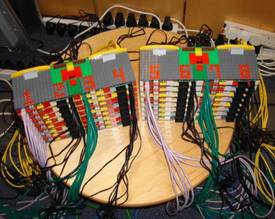
A team of computer scientists at the University of Southampton in the UK created a supercomputer out of 64 Raspberry Pi matchbox Linux-on-a-chip computers and Lego. The team included six year old James Cox, the son of project lead Professor Simon Cox, "who provided specialist support on Lego and system testing."

Here's a PDF with instructions for making your own Raspberry Pi/Lego supercomputer.

Professor Cox comments: “As soon as we were able to source sufficient Raspberry Pi computers we wanted to see if it was possible to link them together into a supercomputer. We installed and built all of the necessary software on the Pi starting from a standard Debian Wheezy system image and we have published a guide so you can build your own supercomputer.”

The racking was built using Lego with a design developed by Simon and James, who has also been testing the Raspberry Pi by programming it using free computer programming software Python and Scratch over the summer. The machine, named “Iridis-Pi” after the University’s Iridis supercomputer, runs off a single 13 Amp mains socket and uses MPI (Message Passing Interface) to communicate between nodes using Ethernet. The whole system cost under £2,500 (excluding switches) and has a total of 64 processors and 1Tb of memory (16Gb SD cards for each Raspberry Pi). Professor Cox uses the free plug-in ‘Python Tools for Visual Studio’ to develop code for the Raspberry Pi.

Professor Cox adds: “The first test we ran – well obviously we calculated Pi on the Raspberry Pi using MPI, which is a well-known first test for any new supercomputer.”

Engineers Build Supercomputer Using Raspberry Pi, Lego [Parity News]

Southampton engineers a Raspberry Pi Supercomputer [Press release]

(Images: Simon J Cox 2012)

I write books. My latest is a YA science fiction novel called Homeland (it's the sequel to Little Brother). More books: Rapture of the Nerds (a novel, with Charlie Stross); With a Little Help (short stories); and The Great Big Beautiful Tomorrow (novella and nonfic). I speak all over the place and I tweet and tumble, too.

MORE:  computer science • floss • Gadgets • happy mutants • lego • raspberry pi • uk

More at Boing Boing

Eurovision 2013: An American in London

The technology that links taxonomy and Star Trek

  • Paul Renault

    The headline reminded me of this skit:
    http://video.google.com/videoplay?docid=5147636284090988855

    • Paul Renault

      Speaking of ‘Steak and Kidney Pee”, I spotted this, just after my post:

  • http://avarana.blogspot.com MarlboroTestMonkey7

    Raspberry content is ok, but needs more Lego

    • http://www.facebook.com/danhuby Dan Huby

      Agreed. They could at least use Technic Lego to provide some motorised cooling.

  • remainzz

    what makes this a super computer?
    is it the fact that you have so many nodes?
    As surely all modern computers are super computers compared to past.

    • http://www.facebook.com/profile.php?id=557683737 Adam Greenfield

      It is called a supercomputer because it is made of Lego, and clearly, this is a super way to make a computer.

  • http://profiles.google.com/stephen.schenck Stephen Schenck

    Why are they measuring everything in giga- and terabits instead of bytes?

    • http://www.facebook.com/scott.p.byrne Scott Byrne

      Because it’s easier for people to grasp the size using ‘chunks’ that people are more familiar with. 

      • http://profiles.google.com/stephen.schenck Stephen Schenck

        What? People almost always talk about memory and flash in terms of gigabytes, not bits.

    • http://www.facebook.com/danhuby Dan Huby

      The person that wrote the press release probably just got the capitalisation wrong. We are used to talking about megabit (Mb) / gigabit (Gb) in relation to bandwidth so  confusing the two is easily done.

      • http://halfbakedmaker.org Robert Baruch

        The hoi-polloi doesn’t know the technical difference between b and B.

        • http://www.xradiograph.com/ OtherMichael

           THERE IS NO DIFFERENCE BETWEEN B AND B

  • http://www.facebook.com/rockyhasn Rocky Hasan

    Nice One. Reminded me of my old pc chipset and my old lego set.

  • Michael Polo

    Neat idea, and looks great. Would be interested in seeing benchmarks against a virtual equivalent machine though

  • Kayin McLeod

    Oh, is this why I haven’t received mine yet.

  • naught_for_naught

    Nice.

  • http://twitter.com/michaelsayyes michael b

    64  of them?  I had a hard time getting just one.

    • http://www.nathanhornby.com/ Nathan Hornby

      Right? 3 months from registration to delivery for me.  For one.

      Love mine, best £25 media center a person could want.  But how in the hell did they get 64 of them?  That said the Pi was built for educational purposes in mind, so maybe the uni got a little preference…

  • brainflakes

    Depending on what you want to compute this isn’t exactly good value:

    Each Pi can apparently compute at .175 GFLOP/s, so in theory this cluster could run at a max of 11.2 GFLOPS/s.

    A single £250 graphic card (eg. OpenCL on a Radeon 5870) can compute at 2.72 TFLOP/s, or 240 times faster for a tenth the price.

    Being general purpose CPUs the Pis may be able to outperform a gfx card on some types of calculations and would probably be easier to program tho.

    Interestingly a Radeon 5870 would have been the worlds fastest supercomputer in 1999 http://en.wikipedia.org/wiki/History_of_supercomputing#Historical_TOP500_table

    • http://www.facebook.com/danhuby Dan Huby

      Each Pi apparently has 24 GFLOP/s due to the built in GPU
      http://www.raspberrypi.org/faqs
      OK, your £250 graphics card is nearly twice as fast but probably not as useful for general purpose computations.

      • squidfood

        Yep!  For generic computations, graphics card programming is still a bear in terms of programming tools.  Many highly-parallel scientific applications are already written using MPI as the standard… it’s worth the speed hit to not have to reprogram.  I’m definitely looking at this!

      • brainflakes

        Ah nice, wonder why it wasn’t mentioned in the post (on the Pi site) I was reading

    • failquail

       I got the impression this was more about demonstrating *how* to set up a supercomputer cluster for university students rather than actually being something you’d actually use for something!

      Much cheaper and power friendly to use such cheap low power PCs for playing around with :)

  • http://twitter.com/cjporkchop cjporkchop

    “The team included six year old James Cox, the son of project lead Professor Simon Cox, ‘who provided specialist support on Lego and system testing.’”

    I hope that kid has business cards. “James Cox, Lego Specialist.”

    • Antinous / Moderator

      See: Rayner Unwin.

  • http://voidstar.com/ jbond

    cue the /. comment: Wow! Imagine a beowulf cluster of these!

  • Ashley Yakeley

    “Lego rack mount” is so much less exciting than “Lego supercomputer”…

  • http://twitter.com/justifun Justifun

    You can find Raspberry Pi’s in stock here
    http://www.mcmelectronics.com/content/en-US/raspberry-pi

  • http://redesigned.com redesigned

    “The first test we ran – well obviously we calculated Pi on the Raspberry Pi using MPI, which is a well-known first test for any new supercomputer.”

    They had me at the Pi on Pi action. :-)