Features Podcasts Family Video Comics Music Tech Science Books Film & TV Games ✚

Jill

A guide to animal CPR

Maggie Koerth-Baker at 7:01 am Tue, Sep 25, 2012

— FEATURED —

Science

Last chance to enter the Armchair Taxonomist challenge!

Book Review

Black Code: how spies, cops and crims are making cyberspace unfit for human habitation

Book Review

We Can Fix it! - a graphic novel time travel memoir

Science

The technology that links taxonomy and Star Trek

— FOLLOW US —

Boing Boing is on Twitter and Facebook. Subscribe to our RSS feed or daily email.


— POLICIES —

Except where indicated, Boing Boing is licensed under a Creative Commons License permitting non-commercial sharing with attribution


— FONTS —

Tweet
Kindle

Back in May, I posted about how the Smithsonian National Zoo took another shot at inseminating Mei Xiang, a female giant panda. Female pandas are only fertile once a year, for 24-72 hours, and the zoo had already tried unsuccessfully to get Mei Xang pregnant for eight years in a row. This year, though, they pulled it off, and Mei Xiang gave birth just a little over a week ago. The bad news, which you may have already heard, is that the baby died last weekend. Nobody really knows why just yet.

Reading the stories about the baby panda's death, I noticed that zookeepers had tried to revive the baby using CPR. And that got me curious. Just how, exactly, do you give a panda CPR. At Slate, L.V. Anderson tackles this question. Turns out, the process isn't all that different from resuscitating a human.

CPR is appropriate when a patient’s heart has stopped (whether or not the patient is human), and the goal is to maximize the amount of blood flowing out of the patient’s heart into other vital organs and to get some air into the patient’s lungs so the patient’s blood will be oxygenated. Some animals, including humans and baby pandas, have bodies shaped in such a way that the best way to pump the heart is to directly compress the chest. Other animals, Iike most dogs and cats, have much rounder chests, which makes it harder to directly compress the heart. With these animals, vets recommend compressing the chest from the side, which puts secondary pressure on the heart.

As anyone who’s recently taken a human CPR course knows, the rate of compression recommended for humans is about 100 beats per minute. (Doctors recommend pumping the chest to the beat of the Bee Gees song “Stayin’ Alive.”) The same rate of compression is recommended for animals; even though dogs and cats have a higher resting heart rate than humans do, the rate of 100 compressions per minute gives the heart a chance to refill with blood between compressions.

Read the rest of the story at Slate.com

Via Laura Helmuth

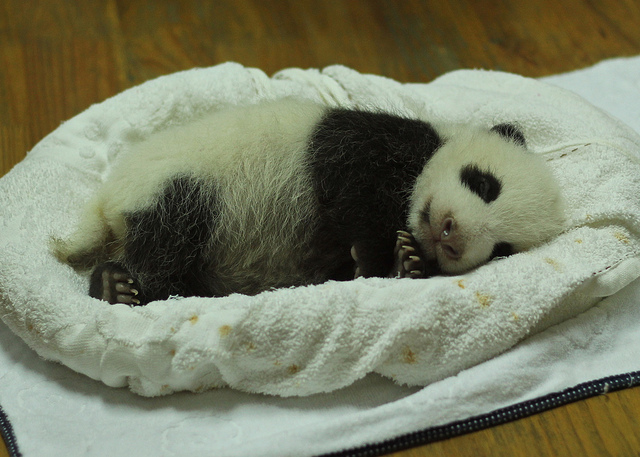
Image: Cheng Du Panda Base, a Creative Commons Attribution (2.0) image from su-may's photostream

Maggie Koerth-Baker is the science editor at BoingBoing.net. She writes a monthly column for The New York Times Magazine and is the author of Before the Lights Go Out, a book about electricity, infrastructure, and the future of energy. You can find Maggie on Twitter and Facebook.

Maggie goes places and talks to people. Find out where she'll be speaking next.

MORE:  animals • baby panda • deaths • reproduction • sad • Science

More at Boing Boing

The technology that links taxonomy and Star Trek

Hackers prepare for first "national holiday" in their honor

  • chgoliz

    In an act of supreme manhood, my best friend’s husband once gave mouth-to-mouth resuscitation and CPR to a dead fawn because my children were distraught.

    Thus, I can speak from experience and say that 4-legged animals lie on their sides when they are hurt or dying, so compressing the heart from the side is entirely obvious in the moment.

    No, it didn’t work for him either, but daaaaamn, he tried.

  • xiagang

    There is no “xang” sound in Mandarin Chinese, so I think this name must be transliterated incorrectly. The most likely name is Mei Xiang. 

    • http://twitter.com/bachandblue bachandblue

      xiangk you very much

      • xiagang

        bu keqi… :) [my pleasure, in Mandarin]

  • VideoMonkey

    It’s an interesting post…but the photo is very misleading.  I was the official videographer at the National Zoo while this cub’s older brother, Tai Shan, was in residence.  A baby panda at one week old weighs less than 4 ounces and is hairless, blind, and toothless. It means that CPR can’t be done with anything more than one finger, really.  In my opinion, an even more impressive undertaking, dealing with such a delicate creature.

  • gellfex

    I once successfully Heimlich-ed my cat choking on a chicken bone she stole off the table. I think that was life #7.