Features Podcasts Family Video Comics Music Tech Science Books Film & TV Games ✚

Jill

Beautiful photos from the Hubble Space Telescope

Maggie Koerth-Baker at 8:48 am Mon, Apr 30, 2012

— FEATURED —

THE LATEST

Guatemala: Archive of documents from Rios Montt genocide trial, overturned 10 days after guilty verdict

THE LATEST

Guatemala: Nation's highest court throws out Ríos Montt genocide trial verdict and prison sentence

Feature

Eurovision 2013: An American in London

Book Review

The Twelve-Fingered Boy - mesmerizing YA horror novel

Book Review

Black Code: how spies, cops and crims are making cyberspace unfit for human habitation

— FOLLOW US —

Boing Boing is on Twitter and Facebook. Subscribe to our RSS feed or daily email.


— POLICIES —

Except where indicated, Boing Boing is licensed under a Creative Commons License permitting non-commercial sharing with attribution


— FONTS —

Tweet
Kindle

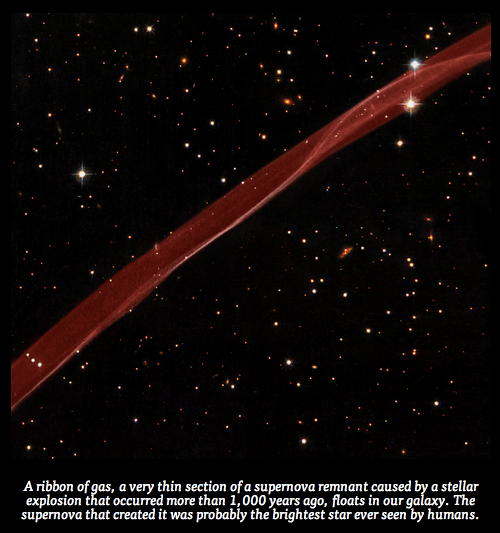
At the Brain Pickings blog, Maria Popova has some amazing images, taken by the Hubble Space Telescope during its 22 years of operation. I love this one. It's such a great reminder of the time scales of space—the remnants of things that happened 1000 years ago are still moving through the cosmos, even while humans have died and been born and moved on to other obsessions.

One other thing to keep in mind as you're looking at these photos—what you see does not always represent exactly what outer space looks like. An astronaut wouldn't see a red ribbon undulating among the stars. One of these Hubble photographs are put together from multiple images taken by different parts of the telescope. Humans colorize the images to make details stand out. In this case, making the stream of gas red allows us to see it and understand its meaning. In that way, a colorized Hubble image is actually more useful and more educational than a 100% accurate photo would have been.

See the rest of the photos at Brain Pickings

Learn more about how Hubble images are made.

Learn about the process of colorizing Hubble images, including why specific colors are chosen.

Maggie Koerth-Baker is the science editor at BoingBoing.net. She writes a monthly column for The New York Times Magazine and is the author of Before the Lights Go Out, a book about electricity, infrastructure, and the future of energy. You can find Maggie on Twitter and Facebook.

Maggie goes places and talks to people. Find out where she'll be speaking next.

MORE:  behind the scenes • Hubble Space Telescope • photography • Science • Space

More at Boing Boing

Eurovision 2013: An American in London

The technology that links taxonomy and Star Trek

  • Ali Hasan

    I agree with your statement. that’s wonderful.

  • Guest

    How much longer than 1000 years? Maybe 1012 more? just wonderin’

    • Mark Dow

      First appeared between April 30 and May 1, 1006. Can’t tell which calendar was used for this date.
      SN 1006
      http://en.wikipedia.org/wiki/SN_1006

      • Guest

         Thanks!

  • Keith K

    If you look around a bit on that last link, you’ll also notice that NASA hosts the raw data online, so you can actually make color versions yourself if you have a little Photoshop know-how.

  • Jorpho

    They found the Nexus, amirite?

  • http://noctilucent-studios.blogspot.com/ Noctilucent Studios

    This image is not from the HST but it has hands down got to be the single most haunting image ever produced.  200,000 Galaxies in a single image. Just try and wrap your mind around that. It is just beyond….beyond.
    http://blogs.discovermagazine.com/badastronomy/2012/03/23/an-ultradeep-image-thats-full-galaxies/

  • Ultan

    Just to be a little pedantic, if it is glowing on its own, as it appears to be, doesn’t that make it a plasma, which is as different from a gas as a gas is from a liquid?
    [Edit: not that all plasmas glow, but if it glows, it's a plasma]